





Daimler Announces Rizon Medium-Duty Electric Truck Brand
DTNA's O'Leary Urges 'the Speed of Right' on Zero-Emissions Path
Infrastructure challenges loomed large over the opening session of the Advanced Clean Transportation Expo.
May 2, 2023
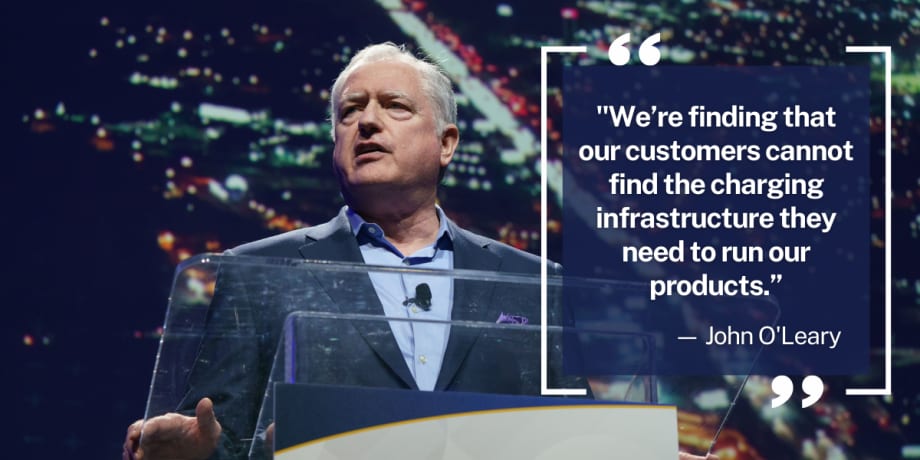
"Our business is the midst of a great transformation. It’s a challenge that many here share," said DTNA's John O'Leary.
HDT graphic based on GNA photo
4 min to read
Daimler Truck North America President and CEO John O’Leary painted a picture of a still-uncertain technology landscape for fleets during the opening session of the Advanced Clean Transportation Expo in Anaheim, California, May 1. That landscape led him to caution the industry to move at the “speed of right” as it gropes its way toward a zero-emissions future.
“The path we are on is one of transformation,” O’Leary said. “We need to maneuver at the speed of right to achieve our goals. This means we need to do things for the right reason at the right time. At DTNA, our belief is that we serve all of those who want to keep the world moving. Our business is the midst of a great transformation. It’s a challenge that many here share.”
Diesel fuel has dominated the trucking industry for over a century, O’Leary pointed out. But he said the days of a single-source fuel for the industry are clearly on the wane, and it's time to change.
“Trucking needs a future comprised of viable alternative power options. Trucking needs cleaner power choices, such as battery-electric and hydrogen fuel cell powertrains. And alternative solutions already exist and can work well in some applications today.”
But, O’Leary cautioned, there is no panacea future power solution out there that will serve many applications the way diesel has for decades.
“We still face many challenges,” he said. “Total cost of ownership must be equal to — or better — than diesel fuel for this clean energy transition to take place. And we need infrastructure to support these new power systems.”
Since 1990, the North American trucking industry has reduced exhaust gas emissions of nitrogen oxides (NOx) by 90%, O’Leary said.
“And we continue to improve diesel engine efficiencies, thanks to our partnership with the Department of Energy on the SuperTruck program,” he said. “Not all technologies we explore on the SuperTruck will mature. But many will move from the concept state to offerings for on-the-road use. To ensure the success of these new technologies and systems, we are looking at developing holistic vehicle life cycles. But we must ensure that we are doing things the right way, from the outset of developing new technology while keeping the future in mind.”
A Three-Tier Track for Zero-Emissions Success
O’Leary noted that while the cost per kilowatt hour of batteries is dropping and on a path to eventual price parity, the numbers are still a long way from the TCO fleets will need to successfully deploy electric trucks on a large scale.
What is needed, O’Leary said, is a three-pronged technology track that includes viable alt-fuel products, TCO parity, and dependable infrastructure.
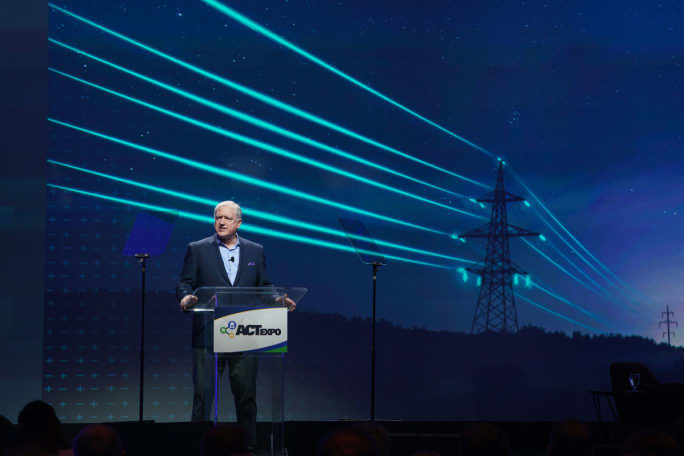
O'Leary said if the power requirements for electric trucks aren't met, "we will find ourselves with a lot of orphaned equipment sitting idle at fleets and on factory floors."
Photo: GNA
“This is why is say the industry needs to move forward at the ‘speed of right,’” O’Leary said. “I commend everyone in this room and beyond it for the progress this industry has made so far. But it is also painfully evident that we’re finding that our customers cannot find the charging infrastructure they need to run our products. We cannot fulfill this technology’s potential until the infrastructure issue is resolved.”
Current lead times for installing DC charging stations for fleets is more than two years, he said.
“We still have yet to determine who will pay for needed infrastructure, where it will be sited, and how we’re going to get power to where it is needed."
For public charging, O’Leary noted the problems are even more acute. Who pays for costly projects? Where are they to be sited? How does additional power demand get there?
"We need utilities to act now to create a bare minimal standard of operability for electric trucks," he said.
California alone will need 5 million kW of installed electric capacity by 2035 for medium- and heavy-duty electric trucks, O'Leary said. "And if we ignore these requirements, we will find ourselves with a lot of orphaned equipment sitting idle at fleets and on factory floors that cannot be utilized to meet our zero-emissions future.”
The answer to the infrastructure issue, O’Leary believes, is for all private and public parties concerned to work together.
“Private companies like DTNA, public utility commissions, utility companies, as well as state and local governments, all need to invest in infrastructure and work to eliminate bureaucratic barriers that stand in our way.”
O’Leary said it is “delusional” to think that zero-emissions technology is ready today to completely supplant diesel power in trucking.
“That’s not true for next year, or even five years from now,” he added. “This industry cannot operate at the speed of light. At DTNA, we understand this. We believe in this coming transition. And we are ready to help find the pathways forward. But, instead of generating positive headlines and patting ourselves on the back for our progress so far, I say this industry must instead roll up its sleeves and work even harder to move together forward at the speed of right.”
O'Leary's comments at ACT Expo echo ones he made to reporters earlier this year during the Manifest event.
More Fuel Smarts

How Volvo Updated Its D13 for EPA 2027 [Watch]
Volvo’s updated D13 promises lower emissions without sacrificing performance or fuel economy. Take a closer look at what changed inside the engine in this HDT Spotlight video.
Read More →
Diesel Price Spike Shortens Payback for Natural Gas Trucks, Report Says
Energy Vision estimates fleets could recover the higher purchase price of an RNG-fueled Class 8 tractor in 1.3 to 2.8 years under current fuel-price scenarios.
Read More →
Calstart Becomes Catalyst Mobility, Reflecting Broader Focus
Calstart is now Catalyst Mobility, reflecting the nonprofit’s growing national role in clean transportation, including zero-emission trucks, infrastructure and incentive programs.
Read More →

Record Diesel Prices Squeeze Trucking Fleets
Average U.S. diesel prices have climbed to nearly $6 a gallon, surpassing the 2022 record as tight refinery capacity and Middle East disruptions keep fuel costs elevated.
Read More →
Sponsored•September 9, 2026
How Fuel Delivery Shapes Engine Performance
Fuel delivery depends on more than what happens at the injector. For fleet, maintenance and technical professionals, looking at the full path from pump to injector can provide useful context for understanding engine performance.
Read More →
East Coast Port Launches $45M Electric Truck Push
The Port Authority of New York and New Jersey announced millions in incentives for zero-emission drayage trucks, yard tractors, and new charging hubs near the port.
Read More →
California Bill Could Shed Light on Electric Truck Prices
Why do battery-electric Class 8 trucks remain so expensive? A California bill headed to Gov. Gavin Newsom would give fleets and state agencies more visibility into what manufacturers charge.
Read More →
Detroit Opens Orders for EPA 2027 Engines
Detroit isn’t starting from scratch to meet EPA 2027 diesel emissions standards. Its Gen 6 DD13 and DD15 engines keep much of today’s platform while updating the fuel and aftertreatment systems.
Read More →
Zero-Emission Truck Corridor Planned for West Coast
California, Oregon, Washington, British Columbia and Baja California are coordinating plans for truck charging and hydrogen fueling from Canada to Mexico.
Read More →
A Closer Look at Kenworth’s Electric T880E Vocational Truck [Video]
Learn more about Kenworth's T880E battery-electric vocational truck at the Paccar Technical Center, including its range, applications, upfitting considerations, and PTO options, in this HDT Spotlight video.
Read More →