




DTNA Offers Electric Commercial Vehicle Charger Line, Consulting
Daimler Trucks North America launched a line of electric commercial vehicle chargers and consulting services from Detroit to support fleets in the deployment of all-electric trucks.

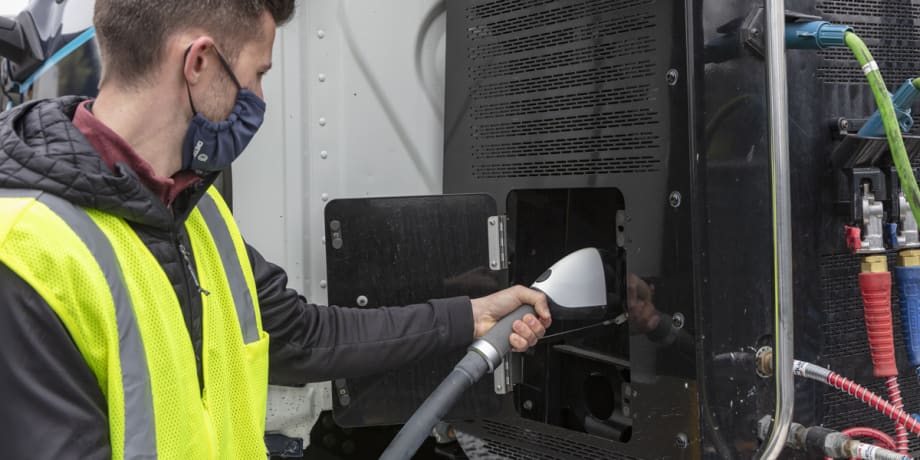
Detroit eFill is a line of commercial vehicle charging stations designed for seamless integration with the Detroit ePowertrain found in Freightliner eCascadia and eM2 trucks.
Photo: DTNA
Daimler Trucks North America (DTNA) launched a line of electric commercial vehicle chargers and consulting services from Detroit to support fleets in the deployment of all-electric trucks.
“Detroit has led the way in reshaping transportation for over 80 years, and with the new eConsulting services and eFill chargers, we are prepared to help support our customers as we embark on the journey into our collective electric future,” said Richard Howard, senior vice president of on-highway sales and marketing at DTNA, in a press release.
Detroit eConsulting
Detroit’s eConsulting services are provided by a team of eMobility experts wholly dedicated to supporting customers navigate electric truck conversion. Three service packages are offered.
Under the top-tier Megaline package recommended for large-scale electric truck deployments, customers receive assistance with planning for charging infrastructure, solar panel, and stationary energy storage projects, along with the support of the eConsulting team to interface with local utilities on their behalf. Additional services in the package include a comprehensive cost-benefit and route analysis, and assistance with capital and operating expenditure optimization.
The Powerline package includes similar benefits to those found in the Megaline package, without support for distributed energy resources or the interface to local utilities. The Baseline package – free to all purchasers of Freightliner electric trucks – includes best practices and dealership-level consultation.
The two higher-tier packages are available to buyers of any electric trucks, and services are not dependent on purchase of a Freightliner truck.
“Detroit eConsulting program is staffed by employees who have thus far supported more than 20 customers with infrastructure projects and electric truck deployments.
Detroit eFill
The Detroit team introduced Detroit eFill chargers, a full line of commercial vehicle charging stations designed for seamless integration with the Detroit ePowertrain found in Freightliner eCascadia and eM2 trucks.
Detroit eFill chargers are extensively tested, warrantied for five years, and versatile enough to charge a wide range of other brands’ electric commercial vehicles, DTNA official said.
Detroit eFill stations were developed in partnership with Power Electronics, a North American supplier of converters for utility scale solar and advanced energy storage systems.
All Detroit eFill chargers available at launch are DC fast chargers carrying the CCS-1 standard, the most common type of electric vehicle charger. Detroit eFill chargers are available with power ratings from 30 kW to as much as 400 kW, providing a scalable solution to enable everyone – from fleets with one or two trucks to truck stop operators running complete charger islands and multiple power cabinets, DTNA officials said.
More Fuel Smarts

How Volvo Updated Its D13 for EPA 2027 [Watch]
Volvo’s updated D13 promises lower emissions without sacrificing performance or fuel economy. Take a closer look at what changed inside the engine in this HDT Spotlight video.
Read More →
Diesel Price Spike Shortens Payback for Natural Gas Trucks, Report Says
Energy Vision estimates fleets could recover the higher purchase price of an RNG-fueled Class 8 tractor in 1.3 to 2.8 years under current fuel-price scenarios.
Read More →
Calstart Becomes Catalyst Mobility, Reflecting Broader Focus
Calstart is now Catalyst Mobility, reflecting the nonprofit’s growing national role in clean transportation, including zero-emission trucks, infrastructure and incentive programs.
Read More →

Record Diesel Prices Squeeze Trucking Fleets
Average U.S. diesel prices have climbed to nearly $6 a gallon, surpassing the 2022 record as tight refinery capacity and Middle East disruptions keep fuel costs elevated.
Read More →
How Fuel Delivery Shapes Engine Performance
Fuel delivery depends on more than what happens at the injector. For fleet, maintenance and technical professionals, looking at the full path from pump to injector can provide useful context for understanding engine performance.
Read More →
East Coast Port Launches $45M Electric Truck Push
The Port Authority of New York and New Jersey announced millions in incentives for zero-emission drayage trucks, yard tractors, and new charging hubs near the port.
Read More →
California Bill Could Shed Light on Electric Truck Prices
Why do battery-electric Class 8 trucks remain so expensive? A California bill headed to Gov. Gavin Newsom would give fleets and state agencies more visibility into what manufacturers charge.
Read More →
Detroit Opens Orders for EPA 2027 Engines
Detroit isn’t starting from scratch to meet EPA 2027 diesel emissions standards. Its Gen 6 DD13 and DD15 engines keep much of today’s platform while updating the fuel and aftertreatment systems.
Read More →
Zero-Emission Truck Corridor Planned for West Coast
California, Oregon, Washington, British Columbia and Baja California are coordinating plans for truck charging and hydrogen fueling from Canada to Mexico.
Read More →
A Closer Look at Kenworth’s Electric T880E Vocational Truck [Video]
Learn more about Kenworth's T880E battery-electric vocational truck at the Paccar Technical Center, including its range, applications, upfitting considerations, and PTO options, in this HDT Spotlight video.
Read More →