




Diesel Prices Spike
Diesel prices have risen to their highest since the end of 2014, and crude oil prices don’t show signs of improving anytime soon.

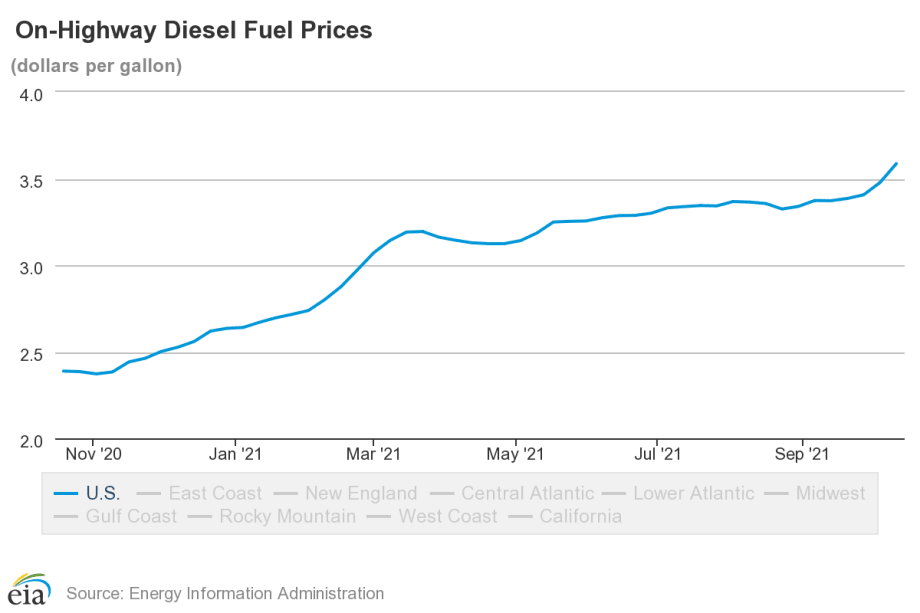
Diesel prices jumped by double digits last week after a slow-but-steady trend of increases.
Source: Energy Information Administration
Diesel prices have risen to their highest since the end of 2014, and crude oil prices (which drive the largest part of fuel prices) don’t show signs of improving anytime soon.
For the week ending Oct. 11, diesel prices saw the third-largest increase in more than a decade, according to Avery Vise, trucking analyst for FTR. According to the Department of Energy, the national average of $3.586 was up nearly 11 cents from the previous week and 18 cents from two weeks earlier. It was $1.20 higher than a year ago. That’s the highest since the end of 2014, Vise said during an Oct. 14 State of Freight webinar.
The highest prices were seen on the West Coast, at $4.425 in California and $3.784 in the rest of the West Coast region. The Central Atlantic region was close behind at $3.705. The least-expensive region for diesel was the Gulf Coast region at $3.335.
Double-digit increases have happened only twice before in the past decade: in September 2017 in the wake of Hurricane Harvey, when they rose more than 15 cents per gallon, and in August 2012 when they rose 11.5 cents.
Vise said if diesel prices continue to rise, it could reverse the recent trend of drivers and owner-operators leaving large carriers to start their own motor carriers as the cost of fuel eats into their profits.
Gasoline prices are high, as well, with a national average of $3.267 up 7.7 cents from last week and $1.10 higher than a year ago.
It's not just a U.S. problem, either. Global headlines note record high diesel prices in France and in India.
The Culprit? Crude Oil
Crude oil futures prices in the U.S. closed above $80 this week for the first time since late in 2014, noted the Wall Street Journal. Oil prices are up 125% from the end of last October.
In its latest Short-Term Energy Forecast, the EIA noted that oil prices have increased over the past year as result of sustained draws on global oil inventories. Prices increased after the Oct. 4 announcement by the Organization of Petroleum Exporting Countries that the group would keep current production targets unchanged.
The WSJ adds that Energy Secretary Jennifer Granholm said recently that the U.S. is considering releasing oil from the Strategic Petroleum Reserve. President Biden has twice urged OPEC to increase oil production more quickly, but so far the oil cartel has brushed off his requests.
According to Politico.com, the White House has been consulting with the oil industry on how to address rising fuel prices. Politico points out that this is “an awkward shift for the Biden administration, which has pledged to move the country away from fossil fuels and has drawn criticism from the industry and Republicans for pausing lease sales of federal land for oil and gas development.”
More Fuel Smarts

How Volvo Updated Its D13 for EPA 2027 [Watch]
Volvo’s updated D13 promises lower emissions without sacrificing performance or fuel economy. Take a closer look at what changed inside the engine in this HDT Spotlight video.
Read More →
Diesel Price Spike Shortens Payback for Natural Gas Trucks, Report Says
Energy Vision estimates fleets could recover the higher purchase price of an RNG-fueled Class 8 tractor in 1.3 to 2.8 years under current fuel-price scenarios.
Read More →
Calstart Becomes Catalyst Mobility, Reflecting Broader Focus
Calstart is now Catalyst Mobility, reflecting the nonprofit’s growing national role in clean transportation, including zero-emission trucks, infrastructure and incentive programs.
Read More →

Record Diesel Prices Squeeze Trucking Fleets
Average U.S. diesel prices have climbed to nearly $6 a gallon, surpassing the 2022 record as tight refinery capacity and Middle East disruptions keep fuel costs elevated.
Read More →
How Fuel Delivery Shapes Engine Performance
Fuel delivery depends on more than what happens at the injector. For fleet, maintenance and technical professionals, looking at the full path from pump to injector can provide useful context for understanding engine performance.
Read More →
East Coast Port Launches $45M Electric Truck Push
The Port Authority of New York and New Jersey announced millions in incentives for zero-emission drayage trucks, yard tractors, and new charging hubs near the port.
Read More →
California Bill Could Shed Light on Electric Truck Prices
Why do battery-electric Class 8 trucks remain so expensive? A California bill headed to Gov. Gavin Newsom would give fleets and state agencies more visibility into what manufacturers charge.
Read More →
Detroit Opens Orders for EPA 2027 Engines
Detroit isn’t starting from scratch to meet EPA 2027 diesel emissions standards. Its Gen 6 DD13 and DD15 engines keep much of today’s platform while updating the fuel and aftertreatment systems.
Read More →
Zero-Emission Truck Corridor Planned for West Coast
California, Oregon, Washington, British Columbia and Baja California are coordinating plans for truck charging and hydrogen fueling from Canada to Mexico.
Read More →
A Closer Look at Kenworth’s Electric T880E Vocational Truck [Video]
Learn more about Kenworth's T880E battery-electric vocational truck at the Paccar Technical Center, including its range, applications, upfitting considerations, and PTO options, in this HDT Spotlight video.
Read More →