




Determining Best Fuel-Saving Technology Focus of Southeast HTUF Event
Figuring out what fuel saving technology is right for your fleet and getting a chance to test drive some of the latest in these innovations was the focus of the first Southeast Regional Fleet Workshop of the High-Efficiency Truck Users in Birmingham, Ala., Wednesday.

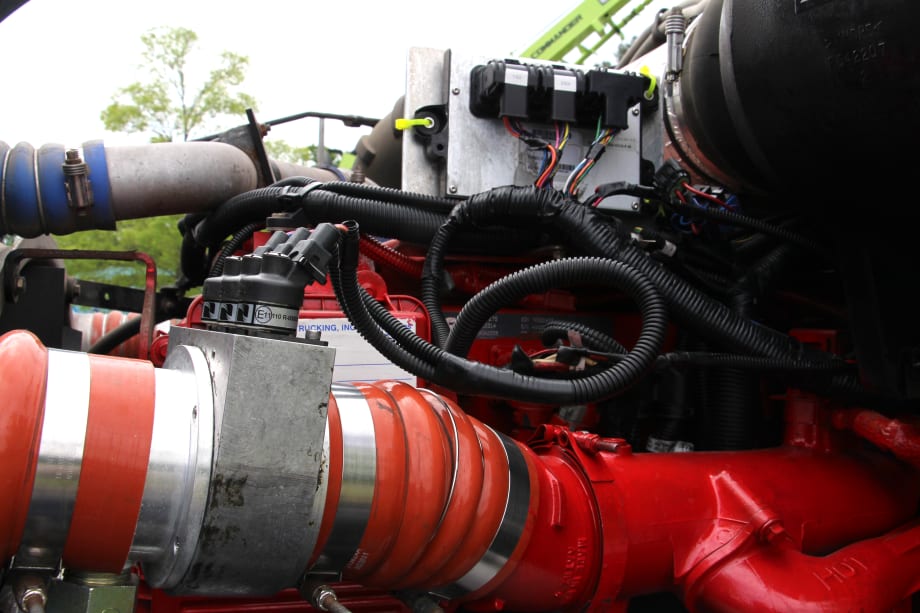
Parts from NGV Systems' diesel/natural gas hybrid retrofit kit on a Cummins ISX engine powering a KW T-2000.

Kevin Beaty, Calstart VP, adressing those attening the opening of the High-Efficiency Truck Users Forum.
BIRMINGHAM, AL -- Figuring out what fuel saving technology is right for your fleet and getting a chance to test drive some of the latest in these innovations was the focus of the first Southeast Regional Fleet Workshop of the High-Efficiency Truck Users in Birmingham, Ala., on Wednesday.
Hosted by the non-profit group Calstart, which brings fleets, truck OEMs and suppliers together to accelerate the commercialization of fuel saving technology, more than 100 people gathered at Barber Motorsports Park.
“There is no silver bullet technology,” said Kevin Beaty, Calstart vice president, in opening remarks to crowd. “Using less fuel isn’t just about the environment. It’s about saving you money.”
In an interview, Beaty said putting together this event, the first of its kind, was a bit of a challenge, because in the Southeast, there are few government incentives for fleets to adopt fuel-saving technologies like there are in other parts of the country such as California.
“Over the last three years, about $40 million to $50 million of incentives have been moved into encouraging the use of hybrid and electric vehicles for commercial vehicles alone [in California]," he said. "Per vehicle, that’s $20,000 up to a $60,000 voucher at the point of sale, so when the fleet purchases the vehicle it really does reduce the price of the vehicle by the amount,” he said.
“Those are large incentive numbers that help get the payback down from above five years to down below three, and in some cases down close to two years, and has resulted in about 40% of all hybrid and electric commercial vehicles that have been sold nationwide in the last thee years have been sold in California.”
Beaty said in the short term, don’t expect to see many alternative/high-efficiency vehicles in the Southeast, as well as some other parts of the country, unless there are financial incentives. The cost of the technology is at a point that incentives are needed to get the industry to the point of scale and where it is economically sustainable.
He also said the group is planning other regional events, in California for this summer as well as in New York in late summer or early fall, followed by another event in California early next year.
Best Practices For Adopting Fuel-Saving Technology
A feature of this meeting were two fleet tutorials, in which those running with heavy trucks all the way down to four-wheelers could learn the best ways to evaluate fuel-saving technology and how to pay for it.
“When you look at new technologies and are looking at short-term trends, don’t just limit your scope to that view,” Mark Kuhn, principal with the engineering and technology consultancy company Ricardo told members at a session about fleet economics and best practices for adopting new technology. “Look at technologies seven to 10 years down the road.”
Calstart’s Beaty also outlined five steps fleets need to take when considering fuel saving technology. One of the first is baselining your fleet -- knowing how much fuel is currently being consumed. He also touched on the importance of steps you can take to use less fuel without adopting new technology, such as reducing idling time.
Beaty also reiterated his earlier message that not all technology is right for all fleets when it comes to looking at fuel saving options. For instance, hybrid technology is not suited those running routes at higher speeds and little stopping or idling.
He pointed out that fleets need to be patient and build a plan for adopting fuel-saving technology that takes several years, rather than rushing into a decision at once. Most importantly, while this new technology can save on fuel bills, Beaty noted it can very expensive and that fleets need to have access to money to pay down the premiums they will shell out for these products.
Different Vehicle Types on Display
A little more than a dozen manufacturers at the HTUF event represented many different parts of fleet operations, ranging from on-highway/long haul trucking and utility work all the way down to commercial vans and passenger cars.
The lone heavy over-the-road truck there was one belonging to NGV Systems, a 2009 Kenworth T2000 model with a 450-horsepower Cummins ISX engine. The company was showing off its new retrofit dual system conversion kit using both diesel and compressed natural gas.
Parts from NGV Systems' diesel/natural gas hybrid retrofit kit on a Cummins ISX engine powering a KW T-2000.
“It allows the use of both diesel and natural gas to be used in operation, to lower the use of diesel by about 50%” said Mike Kilbourn, partner with NGV, in an interview.
“It uses diesel and natural gas under different ratios,” he said. “At idle you are on all diesel because there is no load, no torque, no demand. It starts on all diesel, but once you begin to drive the vehicle under load, that’s when the natural gas usage really comes up.
"If you run out of natural gas, which happens, it will convert automatically back to all diesel and keep going. When you get natural gas, the system will automatically kick back on again.”
Kilbourn says all that is done to install the system is to add a natural gas injection collar on the air intake, just before it enters into the engine, along with adding the company’s electronic control unit, which controls all of it, as well as a natural gas fuel tank.
Click here for a photo gallery of the various types of vehicles at the event.
More Fuel Smarts

How Volvo Updated Its D13 for EPA 2027 [Watch]
Volvo’s updated D13 promises lower emissions without sacrificing performance or fuel economy. Take a closer look at what changed inside the engine in this HDT Spotlight video.
Read More →
Diesel Price Spike Shortens Payback for Natural Gas Trucks, Report Says
Energy Vision estimates fleets could recover the higher purchase price of an RNG-fueled Class 8 tractor in 1.3 to 2.8 years under current fuel-price scenarios.
Read More →
Calstart Becomes Catalyst Mobility, Reflecting Broader Focus
Calstart is now Catalyst Mobility, reflecting the nonprofit’s growing national role in clean transportation, including zero-emission trucks, infrastructure and incentive programs.
Read More →

Record Diesel Prices Squeeze Trucking Fleets
Average U.S. diesel prices have climbed to nearly $6 a gallon, surpassing the 2022 record as tight refinery capacity and Middle East disruptions keep fuel costs elevated.
Read More →
How Fuel Delivery Shapes Engine Performance
Fuel delivery depends on more than what happens at the injector. For fleet, maintenance and technical professionals, looking at the full path from pump to injector can provide useful context for understanding engine performance.
Read More →
East Coast Port Launches $45M Electric Truck Push
The Port Authority of New York and New Jersey announced millions in incentives for zero-emission drayage trucks, yard tractors, and new charging hubs near the port.
Read More →
California Bill Could Shed Light on Electric Truck Prices
Why do battery-electric Class 8 trucks remain so expensive? A California bill headed to Gov. Gavin Newsom would give fleets and state agencies more visibility into what manufacturers charge.
Read More →
Detroit Opens Orders for EPA 2027 Engines
Detroit isn’t starting from scratch to meet EPA 2027 diesel emissions standards. Its Gen 6 DD13 and DD15 engines keep much of today’s platform while updating the fuel and aftertreatment systems.
Read More →
Zero-Emission Truck Corridor Planned for West Coast
California, Oregon, Washington, British Columbia and Baja California are coordinating plans for truck charging and hydrogen fueling from Canada to Mexico.
Read More →
A Closer Look at Kenworth’s Electric T880E Vocational Truck [Video]
Learn more about Kenworth's T880E battery-electric vocational truck at the Paccar Technical Center, including its range, applications, upfitting considerations, and PTO options, in this HDT Spotlight video.
Read More →