




Despite Slow Growth, Capacity Balance Means Trucking's Doing OK
The economy is expected to continue to grow slowly amidst a variety of headwinds, but because the trucking industry has not been adding back capacity cut or lost during the recession, pricing trends are largely positive, with flatbed, tanker and reefer business leading the way, according to transportation analysts at Stifel Nicolaus

Growth in trucking to support hydraulic fracturing operations in natural gas drilling may be inflating truck tonnage numbers.
The economy is expected to continue to grow slowly amidst a variety of headwinds, but because the trucking industry has not been adding back capacity cut or lost during the recession, pricing trends are largely positive, with flatbed, tanker and reefer business leading the way, according to transportation analysts at Stifel Nicolaus,
who took a look at the transportation and logistics industry in its third annual "Shaking the Sand out of the Sneakers" post-Labor-Day conference call Tuesday.
Although the recovery from the recession has been very slow, it's relatively steady, pointed out John Larkin, Stifel Nicolaus managing partner. In fact, he said, when you look at headwinds such as the financial situation in the Eurozone, China's slowing economy, the tinderbox in the Middle East, and high unemployment and regulatory burdens here in the U.S., he said, you could say the slow grown is actually impressive.
Larkin pointed to charts tracking retail sector growth, manufacturing and inventories to indicate that the economy is largely moving sideways. For instance, the August manufacturing numbers came out Tuesday from the Institute of Supply Managers with an index of 49.6 - anything below 50 indicates contraction. "It's the third straight month of contraction after a fairly long-range period of expansion as we climbed out of the recessionary trough," Larkin said. "These readings are not terrible distressing, but nonetheless, it's additional evidence suggesting the economy's moving sideways."
On the brighter side, there has been some recovery in the housing market - although Larkin points out that "the arithmetic can be misleading." We've seen a 74% rise in new home sales after falling 80% off the peak, but the way percentages work, "we still have a long way to go."
Nevertheless, it's helping the flatbed sector. "Given the amount of flatbed capacity that has found its way out of the market, even this small mount of rebound has tightened up supply and demand in the flatbed truckload sector," Larkin said.
Dave Ross notes that strength in some sectors, such as tank trucks (which have benefited from the hydraulic fracturing boom), flatbed and reefers, are inflating volume trends somewhat.
"We think the year-over-year increase on tonnage is a little misleading," he said. "There's a lot of strength in fracking, where you have lots of short haul heavy moves," driving up those tonnage numbers. Van trailers, which have been a weaker segment, are also more likely to haul lightweight loads such as potato chips, skewing the American Trucking Associations' tonnage numbers.
Fuel prices and capacity constraints such as increased regulation may be reversing the trend we've seen since trucking deregulation in 1980 of ever-more-efficient logistics. When you look at logistics costs as a percentage of GDP, there has been a fairly stead trend downward since 1980, with a dip in the 2002-2004 time frame of the last economic downturn.
"We spent 16.2% of every GDP dollar on transportation and logistics at the time of deregulation," Larkin explained. "That bottomed out in the 8% range, but the last couple of years have seen the trend reverse a bit, and I think as we run into capacity constraints and deal with increased federal regulation, you may see that trend continue."
Of course, that will mean higher rates for carriers, though the situation is somewhat different for truckload and less-than-truckload.
Speaking about a "laundry list of alphabet-soup regulations" being imposed on the trucking industry, Larkin said, "The net effect of all of these is to either reduce the number of drivers approved to operate Class 8 trucks or to reduce the productivity of those safe drivers. Over the next five years or so as all these regulations are implemented, you have potential to lose 10%, some say as much as 15% of the capacity of the industry."
Piling on top of that trends is the fact that large carriers are diversifying away from the traditional longhaul truckload market, Larkin said, because it's too cylical, too seasonal, too driver-intensive and too capital-intensive. "That just exacerbates the tightness of supply and demand in the marketplace," he said.
A number of large shippers, seeing the writing on the wall, "are adopting what we call Core Carrier Concept Part II: Working with the biggest, most sophisticated, most well-capitalized large carriers to lock in capacity" against the day all those regulations and/or a faster-recovering economy result in a capacity shortage.
As a result, Stifel Nicolaus expects about a 1% to 3% rate increase through the rest of the year, both contract and dedicated. Looking ahead, if we see continues 1% to 2% GDP growth, rate increases will likely continue in that vein. If GDP grows a more typical 2% to 3%, those rate increases could be in the mid to upper single digits in the 2013-2014 time period.
While truckload is more driven by retail and consumer spending, less-than-truckload is heavily driven by manufacturing, said David Ross, TITL HERE.
Although the LTL industry is more consolidated than truckload and more consolidated than it's ever been, with the top five carriers representing more than 55% of the market, they still need prices to increase in order to significantly improve their margins, Ross explained.
The firm is forecasting rate increases for 2013, excluding fuel surcharges, to be up 3% to 5% year over year. Tightness in truckload could benefit LTL pricing as less-than-truckload carriers pick up the slack.
The LTL market is also seeing some diversification, although not to the extent of truckload, with LTL carriers partnering with international shipping company logistics units to offer seamless international less-than-container-load and less-than-truckload service. In addition, some have diversified into more asset-light segments, such as the recent purchase of Panther Expedited Services by ABF parent company Arkansas Best.
"LTL's been losing share to truckload and parcel for years, but we think most of that is done, and more likely they're going to gain a little share back, especially with the tightness on the truckload side," he said.
You can't talk about LTL without talking about the struggles of YRC, the second largest overall player and the largest unionized LTL. "They have had a lot of struggles the last few years and are still trying to come up with a sustainable business model," Ross said, predicting that YRC Freight, the old Yellow/Roadway, is the most in jeopardy.
"We're watching this closely; any further consolidation of YRC could help tighten supply and demand in the overall industry."
More Fleet Management

What the U.S.-Canada Trade War Means for Trucking
Escalating U.S.-Canada tariffs could disrupt cross-border freight, reduce truck volumes, raise costs, and create new uncertainty for carriers on both sides of the border.
Read More →
What Are Trucking’s Top Concerns for 2026?
The American Transportation Research Institute wants to know what's worrying trucking fleet managers, drivers, and other stakeholders in its annual Industry Issues survey.
Read More →
American Trucking Associations Looks for a New Leader
ATA President and CEO Chris Spear abruptly left his job at the association on August 21, at a pivotal time for the trucking industry.
Read More →
Public Wi-Fi Cybersecurity Risks: How Truck Drivers and Fleets Can Protect Their Data
Public Wi-Fi can expose truck drivers and fleets to credential theft, malware, and other cyber threats. Here’s how to reduce the risk on the road.
Read More →
For Nicky Cupp, Fleet Innovation Starts With Frustration
HDT Truck Fleet Innovator Nicky Cupp turns everyday pain points at Fraley & Schilling into opportunities for better technology and smarter processes.
Read More →
Adam Buttgenbach’s Approach to Electric Trucks: Start With Where They Fit
HDT Truck Fleet Innovator Adam Buttgenbach helped PepsiCo build one of North America’s largest EV fleets by focusing on where electric trucks make operational sense.
Read More →
Deen Albert: Let Automation Do the Math, People Make the Decisions
HDT Truck Fleet Innovator Deen Albert makes sure people are still at the heart of operations at Grand Island Express, even while adopting artificial intelligence tools. AI-assisted dispatch helped boost revenue 25% with the same number of trucks.
Read More →
Trimble’s New AI Agent Takes Aim at Fleet Back-Office Busywork
Arc Agent works across Trimble TMS products to automate repetitive tasks such as freight orders, maintenance, invoices, fuel costs and more.
Read More →
How HDT’s 2026 Truck Fleet Innovators Are Rethinking Fleet Operations
Meet five trucking leaders who are challenging assumptions, solving operational problems, and putting innovative ideas to work.
Read More →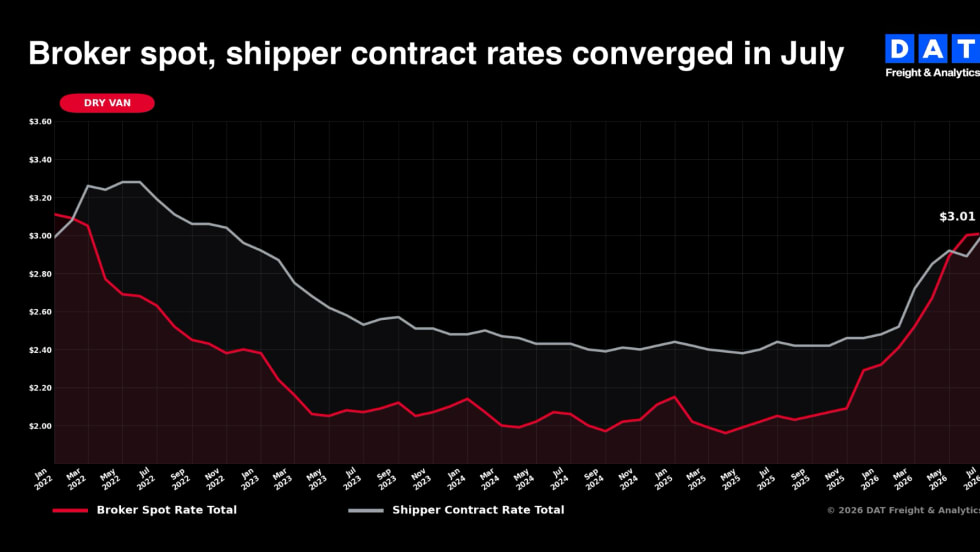
Tight Trucking Capacity Pushes Rates Higher Even as Freight Volumes Fall
“Spot rates moving ahead of contract rates have historically signaled a tightening market, but we haven’t seen a capacity-driven market quite like this one,” said DAT's Dean Croke.
Read More →