




Electric Freightliner Customer Experience Fleet Hits the Road
Eight new Freightliner electric trucks will soon go into the hands of fleet customers, which will help the OEM evaluate their performance in real-world trucking applications.

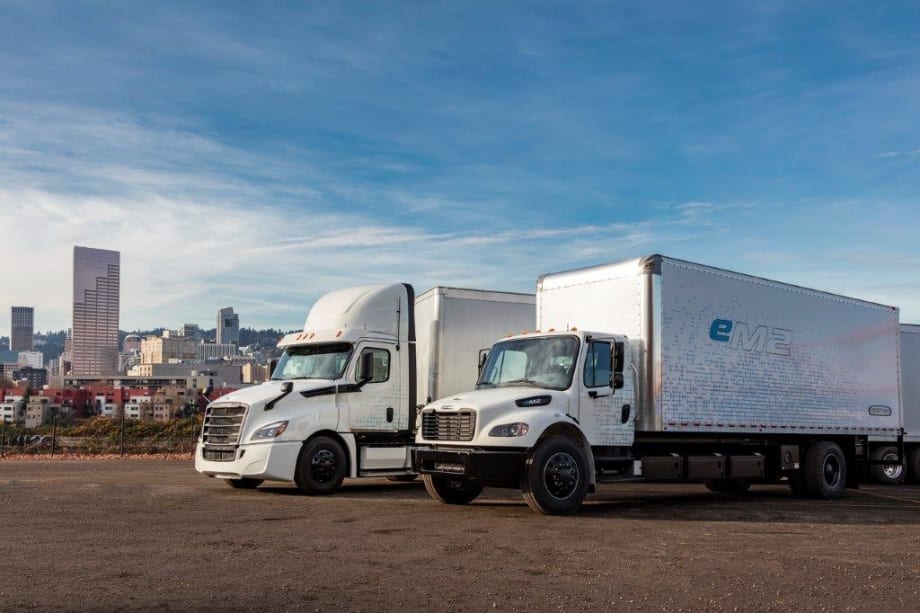
Freightliner is preparing to put eight new electric trucks in the hands of fleet customers to learn more about how they perform in the real world.
Photo: Freightliner
Daimler Trucks North America is launching the Freightliner Customer Experience Fleet of all-electric pre-series trucks, putting six heavy-duty Freightliner eCascadias and two medium-duty eM2 106 trucks into customer hands. Ultimately, the OEM said, at least 14 different fleets will get a chance to help in evaluating the demonstrator trucks.
The Freightliner CX Fleet is part of DTNA’s ongoing "co-creation" initiative that engages customers in the commercial electric vehicle development process by deploying trucks in real-world applications. At least 14 customers who collectively represent more than 150,000 Class 6-8 trucks currently on the road in the U.S. will help test the new Freightliner CX Fleet.
The Freightliner CX Fleet adds to the 30-vehicle Freightliner Electric Innovation Fleet, which started operation in late 2018 to provide feedback and real-world use data on the integration of battery electric trucks in large-scale fleet operations. The Freightliner Electric Innovation Fleet recently hit a milestone, surpassing 100,000 cumulative miles of operation.
Related: Freightliner Delivers First eCascadia Electric Trucks
Freightliner CX Fleet participants are members of the Freightliner Electric Vehicle Council, a group of customers working with Freightliner to identify and address potential hurdles to large-scale deployment of commercial battery electric vehicles. Over the next 22 months, DTNA will collect and analyze data and feedback from the CX Fleet to continue to improve on electric vehicle design and help customers transition to electric fleets.
“It’s critical that we collaborate with customers across multiple segments to further our understanding of how commercial battery electric trucks will be part of a long-term solution in CO₂-neutral transportation,” said Richard Howard, senior vice president, On-highway sales and marketing, DTNA, in a release. “Our customers provide important, continuous feedback that contributes to our ongoing design and purposeful innovation of these trucks and together we will lead the future.”
The eCascadia is a Class 8 tractor designed for local and regional distribution and drayage; the eM2 is a Class 6/7 truck designed for local distribution, pickup and delivery, food and beverage delivery, and last-mile logistics applications.
More Fuel Smarts

How Volvo Updated Its D13 for EPA 2027 [Watch]
Volvo’s updated D13 promises lower emissions without sacrificing performance or fuel economy. Take a closer look at what changed inside the engine in this HDT Spotlight video.
Read More →
Diesel Price Spike Shortens Payback for Natural Gas Trucks, Report Says
Energy Vision estimates fleets could recover the higher purchase price of an RNG-fueled Class 8 tractor in 1.3 to 2.8 years under current fuel-price scenarios.
Read More →
Calstart Becomes Catalyst Mobility, Reflecting Broader Focus
Calstart is now Catalyst Mobility, reflecting the nonprofit’s growing national role in clean transportation, including zero-emission trucks, infrastructure and incentive programs.
Read More →

Record Diesel Prices Squeeze Trucking Fleets
Average U.S. diesel prices have climbed to nearly $6 a gallon, surpassing the 2022 record as tight refinery capacity and Middle East disruptions keep fuel costs elevated.
Read More →
How Fuel Delivery Shapes Engine Performance
Fuel delivery depends on more than what happens at the injector. For fleet, maintenance and technical professionals, looking at the full path from pump to injector can provide useful context for understanding engine performance.
Read More →
East Coast Port Launches $45M Electric Truck Push
The Port Authority of New York and New Jersey announced millions in incentives for zero-emission drayage trucks, yard tractors, and new charging hubs near the port.
Read More →
California Bill Could Shed Light on Electric Truck Prices
Why do battery-electric Class 8 trucks remain so expensive? A California bill headed to Gov. Gavin Newsom would give fleets and state agencies more visibility into what manufacturers charge.
Read More →
Detroit Opens Orders for EPA 2027 Engines
Detroit isn’t starting from scratch to meet EPA 2027 diesel emissions standards. Its Gen 6 DD13 and DD15 engines keep much of today’s platform while updating the fuel and aftertreatment systems.
Read More →
Zero-Emission Truck Corridor Planned for West Coast
California, Oregon, Washington, British Columbia and Baja California are coordinating plans for truck charging and hydrogen fueling from Canada to Mexico.
Read More →
A Closer Look at Kenworth’s Electric T880E Vocational Truck [Video]
Learn more about Kenworth's T880E battery-electric vocational truck at the Paccar Technical Center, including its range, applications, upfitting considerations, and PTO options, in this HDT Spotlight video.
Read More →