





Listen to HDT Talks Trucking Special Report: Robotic Trucking, the Waymo Way
Daimler Trucks, Waymo Team up to Tackle Autonomous Trucking
An autonomous-truck partnership between Waymo and Daimler will produce a unique version of the Freightliner Cascadia fitted with integrated redundancy for all safety systems, rather than bolt-on components. It will be driven by Waymo's advanced AI driving system, The Waymo Driver.
October 27, 2020
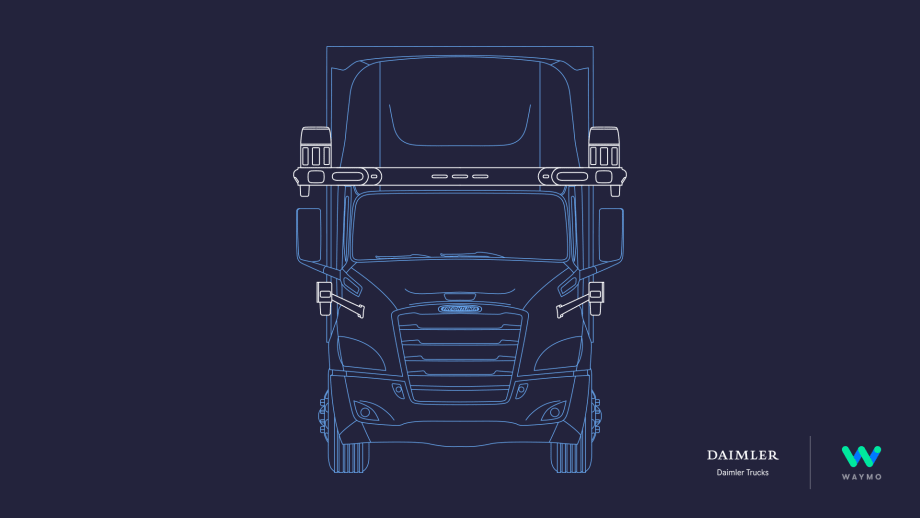
Daimler says automated trucks have huge potential, not only for trucking companies, but for society and the overall economy.
Photo: Waymo
7 min to read
Daimler Trucks and Waymo are combining their expertise to advance the development of SAE Level 4 autonomous truck technology. The two companies have initiated a global strategic partnership that will combine Waymo's automated driver technology with a unique version of Daimler's Freightliner Cascadia.
The two companies say they share the common goal of improving road safety and efficiency for fleet customers. The autonomous Cascadia, equipped with Waymo's advanced AI driving system, the Waymo Driver, will be available to customers in the U.S. in the coming years. Waymo and Daimler Trucks will also investigate expansion to other markets, including Europe, in the near future.
Martin Daum, chairman of the board of management at Daimler Truck AG, said the strategic partnership with Waymo is an important step toward bringing production versions of highly automated trucks to the road.
"This is a historic moment, when the best in truck manufacturing meets the best in software, which is Waymo, and to combine the two forces," he said Oct. 26 in an online media briefing. "We're delivering what we call a redundant chassis that is able to be electronically driven to someone who can provide the software that makes that happen safely."
Waymo is an autonomous driving technology company that started as the Google Self-Driving Car Project in 2009. It put its first AI-powered Class 8 truck on the road in the spring of 2017. To date, Waymo says "World’s Most Experienced Driver," the AI system referred to as the Waymo Driver, has driven over 20 million miles autonomously on public roads across 25 U.S. cities and over 15 billion miles in simulation.
“We have the highest regard for Daimler’s engineering skills and broad global truck product portfolio, and so we look forward to scaling the Waymo Driver, together with our new partner, to improve road safety and logistics efficiency on the world’s roadways,” noted Waymo CEO John Krafcik.
Calling the agreement an exciting moment in the journey towards self-driving trucks, Daimler Trucks North America President and CEO Roger Nielsen, said automated trucks have huge potential, not only for trucking companies, but also for society and the overall economy.
"The ever-rising demand for road transportation, fueled in part by all this e-commerce growth we are seeing, creates this great and compelling business case for self-driving trucks in the U.S.," he said. "We've always said, our technologies must make a strong business case for our customers. We don't innovate just for the sake of innovation. Our goal with autonomous driving is to push these engineering solutions that will increase safety and help our customers run their business more efficiently.

Building on Expertise
The partnership will see Waymo will bring its software, its sensing, and its AI processing capabilities to the table while Daimler brings its expertise in chassis engineering and the development of redundant safety systems like steering, brakes and powertrain controls. No such technology with mass production capability exists today, so Daimler's tier 1 suppliers will be tasked with building it from the ground up.
Krafcik, whose own engineering background is in automotive chassis, understands the scope of the challenge.
"Steering and braking systems are some of the longest lead component items that we have in automotive and truck manufacturing," he said. "These two companies coming together gives a strong signal to the tier one providers that yes, this is real. And [the partnership] is going to accelerate the pace of development of those components."
"I would never underestimate the difficulties we'll have on the hardware, because ultimately, it has to perform at 100% without any fault," Daum added. "I think it's a good leverage and increase in efficiency if the two leading companies work together."
Dual Strategy Approach
Daum twice mentioned a "dual strategy" approach of working with "two strong partners" to deliver autonomous L4 solutions, without mentioning the other half of the "dual," which of course is Daimler subsidiary Torc Robotics. Daum declined to discuss the matter, saying, "The corporation [Daimler] is about the chassis, and not about the software. So I would say I don't want to comment today on the software things in depth. On the chassis, we see a huge synergy to have the chassis for both virtual drivers."
Responding to another question about the dual strategy, Neilson said as far back as the 1930s when Freightliner first started building trucks, the company had always offered its customers choices. "By having a dual-strategy approach where we're working with Waymo and another company, we definitely give our customers that choice that they demand of us."
HDT followed up with Daimler HQ for some clarification on the matter of Torc Robotics. They told HDT the company is developing a customized Freightliner Cascadia truck chassis with redundant systems that would enable the integration of the Waymo Driver. Meanwhile, the partnership with Torc enables full integration of the Freightliner Cascadia truck with Torc’s virtual driver, supported with an operations and network center to run automated trucks. This includes environment, infrastructure, and vehicle control center to manage the fleets.
"We are collaborating with our truck customers to ensure that our solutions match their (future) needs," the spokesperson said. "Daimler Trucks’ and Torc’s integrated self-driving product will be designed for on-highway hub-to-hub applications, especially for long-distance, monotonous transport between distribution centers.
"Even though these are independent projects, our goal is to develop the best-in-class vehicle chassis for both virtual driver solutions and to target as much synergies as possible," Daimler said.
Further, "Daimler Trucks will continue to be the face to the customers from a vehicle perspective; meaning our dealers remain the contact to the customers when it comes to selling trucks and our fully-integrated solution with Torc’s virtual driver. As a technology provider for fleets Waymo is partnering with OEMs and Tier 1 suppliers to make trucks available with the Waymo Driver, like ours, and provide their Driver-as-a-Service to fleets who then operate those L4 trucks."
The Development Timeline
In another press briefing six weeks earlier, Peter Vaughan Schmidt, head of Daimler Truck’s Autonomous Technology Group, said the goal of the work with Torc was to bring “highly automated” SAE Level 4 trucks into commercial production "within the decade." The collaboration with Waymo might shorten that timeframe, but nobody on the call would commit to a date.
Daum described the Level 4 space as completely uncharted territory. He said it was like the old ages of discovery, when explorers set out to discover the New World. "You never know where you will end and what you will experience," he said. "There will be some positive surprises and some negative surprises. ... This isn't like an ordinary development where you know exactly when you started and in 37 months from now you start production."
Neilson said Daimler would not release a vehicle for Level-4 operation until it was absolutely convinced that it is safe to operate. "There's millions of miles of testing, both simulated and in real life yet, that we would we need to drive through to get to the point where we are convinced that we have this solution properly designed and developed," he said.
Krafcik said he expects the development time for the redundant systems and getting the mass production tools up and running will be considerable, but seemed to suggest that Waymo is already at the table and comfortable with its position.
"This is an application of existing technology. It's a different application, but the level of invention required from our side is really quite low," he said. "It's taken us 11 years and billions and billions of miles of experience to get to where we are today. So, for us, it's a much more solvable space. It's relatively straightforward application of our technology."
Technology Rollout
When the trucks are finally up and running, initial deployment will likely be in the southwest, where Waymo already has operations underway. It's already operating in Arizona, New Mexico, Texas, and California, and there is lots of logistics traffic in the region. The company already has operational bases in Texas, Phoenix, and throughout California. Future plans include other regions of the U.S. as well as Europe and other markets.
Looking way out, Krafcik said Waymo plans to unlock a full suite of driving capabilities not just highway driving, but full hub-to-hub capability including the ability to navigate very complicated city environments.
"You'll see us with time unlocking all this capabilities," he said. "We're starting out now, as good L4 developers do, with easier domains and focusing first on pure highway driving. But we are developing those capabilities to be fully able to take the load from the point where the load gets loaded to the point where it is discharged."
There was no word on the size of the development fleet, but Krafcik did say the fleet would be large enough to service the needs of Waymo's customers.
More Equipment

How Volvo Updated Its D13 for EPA 2027 [Watch]
Volvo’s updated D13 promises lower emissions without sacrificing performance or fuel economy. Take a closer look at what changed inside the engine in this HDT Spotlight video.
Read More →
Michelin Tire Improves Efficiency and Durability for Regional Fleets
The Michelin X Multi Energy D2 is a regional haul drive tire engineered to help fleets improve fuel efficiency, durability and traction in demanding stop-and-go operations.
Read More →
ZF Expands Commercial Vehicle Push in North America
ZF is expanding its North American commercial-vehicle presence with new transmission applications, electrification, trailer technology and autonomous-driving systems.
Read More →
Tesla Wants a Self-Driving Semi. Are Cameras Enough?
Could Tesla’s camera-only autonomous driving technology work on an 80,000-pound Semi? In this commentary, HDT's Deborah Lockridge takes a look at Tesla, Cybercab, and how autonomous trucks see the road.
Read More →
Kodiak: Driverless Long-Haul Truck Launch on Track for 2026
Kodiak AI says its driverless long-haul safety case is 93% complete and it remains on track to begin commercial operations by year-end 2026.
Read More →
What DOT’s Automated Vehicle Strategy Means for Trucking
The U.S. Department of Transportation issued a new automated-vehicle strategy that outlines plans for driverless-truck regulations, cross-state freight corridors, and federal safety standards.
Read More →
East Coast Port Launches $45M Electric Truck Push
The Port Authority of New York and New Jersey announced millions in incentives for zero-emission drayage trucks, yard tractors, and new charging hubs near the port.
Read More →
PlusAI Going Public to Fund Autonomous Truck Launch
A SPAC deal could provide PlusAI with up to $300 million as it works toward a 2027 commercial launch of factory-built autonomous trucks.
Read More →
NHTSA Moves to Rewrite Truck Fuel-Economy Rules
The National Highway Traffic Safety Administration says it lacks authority to regulate medium- and heavy-duty truck engines separately from complete vehicles, but the existing standards have not yet been eliminated.
Read More →
Detroit Opens Orders for EPA 2027 Engines
Detroit isn’t starting from scratch to meet EPA 2027 diesel emissions standards. Its Gen 6 DD13 and DD15 engines keep much of today’s platform while updating the fuel and aftertreatment systems.
Read More →