




Daimler Showcases Second-Generation Autonomous Freightliner Cascadia
Daimler Trucks zeros in on driver safety and freight efficiency as its main autonomous technology goals.
November 13, 2020

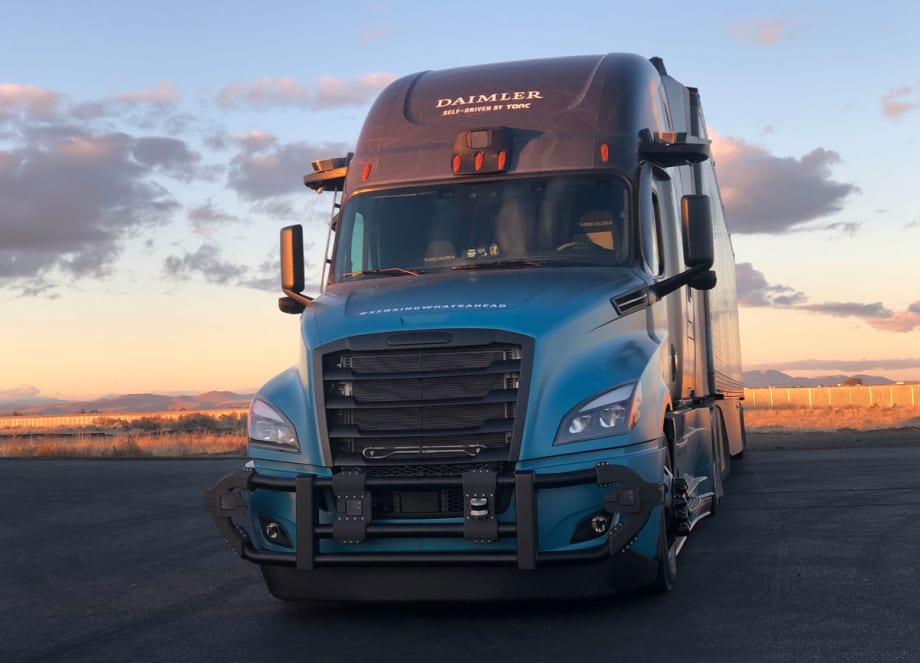
A second-generation Freightliner Cascadia awaits nightfall at the company’s Madras, Oregon, proving grounds. Note the sensor clusters on the front bumper and above the cab.
Photo: Jack Roberts
5 min to read
It was Daimler Trucks that lit the autonomous trucking fuse in North America when its revolutionary Inspiration autonomous concept truck drove itself across Nevada’s Hoover Dam in 2015. The splashy press reveal set off a debate that still rages today about the If, How and When merits of autonomous trucks. Five years on, Daimler is focusing on a more deliberate, nuanced, development program that puts driver safety at the center of its autonomous trucks R&D.
At a press briefing attached to the official press reveal of the new Western Star 49X Class 8 vocational truck at the company’s proving grounds outside of Madras, Oregon, Anika Friesinger, director and project leader of DTNA’s Autonomous Vehicles program, briefed journalists on the current status of the company’s efforts and its new collaborations with Torc Robotics and Waymo.
Friesinger noted that DTNA is now refining its second-generation autonomous truck, based on its current new Cascadia Class 8 on-highway tractor. Two recent versions of the autonomous Cascadia trucks were on display at Madras, and both provided hints as to how this emerging technology will change truck designs in the coming years.
Most noticeable on the tractors were large, front bumper assemblies – similar to aluminum cattle pushers common on trucks running in areas with wild game and farm animals – and large, circular-shaped lidar clusters mounted above the cab doors on both sides of the trucks.
These assemblies are essentially sensor housings, packed full of cameras, radar and lidar systems that constantly feed operational telemetry to the truck’s on-board computers, as well as to the Detroit DT automated transmission.
It is worth noting that automated transmissions have evolved to become the “brains” of a modern tractor-trailer. And autonomous technology has taken the capabilities and responsibilities handled by these vehicle systems to levels of data management and operational commands that were unimaginable a few years ago.
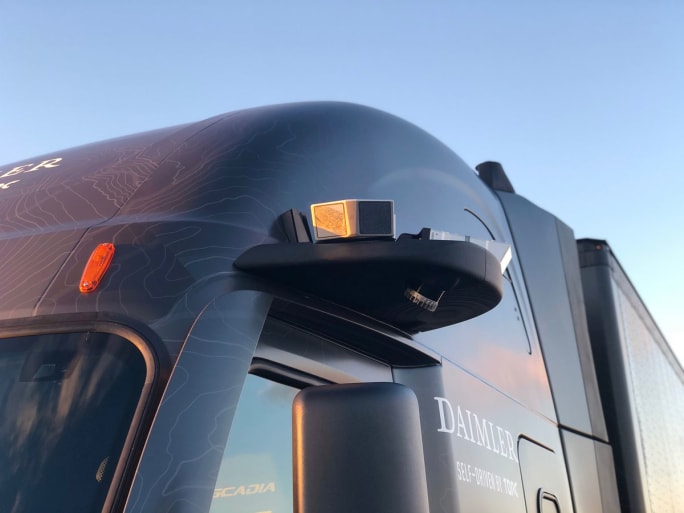
A close inspection of the lidar mounts atop the Cascadia’s cab show sensor and camera arrays around both the top and bottom, as well as the front and the rear, of the cluster.
Photo: Jack Roberts
Focusing on Driver Safety and Freight Efficiency
As Daimler engineers have learned more about the current capabilities and limitations of autonomous technology, Friesinger said the company has moved to focus more on driver safety and freight efficiency as the main drivers of its R&D efforts on the autonomous front.
“We believe that our recent developments, the advent of Level 4 autonomous technology, will revolutionize how our customers operate Class 8 trucks in long-haul fleet operations,” Friesinger said. “And we have also come to understand that we need strong partners in order to bring this technology to market. Which is why we began working with Torc Robotics one and half years ago and have since acquired a majority stake in that business. And that partnership has paid off, helping us to develop many of the safety features found on these autonomous Cascadia trucks.”
Friesinger also pointed to DTNA’s partnership with Luminar, a new autonomous tech partner for the OEM. Luminar is playing a key role in developing the lidar sensor clusters located above the Cascadia’s cab, as well as the onboard lidar systems and their integration into the vehicle’s powertrain and autonomous control system.
She also noted that the company’s new relationship with Waymo is quickly getting up to speed as well. The two companies announced just a few weeks ago that they had initiated a global strategic partnership that will combine Waymo's automated driver technology with a unique version of Daimler's Freightliner Cascadia.
“At all times, safety is our utmost priority,” Friesinger added. “And that means that compared to other companies today, we are not always very aggressive in messaging when it comes to our latest developments. That’s because we feel it is more important to have a safe and reliable vehicle ready for fleets when technology is perfected. That is why you do not hear much from DTNA these days talking in terms of a timeline or years when this technology will become available. Our position is that autonomous technology must be safe and reliable before we will make an announcement along those lines.”
Talking to fleets to better understand their expectations and desires for autonomous trucks is also a major priority for DTNA’s autonomous trucks program, Friesinger noted. “We want to understand fully how this technology will fit into their businesses. We are interested in both how they are moving freight today, which business models – hub-to-hub, for example – will be the prime candidates for autonomous trucks when they are ready for deployment in North America. So, there is quite a bit of evolution in our thought processes going on today as we work on this technology.”
That evolution of thought is also occurring on the fleet/customer side of the equation as well, Friesinger added. “Our customers are turning to us more and more now with questions about the future of autonomous technology and how they can prepare for it,” she said. “For example, we are getting questions about that kind of trailers fleets should be buying today, and what features they should have, so they will be compatible with autonomous trucks when they do appear in the future.”
Friesinger stressed, however, that the road forward will not be easy for DTNA engineers. “It will take time before autonomous technology overtakes manual vehicle control and begins to move large volumes of freight,” she said. “We have much to learn about how these systems perform in ice and snow, and how operations and infrastructure will adapt to deal with routine emergencies such as flat tires and pre-trip inspections.”
There is still much to learn, Friesinger noted. But, regardless of predictions and timelines, DTNA is convinced that autonomous technology will be a vital fleet management tool in the not-so-distant future – and that the company is determined to deliver systems that will help its customers move freight both more safely and efficiently when the technology is ready.
More Fleet Management

Sponsored•September 16, 2026
Color Match Smarter: Tools That Restore & Perform
For fleet managers and collision repair professionals keeping heavy-duty trucks on the road, getting the color right the first time isn't just about appearance — it's about efficiency, turnaround time, and bottom-line results. Discover how today's digital color tools are transforming the repair process from guesswork to precision.
Read More →
FMCSA Pauses Biennial-Update Enforcement Amid Motus Transition
Carriers whose updates were due on or after June 1 have more time, while FMCSA works to stabilize its new registration system and warns of phishing sites impersonating its new carrier registration system, Motus.
Read More →
Sponsored•September 14, 2026
2026 Blueprint for Countering Smarter Supply Chain Theft
Cargo theft is no longer just the cost of doing business. It's a multi-billion-dollar criminal enterprise exploiting vulnerabilities across your fleet, drivers, and supply chain.
Read More →


Sponsored•September 1, 2026
How Telematics Improves Visibility, Control, and Performance in Refrigerated Fleets
Explore how telematics help refrigerated fleets improve visibility, uptime, efficiency, compliance, and cargo protection across connected cold chain operations.
Read More →
What the U.S.-Canada Trade War Means for Trucking
Escalating U.S.-Canada tariffs could disrupt cross-border freight, reduce truck volumes, raise costs, and create new uncertainty for carriers on both sides of the border.
Read More →
What Are Trucking’s Top Concerns for 2026?
The American Transportation Research Institute wants to know what's worrying trucking fleet managers, drivers, and other stakeholders in its annual Industry Issues survey.
Read More →
American Trucking Associations Looks for a New Leader
ATA President and CEO Chris Spear abruptly left his job at the association on August 21, at a pivotal time for the trucking industry.
Read More →
Public Wi-Fi Cybersecurity Risks: How Truck Drivers and Fleets Can Protect Their Data
Public Wi-Fi can expose truck drivers and fleets to credential theft, malware, and other cyber threats. Here’s how to reduce the risk on the road.
Read More →
For Nicky Cupp, Fleet Innovation Starts With Frustration
HDT Truck Fleet Innovator Nicky Cupp turns everyday pain points at Fraley & Schilling into opportunities for better technology and smarter processes.
Read More →
Adam Buttgenbach’s Approach to Electric Trucks: Start With Where They Fit
HDT Truck Fleet Innovator Adam Buttgenbach helped PepsiCo build one of North America’s largest EV fleets by focusing on where electric trucks make operational sense.
Read More →