




Cummins Unveils ISX Efficiency Improvements
LOUISVILLE, KY -- Under the theme of "redefining efficiency," Cummins Tuesday night announced fuel-saving enhancements to the 2015 ISX15 big-bore diesel and a peek at the 2017 ISX15, which will feature a lighter and smaller aftertreatment system along with a more efficient turbocharger and reduced parasitic loss.

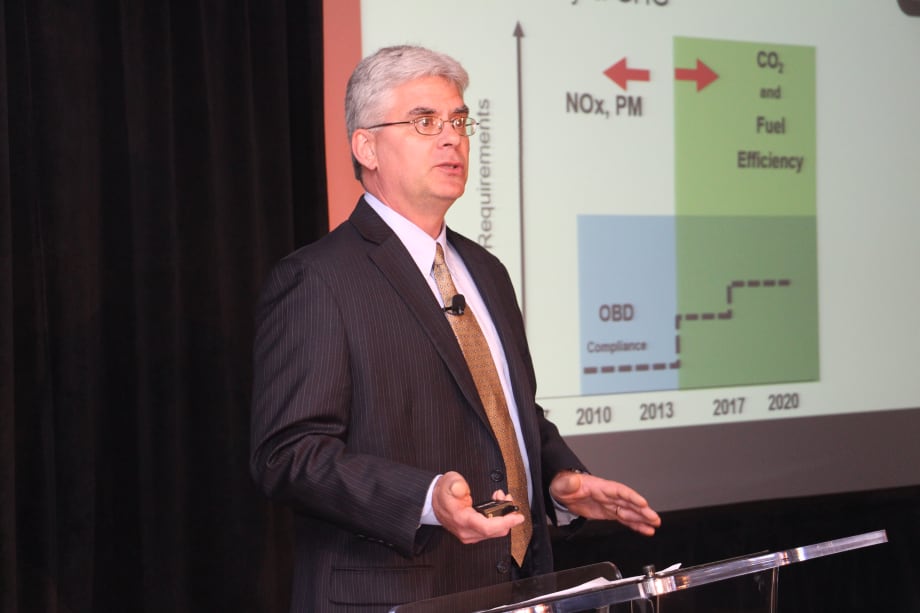
Jim Fier discusses the movement of EPA emissions regs from particulate matter and NOx to greenhouse gases and fuel economy. Photo by Evan Lockridge
Jim Fier discusses the movement of EPA emissions regs from particulate matter and NOx to greenhouse gases and fuel economy.Photo by Evan Lockridge
LOUISVILLE, KY -- Under the theme of "redefining efficiency," Cummins Tuesday night announced fuel-saving enhancements to the 2015 ISX15 big-bore diesel and a peek at the 2017 ISX15, which will feature a lighter and smaller aftertreatment system along with a more efficient turbocharger and reduced parasitic loss.
Srikanth Padmanabhan, vice president of Cummins engine business, explained that while the previous decade of its on-highway business was focused on the environment and emissions, over the next several years it's all about efficiency.
And redefining efficiency, he said, is not just for new products, but also for the many Cummins engines already in use.
Jim Fier, vice president of engineering for Cummins' heavy/medium/light-duty engine business, noted that the new focus in federal emissions regulations is greenhouse gases and fuel economy. Customers, he said, "are more receptive to that technology" than they were to the numerous rounds of particulate matter and NOx reductions, "and sometimes are in the pull mode."
As a result, he said, instead of engine design being a process of coming out with a new emissions-level engine every three years, "it's something we're doing continually."
That approach was evident in the announcements made to trucking reporters Tuesday ahead of the Mid-America Trucking Show in Louisville, Ky.
2015 ISX15
One key part of Cummins' fuel economy enhancements is the new Adept technology for the ISX15, a suite of electronic engine features Cummins says offers up to a 3% improvement in fuel economy initially for customers operating with automated manual transmissions.
Adept uses load-, speed- and grade-sensing technology to make adjustments to speed, power and transmission gear to take advantage of vehicle momentum for better fuel economy.
The first package of Adept includes two features: SmartCoast and SmartTorque2 (ST2). SmartCoast operates when the vehicle is coasting downhill by disengaging the driveline and returning the engine to idle to reduce drag, conserve vehicle momentum and, ultimately, improve fuel economy.
ST2 uses the same torque management intelligence first introduced on the SmartAdvantage Powertrain to help eliminate unnecessary downshifts and keep the engine operating in the most fuel-efficient “sweet spot.”
The first Adept package will be available in summer 2015, and customers will be able to upgrade as future packages are released. Additional features will be announced soon.
The 2015 ISX15 also now features NanoNet media lube filtration for better protection and filter life. Also, Cummins has extended the Diesel Particulate Filter cleaning interval to 400,000 miles for line-haul applications that average greater than 5.5 mpg.
2017 ISX15
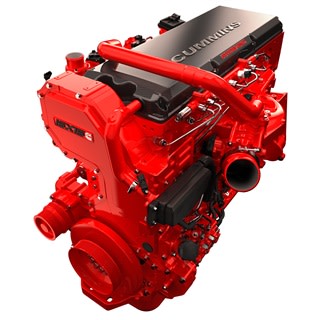
The 2017 Cummins ISX15.Photo courtesy Cummins
The 2017 ISX15, with a horsepower range from 400 hp to 605 hp, will feature integrated Adept technology.
There will be two distinct packages, one optimized for customers seeking maximum fuel economy and the other for premium- and high- performance-oriented fleets.
Design updates to the ISX15 for 2017 include a more responsive and efficient turbocharger, further optimization for downspeeding, integrated Adept technology and continued reduction in parasitic loss.
Some of the reduction in parasitic loads include less friction in the rings, some auxiliary lube and cooling system improvements that reduce pressure drop, Fier explained.
Cummins officials said they also "will continue to push the envelope on extending maintenance intervals" on the 2017 ISX15. The technology will be tested in nearly 9 million miles of real-world experience – the most testing of any product launch to date, according to the company. This is the equivalent of making 4,000 trips coast-to-coast.
Another key feature of the 2017 ISX15 engine system is the new Single Module aftertreatment system from Cummins Emission Solutions. This new aftertreatment system for 2017 offers up to 60% reduction in size and space needs and weighs up to 40% less and is more efficient, thanks to advancements in catalyst technologies and urea dosing solutions.
Redefining Tour
Cummins will take these new and improved technologies on the road this summer with the Cummins Redefining Tour, featuring a fleet of Cummins ISX15-powered heavy-duty trucks.
During the tour, customers will have an opportunity to learn about current and future products and technologies, including Adept technology; Connected Diagnostics, the first application in the suite of Cummins Connected Solutions; real 2017 prototype engines powering the truck fleet, as well as engine system displays representing the product lineup for the North American truck market. More information is available at www.cumminstour.com.
More Fuel Smarts

Geotab Links Fleet Card to Vehicle Data
The new card combines fuel discounts with telematics-based purchase controls. Geotab’s analysis also points to potential savings from choosing lower-priced fuel stops.
Read More →
Fleet Economics Shape Electric Truck Outlook
ACT Research expects costs, charging infrastructure, and technology improvements to drive zero-emission commercial vehicle adoption as federal regulations and incentives retreat.
Read More →
Wex Adds Cardless Fuel Payments for Over-the-Road Customers
A new fuel card feature for Wex customers offers convenience and security.
Read More →

New California Law Could Shed Light on Electric Truck Prices
Why do battery-electric Class 8 trucks remain so expensive? A California bill signed by Gov. Gavin Newsom would give fleets and state agencies more visibility into what manufacturers charge.
Read More →
How Volvo Updated Its D13 for EPA 2027 [Watch]
Volvo’s updated D13 promises lower emissions without sacrificing performance or fuel economy. Take a closer look at what changed inside the engine in this HDT Spotlight video.
Read More →
Diesel Price Spike Shortens Payback for Natural Gas Trucks, Report Says
Energy Vision estimates fleets could recover the higher purchase price of an RNG-fueled Class 8 tractor in 1.3 to 2.8 years under current fuel-price scenarios.
Read More →
Calstart Becomes Catalyst Mobility, Reflecting Broader Focus
Calstart is now Catalyst Mobility, reflecting the nonprofit’s growing national role in clean transportation, including zero-emission trucks, infrastructure and incentive programs.
Read More →
Record Diesel Prices Squeeze Trucking Fleets
Average U.S. diesel prices have climbed to nearly $6 a gallon, surpassing the 2022 record as tight refinery capacity and Middle East disruptions keep fuel costs elevated.
Read More →
How Fuel Delivery Shapes Engine Performance
Fuel delivery depends on more than what happens at the injector. For fleet, maintenance and technical professionals, looking at the full path from pump to injector can provide useful context for understanding engine performance.
Read More →
East Coast Port Launches $45M Electric Truck Push
The Port Authority of New York and New Jersey announced millions in incentives for zero-emission drayage trucks, yard tractors, and new charging hubs near the port.
Read More →