




CSA Changes Draw Strong Commentary
When the Federal Motor Carrier Safety Administration asked for comments on changes in its CSA safety enforcement program, it got an earful. Almost everyone supports the concept of the overall CSA program, but the details do not get much love
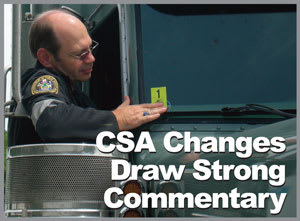
When the Federal Motor Carrier Safety Administration asked for comments on changes in its CSA safety enforcement program, it got an earful.
Almost everyone supports the concept of the overall CSA program, but the details do not get much love.
The changes, part of an ongoing CSA revision process, apply to several of the seven safety performance categories that are at the heart of the program.
The agency plans to move cargo and load-securement violations out of the Cargo-Related category into the Vehicle Maintenance category. It also wants to change Cargo-Related to a new category, Hazardous Materials.
The request for comments is part of an ongoing effort by the agency to address industry concerns that the CSA process has not been open enough and that flaws in the system are causing more problems than they solve.
In a related development, the agency recently asked its industry advisory board - the Motor Carrier Safety Advisory Committee - to appoint a subcommittee to provide ideas and recommendations to improve CSA. The subcommittee will hold its first meeting August 28 in Alexandria, Virginia.
The BASICs changes drew vigorous comment from all sectors of the transportation community.
Trucking interests have varying reactions.
American Trucking Associations applauded the agency for opening up the CSA change process to comments and suggestions but wants more details on the data and analysis the agency uses to develop changes.
More openness would help generate more informed comments, and it would stave off skepticism about CSA, the association said.
ATA supports moving cargo and load-securement violations into the Vehicle Maintenance category. It also supports creation of a separate HazMat category, but said the method for determining performance in that category needs to be improved.
Individual trucking companies underscored concerns about the HazMat change.
J.B. Hunt told the agency that inconsistencies in the preview scores "should cause FMCSA to question the data accuracy, methodology and peer groupings used to arrive at the pending hazardous material scores."
Schneider National and ABF Freight System said the HazMat category should not be made public until the agency can confirm that it is accurate.
"It is inappropriate to make carriers' scores public in the HM (category), as shippers, insurance providers and plaintiff's attorneys may erroneously label safe, responsible carriers as unsafe," Schneider said.
Knight Transportation said that hazmats such as paint and cleaning products make up less than 1% of all its loads, and it has had just one hazmat violation this year, but the agency's new system gives it a 98% ranking. The new category creates a bias against large carriers that haul relatively few hazmats, Knight said.
The solution, Knight said, is to not score carriers that have statistically irrelevant numbers of hazmat inspections or violations.
Echoing the theme that Schneider sounded, Landstar said the agency needs to be more mindful that CSA has become a measuring system that shippers are using to pick carriers.
"Our concern is CSA's effect on interstate commerce when, based on the model, at any given time 35% of all carriers will be over threshold in at least one (category)," Landstar said.
"Customers are asking for published and non-published scores. Carriers and brokers are concerned about brokering freight to carriers with high CSA scores. We cannot use a 'work in progress' as an industry measurement tool."
The industry lacks confidence in CSA because it has been through so many changes, the company said.
"We believe it is difficult for FMCSA to reconcile statements such as CSA is a "major tool for measuring the safety of individual motor carriers" and CSA is used to "help identify and monitor safety problems," when a motor carrier has a high (score) one month and the same (score) may be significantly lower the next month based solely upon changes to
CSA methodology."
The company went on: "We appreciate that CSA is a work in progress. However, we do not believe a work in progress should be published as a safety measurement tool. The consequences are too great. We suggest that CSA not be available for public view until data proves CSA measures safety."
The Owner-Operator Independent Drivers Association echoed this observation. It said the CSA system is fundamentally flawed - it "does not accurately or objectively assess motor carrier safety" - and should be suspended until the agency can fix the problems.
Steven Bryan, CEO of the CSA services provider Vigillo, said his company's analysis shows that carriers with high scores in the new HazMat category have low scores in other categories.
The "tissue-thin" data in the new hazmat category does not predict future crashes, Vigillo said.
"Yet this new, publicly available (category) will become the focus of brokers, shippers, drivers, plaintiffs and law enforcement as equivalent to (categories) with true safety backbone," the company said.
The Transportation Intermediaries Association, representing third-party logistics providers, underscored the concern about using CSA to select carriers. It asked the agency to remove all resources geared toward shippers and brokers from its website.
"These resources will have a serious adverse effect on the industry and will increase vicarious liability and negligent hiring concerns for shippers and brokers," the group said.
This issue is at the heart of a suit against the agency by a group representing small carriers and brokers.
The Alliance for Safe, Efficient and Competitive Truck Transportation has asked a federal appeals court to review aspects of the CSA program.
In a recent interview, ASECTT President Tom Sanderson said that shippers are misinterpreting CSA data. Sanderson, who also is CEO of Transplace, a third-party logistics provider and broker, gave an example.
He said Transplace sent a veteran carrier with a satisfactory safety rating to a new brokerage customer, but when the carrier arrived the customer rejected it because its CSA scores were too high. The customer then said it would no longer do business with Transplace.
"It's an example of a shipper that's taking those scores as somehow being superior to a safety fitness determination," he said.
"Shippers are drawing the wrong conclusion from the data," he said.
The immediate solution, he said, is for the agency to use CSA to guide its own enforcement actions, but remove the data from the view of shippers.
"There's absolutely no benefit to having that information published on the web," he said, although he acknowledged that the system helps carriers improve their safety performance.
He said the agency would have been better off keeping CSA under wraps until it finished work on its new safety fitness rule. The proposed rule is scheduled to be published next January, and the final rule is not likely until late next year at the earliest.
Related Stories:
7/23/2012 - Small Carriers, Brokers Launch Legal Challenge to CSA
7/12/2012 - Concerns about CSA Aired at House Hearing
5/5/2012 CSA Data May Indicate Move by Drivers to Independent Owner-Operators
More Drivers
Medical Cards, English Proficiency Reshape Roadcheck Violations
Medical-card violations jumped to the top of the driver out-of-service list during CVSA’s 2026 International Roadcheck, while English-language proficiency violations appeared among the leading violations for the first time.
Read More →
Driver Trust Can Make or Break the Success of Fleet Safety Technology
New Teletrac Navman research suggests that onboarding, transparency about driver data, and positive feedback can play a significant role in how commercial drivers respond to safety and coaching technology.
Read More →
EEOC Sues KLLM Over Alleged Sex Discrimination in Driver Training
KLLM is facing a federal sex-discrimination lawsuit over policies the EEOC alleges put female truck driver trainees at a disadvantage.
Read More →
FMCSA Moves to Codify English Language Requirements for Commercial Drivers
By changing regulations on English-language proficiency requirements for commercial drivers, rather than relying on a guidance memo, the FMCSA said future administrations won't be able to walk back the Trump administration's stricter enforcement with just a memo.
Read More →
Drivers Put Western Star Trucks to the Test at Star Nation Experience
Watch to get an inside look at the Western Star trucks, technology, and community behind the Star Nation Experience 2026!
Read More →
Trump Administration Looks to Put More Veterans Behind the Wheel
The Freedom Haulers program pulls together existing and expanded programs at several federal agencies to recruit veterans to drive commercial heavy-duty trucks and cut the red tape for them to get a CDL, training, and employment.
Read More →
Putting Mack’s Command Steer to the Test
A test drive of Mack’s Command Steer active steering system evaluates how it can make truck driving easier and less tiring.
Read More →
Competition Heating Up for Truck Drivers
New report reveals rising driver hiring costs, the return of sign-on bonuses, growing AI advantages, and the operational factors shaping driver retention.
Read More →
How Fraley & Schilling Improved Logbook Compliance by Over 50%
Fraley & Schilling needed a way to close a compliance workflow gap in its ELD system without adding more work from driver training, reminders, and back-office follow-ups. It found the answer in a custom driver app.
Read More →
Volvo Goes Gaming
Volvo has roared into American Truck Simulator with two new flagship trucks.
Read More →