




CSA 2010 Changes Look Promising, Carriers Say
The Federal Motor Carrier Safety Administration appears to have made a good start at correcting shortcomings in its CSA 2010 Safety Measurement System, according to trucking companies that are testing the program. Preliminary reports from carriers in
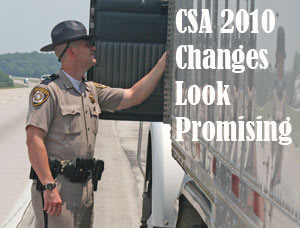
The Federal Motor Carrier Safety Administration appears to have made a good start at correcting shortcomings in its CSA 2010 Safety Measurement System, according to trucking companies that are testing the program.
Preliminary reports from carriers in the states where Comprehensive Safety Analysis 2010 is being pilot-tested indicate that safety scores are changing "somewhat dramatically" under revised system, said David Osiecki, senior vice president of policy and regulatory affairs at American Trucking Associations.
"That's the direction of the feedback we're getting," Osiecki said. Carriers that formerly said the system was falsely labeling them as deficient are now reporting that they are no longer deficient. "It's very early, and only a handful of carriers, but uniformly they have said these changes seem to be going in the right direction."
The revisions in the system go to areas that have been of major concern to carriers, such as the agency's method of measuring exposure in order to determine safety performance, severity weightings for roadside inspections and accounting for size-and-weight violations.
The agency is strongly urging carriers to learn how the new system will work and preview their data. Starting Aug. 16 carriers can go online at the FMCSA website (http://csa2010.fmcsa.dot.gov) and see how they are performing in each of the seven Behavior Analysis and Safety Improvement Categories, or BASICS.
"This early look gives motor carriers an opportunity to understand and address their safety compliance issues right away," the agency said recently.
Nasty Surprise
All indications from the field are that carriers that have not familiarized themselves with the new safety system may be in for a surprise.
Rob Abbott, vice president of safety policy at ATA, predicts that around 25 percent of the nation's fleet will be getting warning letters from FMCSA starting in December. "Depending on how you do the math, you're talking about tens of thousands of motor carriers that will get warning letters that will instantly raise their awareness and the need to begin paying attention and looking into their scores. That's a good thing."
Abbott, who has been working on ATA's analysis of the changes in the CSA 2010 methodology, underscored Osiecki's report that the system appears to be getting better.
He said the changes appear to be having a "substantial impact" on carriers' percentile rankings and scores. "Early indications are that the changes improve the system's ability to target unsafe operations," he said. "The feedback from our members (in the pilot states) is that the changes are very positive ones and that they are seeing improvements in their scores and a more accurate reflection of their true safety posture."
FMCSA Listened
The agency made substantive revisions to the system, partly in response to what it has learned from the 18-month pilot test and partly, Abbott believes, in response to feedback from stakeholders such as ATA.
"We held a series of private meetings with (FMCSA Administrator Anne Ferro) and her staff, showing them examples of how we felt the previous methodology was not accurate and didn't do an effective job of targeting truly unsafe carriers," Abbott said. "We were able to show instances of carriers that have super crash rates and great recent compliance reviews, but the system showed that they were labeled as safety deficient."
"If you target carriers based on flawed methodology, you're really using your limited resources to focus on the wrong carriers," he added. "We really appreciate the administrator's willingness to listen and address our concerns."
The changes the agency made concern the key CSA 2010 mechanism of organizing carrier safety performance into seven Behavioral Analysis Safety Improvement Categories, or BASICs. They are: Unsafe Driving, Fatigued Driving, Driver Fitness, Controlled Substances and Alcohol, Vehicle Maintenance, Cargo-Related, and Crash Indicator. Carriers receive a percentile ranking of their performance in each category compared to other, similar carriers, and an enforcement action will be triggered when their rank exceeds a threshold determined by the agency.
The most significant change the agency made in this system is to amend the way it measures a carrier's exposure to risk in the Unsafe Driving and the Crash Indicator BASICs. Formerly, the agency based its calculation solely on the number of power units a carrier runs. Now it will use a measure based on a combination of power units and vehicle miles traveled.
In support of this change, Abbott said, the agency is mandating that carriers supply mileage information in their regular reports on the MC-150 form. "Over time, the agency will be getting more meaningful (mileage) data," he said.
The agency also said it will no longer use power units to establish which group the carrier is in, in these two categories. The Crash Indicator category will use the number of crashes, and the Unsafe Driving category will use the number of inspections with a violation.
This improves the system's ability to compare performance among like operations, Abbott said. "It puts you in a category not of people with same number of trucks but with people with the same number of inspections or type of violations," he said.
In doing this the agency has acknowledged that there are significant differences among state enforcement programs, Abbott said. "Some states have far more robust programs (than others), and some motor carriers operate in environments where they are subject to these programs. It's a smart change to account for that."
The new system also separates carriers into segments based on vehicle configuration - combination units versus straight trucks.
The power-unit count also will be dropped from the Controlled Substances/Alcohol category. The exposure measurement there will be the number of relevant inspections.
In addition, severity weightings for some roadside inspection violations will be updated. Abbott described this change as an acknowledgement that it is important for the program to focus less on paperwork violations and more on true safety performance.
Also, the agency said it will change its approach to carriers with a history of size and weight violations. Rather than counting these violations in the Cargo-Related category, it will send alerts to roadside inspectors when carriers have a history of these violations.
Abbott said ATA will continue to gather data from its members in the pilot states and expects to have a clearer understanding of the impact of these changes by mid-September.
Who's at Fault?
One continuing area of concern from the industry's perspective is that the system does not recognize that a carrier may not have been at fault in an accident that is counted in the data. ATA has been pressing the agency to come up with a way to recognize the difference between preventable and non-preventable accidents in its performance measurement system.
The agency holds that no matter who is at fault, a crash is a legitimate indicator of the likelihood of another crash, but at the same time understands the industry's concern. Administrator Ferro recently told Congress that the agency intends to analyze a carrier's data for fault if the carrier's safety fitness rating comes into question.
"Any crashes in a carrier's safety record will be assessed for accountability before being used to weigh in on the carrier's safety rating," she said at a hearing in June.
Abbott noted that the agency plans to assemble a team to review crash reports and make accountability determinations, but added that this is not likely to happen by November when the system is scheduled to go live.
"We are eager to have them make that change as quickly as possible," he said, and added: "There certainly seems to be a very genuine intent to partner and look a
More Drivers

Why Hiring Truck Drivers Is Getting Harder
Higher recruiting costs, a shrinking driver pool, and renewed pay competition are raising the stakes for fleets heading into 2027.
Read More →
Roehl Offers Truck Drivers $10,000 Retention Incentive
Payments begin after the first load and continue in mileage-based installments for eligible experienced drivers joining the fleet.
Read More →
Platform Science Adds Dispatch and Safety Tools
Four additions to PS Fleet help fleets monitor loads, manage driver coaching, share truck locations and adjust video system settings.
Read More →
When Language Stops the Truck: The Return of ELP Out-of-Service Orders
English language proficiency rules for commercial drivers aren’t new, but renewed out-of-service enforcement has raised the stakes. Here’s what carriers need to know before a driver reaches a roadside inspection.
Read More →
Samsara Launches Custom AI Agent Builder
Agent Studio lets fleets create AI tools for hours-of-service monitoring, reporting and driver support, including agents that communicate by phone.
Read More →
Trucker Path Expands Reserved Parking Network
Trucker Path has added close to 6,000 more truck parking spaces to its Trucker Path Reserved Parking Network with the addition of Safe Truck Parking.
Read More →
EEOC Sues Texas Trucking Company Over Driver Age Limits
The agency says Trancasa USA rejected applicants over 65 and applied tougher driving-record standards to those over 60.
Read More →
Nussbaum, Roehl Announce Second Driver Pay Increase This Year
This year has seen a swath of major truck driver pay increases as freight capacity has tightened.
Read More →
From One Generation to the Next: How Mentorship Builds Safer Truck Drivers
After three decades in trucking, Harold Perry shares what he's learned about driver safety, mentorship, and helping the next generation build confidence behind the wheel.
Read More →
Truck Drivers Need More Than Another Alert
Fleets have more visibility into truck health, safety events, and driver activity than ever. The next challenge is turning all that information into useful guidance for the person who has to decide what to do next.
Read More →