




Clean Truck Procession Opens New Port of Long Beach Bridge
A procession of clean, zero-emissions and near-zero-emissions drayage trucks were a highlight of ceremonies marking the opening of a new bridge at the Port of Long Beach.

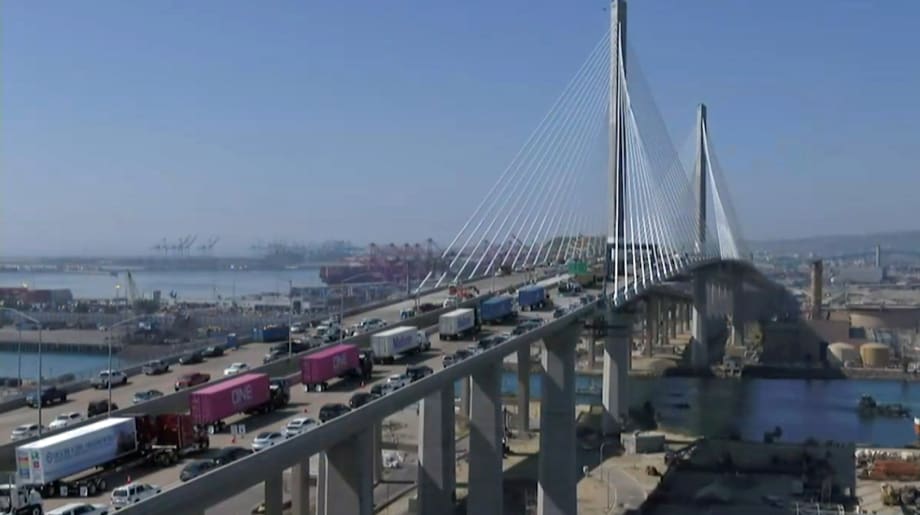
Battery-electric, natural-gas, and fuel-cell electric trucks were featured in a clean trucks parade to celebrate the opening of Port of Long Beach’s new cable-stayed bridge
Photo: Screenshot of live-streamed POLB event
A procession of clean, zero-emissions and near-zero-emissions drayage trucks were a highlight of ceremonies marking the opening of the new bridge at the Port of Long Beach.
The “first drive” over the bridge on Oct. 2 was led by 30 cargo trucks representing the port’s terminals and major shipping lines for the new bridge, which was scheduled to open to traffic by 5 a.m. Monday, Oct. 5.
Battery-electric, natural-gas, and fuel-cell electric trucks were featured in the parade, driven by NFI/Cal Cartage, Total Transportation Solutions, Golden State Logistics, Gold Point, Quick Pick Express, Overseas Freight, MDB Transportation, Southern Counties Express, Tradelink Trans, Duncan & Sons, Pacific 9 Transportation, Green Trucking, and Pacific Drayage Services.
The new Port of Long Beach bridge — a $1.5 billion, 7-year joint effort with Caltrans, the U.S. Department of Transportation, and the Los Angeles County Metropolitan Transportation Authority — will provide greater access for larger cargo ships to enter the port’s inner harbor terminals and provide expanded capacity for truck traffic. Combined, the Ports of Long Beach and Los Angeles handle nearly 40% of the nation's total containerized import traffic and 25 percent of its total exports. Since 2008, the two ports have collaborated on a Clean Truck Program to reduce the impact of truck emissions on the local community, with a goal of fully transitioning to zero-emission drayage trucks by 2035.
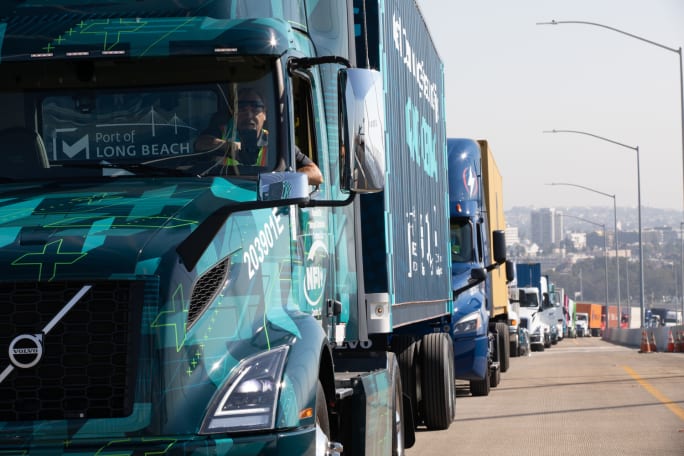
Volvo Trucks North America’s Class 8 VNR Electric truck led a group of Southern California freight movement fleets in a clean truck parade on Friday, October 2 to commemorate the opening of Port of Long Beach’s new cable-stayed bridge.
Photo: Volvo Trucks
First in line was Volvo Trucks North America’s Class 8 VNR Electric truck for NFI. A second VNR Electric later in the procession was there representing Dependable Highway Express (DHE). The two fleets are partners in the Volvo LIGHTS (Low Impact Green Heavy Transport Solutions) project. They are piloting Volvo Trucks’ battery-electric models through 2021, demonstrating the trucks’ ability to reliably move freight between the ports of Long Beach and Los Angeles and warehouses throughout the region with less noise and zero emissions.
There were also several BYD electric trucks, a Freightliner eCascadia that Knight-Swift recently started testing, and a Kenworth-Toyota zero-emissions hydrogen-fuel-cell truck.
There were also many natural-gas powered trucks in the parade. The California Natural Gas Partnership noted that seven fleet operators—NFI, Total Transportation Solutions Inc. (TTSI), MDB Transportation, Tradelink Transport, Pacific 9 Transportation, Overseas Freight, and Green Trucking—collectively operate 157 natural gas heavy-duty trucks that log more than 6.4 million miles per year, hauling freight daily to and from the ports of Long Beach and Los Angeles. In total, more than 700 natural gas trucks regularly haul freight to and from the two ports, representing approximately 6% of the active drayage truck fleet.
The fleets in the parade operate natural gas trucks that were factory built by Freightliner, Kenworth, Mack, Peterbilt and Volvo, and are commercially available for purchase across the nation. The heavy-duty, Class 8 trucks feature Cummins Westport’s NZE ISX12N near-zero emission (.02 g NOx / bhp-hr) natural gas engine, which is 90% cleaner than the EPA’s current heavy-duty NOx emission standard.
“The modern, fuel-efficient trucks parading across our bridge on Friday signify our industry-leading efforts toward breathing cleaner air and improving the quality of life for our community since the Clean Truck Program was enacted 12 years ago,” said Mario Cordero, executive director of the Port of Long Beach.
More Fuel Smarts

How Volvo Updated Its D13 for EPA 2027 [Watch]
Volvo’s updated D13 promises lower emissions without sacrificing performance or fuel economy. Take a closer look at what changed inside the engine in this HDT Spotlight video.
Read More →
Diesel Price Spike Shortens Payback for Natural Gas Trucks, Report Says
Energy Vision estimates fleets could recover the higher purchase price of an RNG-fueled Class 8 tractor in 1.3 to 2.8 years under current fuel-price scenarios.
Read More →
Calstart Becomes Catalyst Mobility, Reflecting Broader Focus
Calstart is now Catalyst Mobility, reflecting the nonprofit’s growing national role in clean transportation, including zero-emission trucks, infrastructure and incentive programs.
Read More →

Record Diesel Prices Squeeze Trucking Fleets
Average U.S. diesel prices have climbed to nearly $6 a gallon, surpassing the 2022 record as tight refinery capacity and Middle East disruptions keep fuel costs elevated.
Read More →
How Fuel Delivery Shapes Engine Performance
Fuel delivery depends on more than what happens at the injector. For fleet, maintenance and technical professionals, looking at the full path from pump to injector can provide useful context for understanding engine performance.
Read More →
East Coast Port Launches $45M Electric Truck Push
The Port Authority of New York and New Jersey announced millions in incentives for zero-emission drayage trucks, yard tractors, and new charging hubs near the port.
Read More →
California Bill Could Shed Light on Electric Truck Prices
Why do battery-electric Class 8 trucks remain so expensive? A California bill headed to Gov. Gavin Newsom would give fleets and state agencies more visibility into what manufacturers charge.
Read More →
Detroit Opens Orders for EPA 2027 Engines
Detroit isn’t starting from scratch to meet EPA 2027 diesel emissions standards. Its Gen 6 DD13 and DD15 engines keep much of today’s platform while updating the fuel and aftertreatment systems.
Read More →
Zero-Emission Truck Corridor Planned for West Coast
California, Oregon, Washington, British Columbia and Baja California are coordinating plans for truck charging and hydrogen fueling from Canada to Mexico.
Read More →
A Closer Look at Kenworth’s Electric T880E Vocational Truck [Video]
Learn more about Kenworth's T880E battery-electric vocational truck at the Paccar Technical Center, including its range, applications, upfitting considerations, and PTO options, in this HDT Spotlight video.
Read More →