





Related: Carrier Transicold Launches Supra 60 Refrigeration Units
Carrier Transicold Expands Supra Line of Truck Refrigeration Units
Three new models have been added to Carrier Transicold’s next-generation Supra series of diesel-powered truck refrigeration units, providing more powerful cooling choices for small to large box trucks.
February 18, 2020
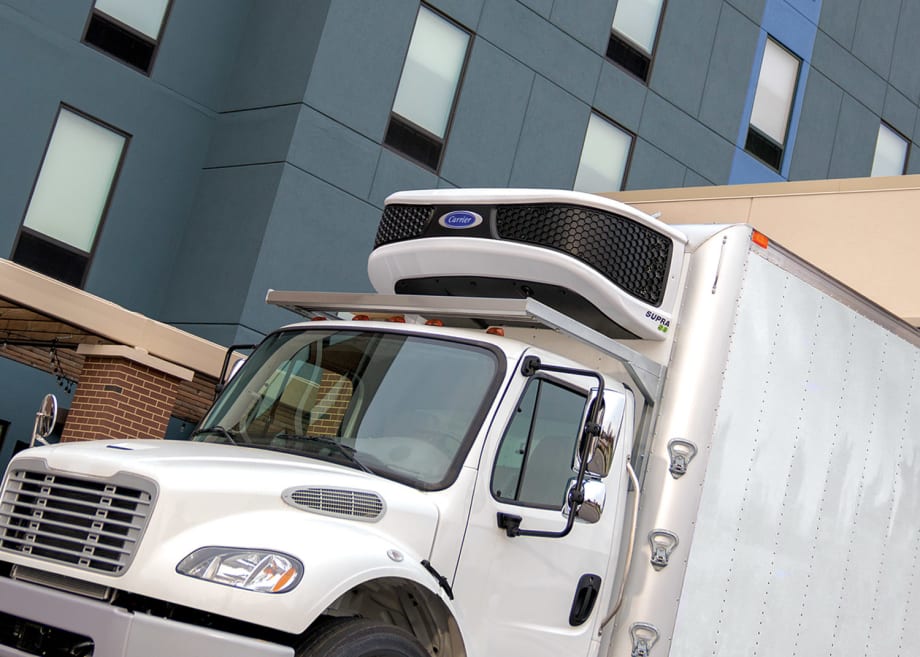
Carrier Transicold said its expanded line of Supra truck refrigeration units use 42% fewer unique components than earlier models.
Photo: Carrier Transicold
2 min to read
Carrier Transicold unveiled three new, next-generation Supra diesel-powered truck refrigeration units. The new models expand the existing Supra product line. The company said the new units give fleets more “powerful” cooling choices for small to large box trucks.
“These next-generation Supra units deliver improved capacities more efficiently, while using less fuel and refrigerant,” said Scott Parker, product manager, truck products, Carrier Transicold. “The new design reduces sound output by as much as three decibels relative to earlier models, making the new Supra series especially well-suited for nighttime urban deliveries. It also trims weight, resulting in units that weigh 5-9% less than comparable competitive units.”
Joining the Supra S6 model, which was introduced in 2019, are the S7, S8 and S9 models, providing solutions for trucks ranging from 10 to 28 feet in length. Carrier Transicold said the new units use about 50% less refrigerant, with all four models provide greater cooling capacity than prior models – up to 20% more, depending on model and operating conditions.
“Improved efficiency means fuel economy is significantly improved,” Parker said. “For example, a Supra S7 unit consumes about 37% less fuel than its predecessor. When parked and operating on electric standby power, models in the new Supra series deliver refrigeration capacities that approach or are equal to their capacities when engine-driven, surpassing some competitive products, which can lose up to a quarter of their capacity when running on electric standby.”
The platform’s new architecture streamlines the refrigeration system into a configuration using 42% fewer unique components than earlier models. To reduce service requirements, the series includes design enhancements, such as the use of maintenance-free fans and upgrades that enabled the oil-service interval to be extended by 33% to 2,000 hours, among other improvements.
A wrap-around honeycomb grille provides a more contemporary appearance and is removable for easy access to internal components. The Supra series now features Carrier Transicold’s APX control technology, providing intelligent performance optimization, automatic trip data recording and enhanced system diagnostics. Drivers can tap into the APX system’s functionality through the dash-mounted Cab Command control interface.
Carrier Transicold said the new Supra series seamlessly integrates with Carrier Transicold’s eSolutions telematics offering, enabling remote monitoring and control of the refrigeration system, GPS location data, geofencing and many more capabilities.
More Equipment

How Volvo Updated Its D13 for EPA 2027 [Watch]
Volvo’s updated D13 promises lower emissions without sacrificing performance or fuel economy. Take a closer look at what changed inside the engine in this HDT Spotlight video.
Read More →
Michelin Tire Improves Efficiency and Durability for Regional Fleets
The Michelin X Multi Energy D2 is a regional haul drive tire engineered to help fleets improve fuel efficiency, durability and traction in demanding stop-and-go operations.
Read More →
ZF Expands Commercial Vehicle Push in North America
ZF is expanding its North American commercial-vehicle presence with new transmission applications, electrification, trailer technology and autonomous-driving systems.
Read More →
Tesla Wants a Self-Driving Semi. Are Cameras Enough?
Could Tesla’s camera-only autonomous driving technology work on an 80,000-pound Semi? In this commentary, HDT's Deborah Lockridge takes a look at Tesla, Cybercab, and how autonomous trucks see the road.
Read More →
Kodiak: Driverless Long-Haul Truck Launch on Track for 2026
Kodiak AI says its driverless long-haul safety case is 93% complete and it remains on track to begin commercial operations by year-end 2026.
Read More →
What DOT’s Automated Vehicle Strategy Means for Trucking
The U.S. Department of Transportation issued a new automated-vehicle strategy that outlines plans for driverless-truck regulations, cross-state freight corridors, and federal safety standards.
Read More →
East Coast Port Launches $45M Electric Truck Push
The Port Authority of New York and New Jersey announced millions in incentives for zero-emission drayage trucks, yard tractors, and new charging hubs near the port.
Read More →
PlusAI Going Public to Fund Autonomous Truck Launch
A SPAC deal could provide PlusAI with up to $300 million as it works toward a 2027 commercial launch of factory-built autonomous trucks.
Read More →
NHTSA Moves to Rewrite Truck Fuel-Economy Rules
The National Highway Traffic Safety Administration says it lacks authority to regulate medium- and heavy-duty truck engines separately from complete vehicles, but the existing standards have not yet been eliminated.
Read More →
Detroit Opens Orders for EPA 2027 Engines
Detroit isn’t starting from scratch to meet EPA 2027 diesel emissions standards. Its Gen 6 DD13 and DD15 engines keep much of today’s platform while updating the fuel and aftertreatment systems.
Read More →