





New Trojan Driver Cargo Theft Scam Bypasses Carrier Vetting Systems
Fewer Cargo Thefts, Bigger Losses: Criminals Target Higher-Value Loads
CargoNet says organized theft rings are stealing fewer shipments but choosing more valuable freight, including metals and technology, resulting in record losses.
August 6, 2026
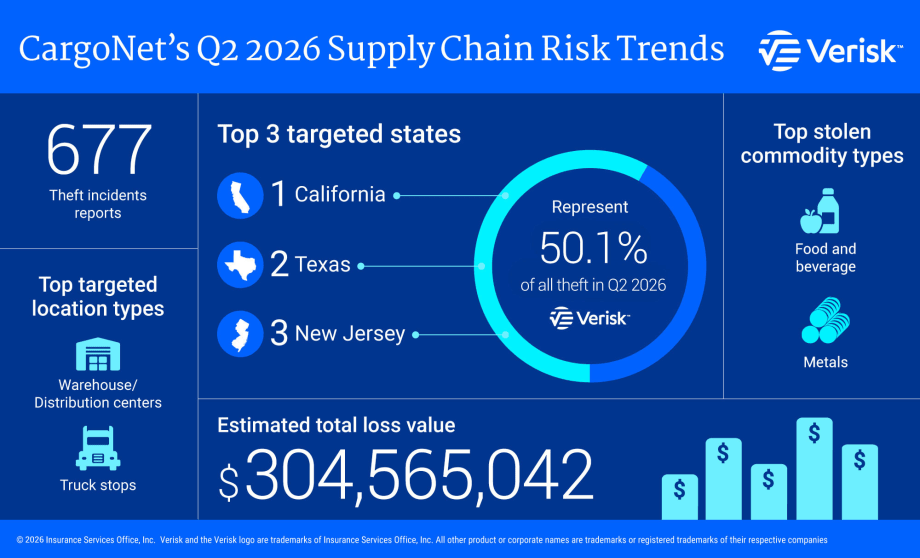
This analysis is powered by data from Verisk CargoNet, a theft-prevention and intelligence-recovery network relied on heavily by trucking security experts in the absence of federal data.
Credit:
Verisk CargoNet
3 min to read
Although the number of cargo theft incidents fell in the second quarter of 2026, organized thieves increasingly targeted higher-value freight, driving estimated losses to more than $304 million, according to new data from Verisk CargoNet.
CargoNet documented 677 cargo theft incidents in the U.S. and Canada during the quarter, down 26% from the same period in 2025 and 14% from the first quarter of 2026. However, estimated losses climbed to $304.6 million, more than double the $135.7 million reported a year earlier.
“The groups driving the largest losses are not necessarily trying to steal more freight; they are trying to identify the right shipment,” said Keith Lewis, vice president of operations at Verisk CargoNet.
“Their focus on metals and enterprise technology shows how closely organized cargo theft now follows value, demand and resale opportunity.”
Cargo Theft Tactics are Shifting
One notable improvement was a drop in the number of thefts using schemes in which malicious actors acquire existing motor carriers, book loads under the carrier's authority, then disappear with the freight.
This goes beyond just buying motor carrier numbers, Verisk CargoNet told Heavy Duty Trucking.
“Their intent is to acquire as much of the operation as possible, including the entire authority, existing contact information such as email addresses and phone numbers, credentials for industry websites, and even vehicles," a spokesperson said in response to an email.
"This helps them avoid the business being flagged as under new ownership, as brokers have been victimized by this scheme so frequently that they are often unwilling to work with companies they suspect have been recently sold.”
Organized thefts of unattended trailers and containers also decreased, particularly in California, Texas, South Florida and the Dallas-Fort Worth area.
However, more sophisticated fraud involving business email compromise and shipment misdirection remained steady.
The report suggests organized theft rings are relying less on stealing unattended equipment and more on infiltrating companies' communication systems to identify and redirect valuable shipments.
High-Value Freight Theft Drives Higher Losses
The increase in losses was driven by several multimillion-dollar thefts involving industrial metals and technology products.
Metal thefts rose from 54 incidents in the second quarter of 2025 to 80 this year. Copper remained the most frequently stolen metal, while thefts involving aluminum, nickel, tungsten, and other specialty metals also increased.
CargoNet also reported continued thefts of enterprise computer equipment, networking hardware, and cryptocurrency mining equipment. These shipments often move as ordinary dry freight despite being worth several million dollars.
Food and beverage thefts declined overall, although seafood thefts increased. CargoNet also reported fewer thefts involving auto parts, tires, dietary supplements and over-the-counter medications.
Cybersecurity's Role in Cargo Theft
Business email compromise continued to play a central role in many of the quarter's largest thefts, underscoring the ongoing challenge of cybersecurity in cargo theft.
According to CargoNet, criminals who gain access to a company's email or transportation management systems can monitor shipment information, impersonate employees or business partners, and redirect loads without raising immediate suspicion.
The company said organized theft groups increasingly use a single compromised account to gain access to multiple parts of the shipping process, allowing them to identify and target high-value freight more effectively.
Bottom Line for Fleets
While overall cargo theft activity declined during the quarter, CargoNet said fleets, brokers and shippers should not interpret that as lower risk. Instead, cargo thieves appear to be focusing on fewer, more valuable shipments and relying on cyber-enabled fraud rather than traditional theft techniques.
More Fleet Management

Why Private Fleets Are Taking More Freight
Private fleets are putting their own trucks on demanding customers and high-cost lanes as companies seek greater control over service, costs, and capacity.
Read More →
Sponsored•September 16, 2026
Color Match Smarter: Tools That Restore & Perform
For fleet managers and collision repair professionals keeping heavy-duty trucks on the road, getting the color right the first time isn't just about appearance — it's about efficiency, turnaround time, and bottom-line results. Discover how today's digital color tools are transforming the repair process from guesswork to precision.
Read More →
FMCSA Pauses Biennial-Update Enforcement Amid Motus Transition
Carriers whose updates were due on or after June 1 have more time, while FMCSA works to stabilize its new registration system and warns of phishing sites impersonating its new carrier registration system, Motus.
Read More →


Sponsored•September 14, 2026
2026 Blueprint for Countering Smarter Supply Chain Theft
Cargo theft is no longer just the cost of doing business. It's a multi-billion-dollar criminal enterprise exploiting vulnerabilities across your fleet, drivers, and supply chain.
Read More →
Sponsored•September 1, 2026
How Telematics Improves Visibility, Control, and Performance in Refrigerated Fleets
Explore how telematics help refrigerated fleets improve visibility, uptime, efficiency, compliance, and cargo protection across connected cold chain operations.
Read More →
What the U.S.-Canada Trade War Means for Trucking
Escalating U.S.-Canada tariffs could disrupt cross-border freight, reduce truck volumes, raise costs, and create new uncertainty for carriers on both sides of the border.
Read More →
What Are Trucking’s Top Concerns for 2026?
The American Transportation Research Institute wants to know what's worrying trucking fleet managers, drivers, and other stakeholders in its annual Industry Issues survey.
Read More →
American Trucking Associations Looks for a New Leader
ATA President and CEO Chris Spear abruptly left his job at the association on August 21, at a pivotal time for the trucking industry.
Read More →
Public Wi-Fi Cybersecurity Risks: How Truck Drivers and Fleets Can Protect Their Data
Public Wi-Fi can expose truck drivers and fleets to credential theft, malware, and other cyber threats. Here’s how to reduce the risk on the road.
Read More →
For Nicky Cupp, Fleet Innovation Starts With Frustration
HDT Truck Fleet Innovator Nicky Cupp turns everyday pain points at Fraley & Schilling into opportunities for better technology and smarter processes.
Read More →