





Related: Los Angeles Sues 3 Port Companies for Driver Misclassification
Bill Would Hold Retailers Liable for Trucking Company Labor Violations
California state Sen. Ricardo Lara introduced a bill that would hold major retailers liable when trucking companies break labor laws, sparked by allegations of misconduct by some port drayage companies.
April 13, 2018
3 min to read
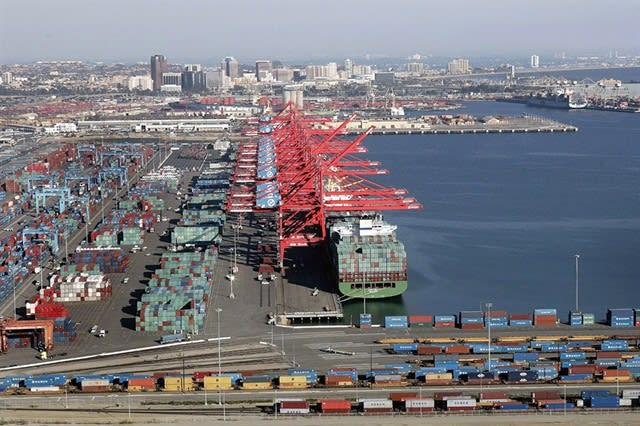
A new bill in California would punish retailers for working with port trucking companies that have been found in violation of labor and employement laws.Photo: Port of Long Beach
California state Sen. Ricardo Lara introduced a bill that would hold major retailers liable when trucking companies break labor laws, sparked by allegations of misconduct by some port drayage companies.
The bill is another attempt to solve the ongoing “driver misclassification” issue at the twin Southern California ports of Los Angeles and Long Beach. Cities such as Los Angeles have been exploring ways to pressure trucking companies into compliance in the past few months, and this bill is the latest effort by state legislators.
Drivers who are considered independent contractors, rather than employees, are not afforded the same wages, benefits, and security of full employees. Several class-action lawsuits have been filed against port trucking companies to compensate drivers for what they say is due them. The idea behind the bill is to force trucking companies into compliance by hitting them in the wallet.
“Port truckers are driving the global economy and delivering for the biggest brands, but they can barely afford to buy clothes for their families,” said Sen. Lara. “These used to be good jobs, and they can be good jobs again if retailers join us in improving labor conditions here in California and putting dignity back in the driver’s seat.”
The bill, SB 1402, would make retailers liable for hiring port trucking companies with unpaid final judgements related to labor and employment law violations. Violations can include failure to pay proper wages or benefits to drivers or imposing unlawful expenses on them. It would create a list of trucking companies that failed to pay final judgements. If retailers hire any of the companies on the list to move goods in and out of the ports, they will also be held liable for future state labor and employment law violations by these companies.
The bill is supported by the mayors representing California’s three largest ports, Long Beach Mayor Robert Garcia, Los Angeles Mayor Eric Garcetti, and Oakland Mayor Libby Schaaf.
“While we have some great trucking companies working at the ports, we need to fix our system to make sure all truckers are treated fairly,” said Garcia. “We need to raise standards, and wages, in the industry while increasing efficiency to make sure our ports continue to be engines of growth.”
There is tension between trucking industry members and labor advocates in the state on whether a problem actually exists. But proponents of change, such as Sen. Lara and the advocacy group Justice for Port Truck Drivers, say drivers are being improperly classified as independent contractors when the drivers have little freedom to choose when and where to work. In some instances, drivers are locked into truck leases that effectively prevent them from working for more than one company and are so expensive that the take-home pay is minimal.
In the past few years, trucking companies that serve these Southern California ports have been hit with multiple lawsuits for this issue, tallying millions of dollars in judgements. The California Labor Commission has generally ruled in favor of drivers in these lawsuits, and the issue has received more public attention through a controversial USA Today series that highlighted the plight of some drivers who were struggling to make a living wage while illegally working long hours.
The Harbor Trucking Association, which represents many of the trucking companies servicing the ports in Southern California, has called the reports misleading, saying USA Today sensationalized the industry by cherry-picking the worst cases. And the stance from the HTA has been that trucking companies have a right choose their business model and that drivers have the right to choose their employment status. Other groups, such as the California Trucking Association, believe that enforcing this proposed rule would only exacerbate the driver shortage.
More Drivers

Truck Drivers Need More Than Another Alert
Fleets have more visibility into truck health, safety events, and driver activity than ever. The next challenge is turning all that information into useful guidance for the person who has to decide what to do next.
Read More →
FMCSA Removes 110 Truck Driver Training Schools from Certified ELDT List
Federal regulators also are targeting more than 160 additional training providers and launching a nationwide audit of third-party CDL skills testers as part of a broader crackdown on trucking fraud.
Read More →
Hours of Service Pilot Programs: FMCSA Readies for 2027 Rollout
Two pilot programs could eventually reshape hours-of-service rules, giving truck drivers options to pause their 14-hour clock or use longer split sleeper rest periods.
Read More →
Medical Cards, English Proficiency Reshape Roadcheck Violations
Medical-card violations jumped to the top of the driver out-of-service list during CVSA’s 2026 International Roadcheck, while English-language proficiency violations appeared among the leading violations for the first time.
Read More →
Driver Trust Can Make or Break the Success of Fleet Safety Technology
New Teletrac Navman research suggests that onboarding, transparency about driver data, and positive feedback can play a significant role in how commercial drivers respond to safety and coaching technology.
Read More →
EEOC Sues KLLM Over Alleged Sex Discrimination in Driver Training
KLLM is facing a federal sex-discrimination lawsuit over policies the EEOC alleges put female truck driver trainees at a disadvantage.
Read More →
FMCSA Moves to Codify English Language Requirements for Commercial Drivers
By changing regulations on English-language proficiency requirements for commercial drivers, rather than relying on a guidance memo, the FMCSA said future administrations won't be able to walk back the Trump administration's stricter enforcement with just a memo.
Read More →
Drivers Put Western Star Trucks to the Test at Star Nation Experience
Watch to get an inside look at the Western Star trucks, technology, and community behind the Star Nation Experience 2026!
Read More →
Trump Administration Looks to Put More Veterans Behind the Wheel
The Freedom Haulers program pulls together existing and expanded programs at several federal agencies to recruit veterans to drive commercial heavy-duty trucks and cut the red tape for them to get a CDL, training, and employment.
Read More →
Putting Mack’s Command Steer to the Test
A test drive of Mack’s Command Steer active steering system evaluates how it can make truck driving easier and less tiring.
Read More →