




Related: Sanders Wants Crackdown on Companies That Don't Pay Drivers Living Wage
L.A. May Ban Port Companies that Misclassify Drivers
The Los Angeles City Council voted unanimously on Dec. 12 to investigate a ban of trucking and warehousing companies that break local, state, and federal employment laws from operating on city property.

Steven Martinez・Web Editor
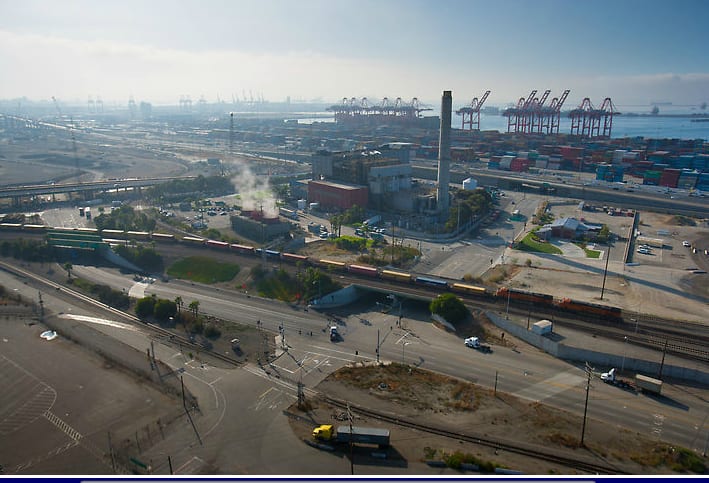
Photo: Port of Long Beach
2 min to read
Photo: Port of Long Beach
The Los Angeles City Council voted unanimously on Dec. 12 to investigate a ban of trucking and warehousing companies that break local, state, and federal employment laws from operating on city property.
The motion directs City Attorney Mike Feuer to submit a written report advising the City of Los Angeles on what options it has to mandate fair wages and working conditions for companies servicing the Port of Los Angeles. The report is also to determine if the city’s land use laws can be used to deny access to port property of companies that have repeatedly violated state and federal employment laws in a similar manner to how the city responds to nuisance activities.
The motion specifically targets companies that have been accused of denying drivers fair wages, rights, and benefits by not classifying them as full employees, which groups like Justice for Port Truck Drivers characterize as driver misclassification.
In the official summary of the City Council’s motion, it makes reference to the controversial USA Today report that described the plight of certain drivers working at the Ports of L.A. and Long Beach who took home little pay and worked long hours just to pay off their truck leases.
That story has been challenged by port trucking companies and stakeholders that claim that USA Today exaggerated the extent of the problem, cherrypicking stories for their extremeness and ignoring the majority of drivers who have made the independent contractor business model work.
The City Council’s summary stated that since 2010, at least 1,150 port truck drivers have filed claims in civil court or with the labor commission against these trucking companies. It further states that judges have sided with drivers 97% of the time.
Council Member and Committee Chair Joe Buscaino stated that it was "unacceptable for companies to profit on city property while exploiting human beings." The motion was sponsored by Council Members Buscaino, Bob Blumenfield, and Mike Bonin.
More Drivers

Truck Drivers Need More Than Another Alert
Fleets have more visibility into truck health, safety events, and driver activity than ever. The next challenge is turning all that information into useful guidance for the person who has to decide what to do next.
Read More →
FMCSA Removes 110 Truck Driver Training Schools from Certified ELDT List
Federal regulators also are targeting more than 160 additional training providers and launching a nationwide audit of third-party CDL skills testers as part of a broader crackdown on trucking fraud.
Read More →
Hours of Service Pilot Programs: FMCSA Readies for 2027 Rollout
Two pilot programs could eventually reshape hours-of-service rules, giving truck drivers options to pause their 14-hour clock or use longer split sleeper rest periods.
Read More →
Medical Cards, English Proficiency Reshape Roadcheck Violations
Medical-card violations jumped to the top of the driver out-of-service list during CVSA’s 2026 International Roadcheck, while English-language proficiency violations appeared among the leading violations for the first time.
Read More →
Driver Trust Can Make or Break the Success of Fleet Safety Technology
New Teletrac Navman research suggests that onboarding, transparency about driver data, and positive feedback can play a significant role in how commercial drivers respond to safety and coaching technology.
Read More →
EEOC Sues KLLM Over Alleged Sex Discrimination in Driver Training
KLLM is facing a federal sex-discrimination lawsuit over policies the EEOC alleges put female truck driver trainees at a disadvantage.
Read More →
FMCSA Moves to Codify English Language Requirements for Commercial Drivers
By changing regulations on English-language proficiency requirements for commercial drivers, rather than relying on a guidance memo, the FMCSA said future administrations won't be able to walk back the Trump administration's stricter enforcement with just a memo.
Read More →
Drivers Put Western Star Trucks to the Test at Star Nation Experience
Watch to get an inside look at the Western Star trucks, technology, and community behind the Star Nation Experience 2026!
Read More →
Trump Administration Looks to Put More Veterans Behind the Wheel
The Freedom Haulers program pulls together existing and expanded programs at several federal agencies to recruit veterans to drive commercial heavy-duty trucks and cut the red tape for them to get a CDL, training, and employment.
Read More →
Putting Mack’s Command Steer to the Test
A test drive of Mack’s Command Steer active steering system evaluates how it can make truck driving easier and less tiring.
Read More →