




Autonomous Technologies Could Mean 'Transformational' Change in Trucking
ORLANDO - Automated vehicle technologies, vehicle electrification, and the rise of transportation as a service (think ride-share services like Uber and Lyft) are creating a “transformational change” in the transportation industry. But what does that mean for trucking?

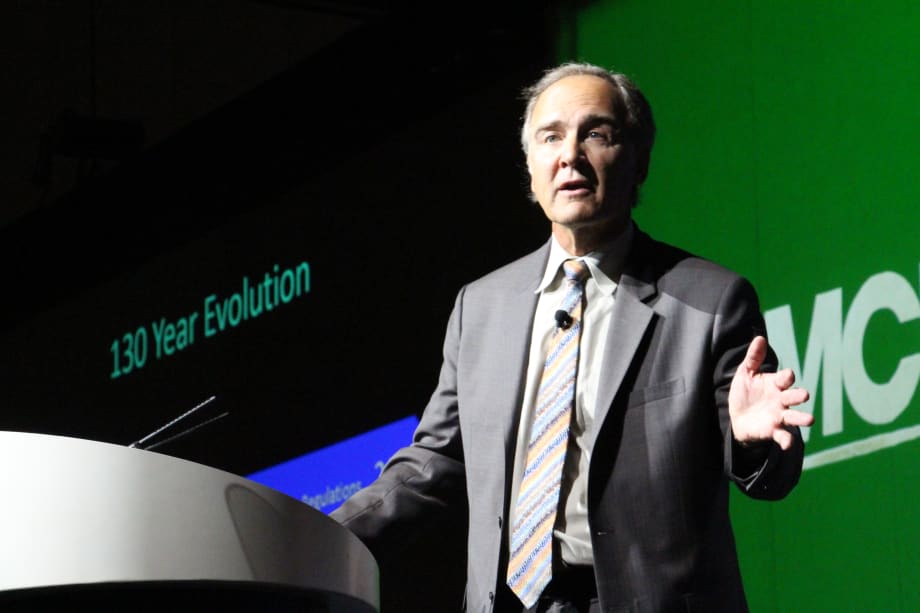
Larry Burns tells ATA attendees his vision of how autonomous vehicles could affect trucking. Photo: Evan Lockridge
Larry Burns tells ATA attendees his vision of how autonomous vehicles could affect trucking. Photo: Evan Lockridge
ORLANDO – Automated vehicle technologies, vehicle electrification, and the rise of transportation as a service (think ride-share services like Uber and Lyft) are creating a “transformational change” in the transportation industry. But what does that mean for trucking?
Self-proclaimed technologist Larry Burns looked at some of the possibilities in a presentation at the American Trucking Associations’ Management Conference and Exhibition Sunday.
During his 1998-2009 tenure heading up R&D at General Motors, Burns was a proponent for the safety benefits of self-driving vehicles. Today he advises companies such as Google and Peloton, governments and research institutions on transportation, energy, and advanced technology.
Since motorized vehicles were first invented in the late 1800s, he noted, although we’ve seen an evolution of the technology, essentially today’s cars and trucks have the same DNA as their predecessors. They’re mechanically driven with an internal combustion engine using oil-based fuel and operate with a human at the controls.
“As you combine autonomous vehicles, electric vehicles, and transportation as a service, you get safer, more convenient, more productive, more personalized, and more affordable transportation services,” he said.
It’s a new age of “automobility,” he said. But what does that mean for trucking?
Unlike the passenger car business, which has been a gradual evolution, Burns observed, trucking’s growth has been triggered by events, such as regulations, the development of the interstate highway system, containerized shipping, the energy crisis, etc. Burns believes the next big event to significantly transform trucking will be autonomous trucks, and he pointed to companies such as Mercedes, Tesla, Peloton and Waymo who apparently do also.
“I can’t predict your future,” he said, but aimed to offer a look at what’s possible, noting, “I’m a technologist.”
Safer trucking. “90% of crashes are caused by driver error. Advanced driver assistance systems are offering near-term benefits,” he said. “Longer term, autonomous driving systems and connected cars could potentially eliminate 90% of crashes.
Lower cost trucking. He showcased ATRI’s latest cost of trucking report and said, “almost every aspect could be positively affected by autonomous trucking.” Although there might end up being higher costs for permits or taxes, he said, “overall there’s more than a 50% cost reduction opportunity.” Autonomous systems, he predicted, will get down to under $10,000 and will last 300,000 miles, “so you’re seeing much lower cost per mile.” He suggested the cost and weight of trucks could even drop if you no longer needed to include a driver cab, HVAC system and the like.
Faster trucking. Because human drivers are restricted to 11 hours of driving time but autonomous trucks could operate twice that long in a day. “Beyond that, think about taking a container off a ship at a port and lowering it onto one of these autonomous, zero-emission platforms, and that container doesn’t get touched again until it gets to a Target store where it’s emptied – and that has a profound impact on the throughput of ports, hubs, terminals and roads.”
Smaller and more frequent trucking shipments. “Autonomous driving lowers shipment scale economies, and e-commerce demands more frequent deliveries,” Burns said. “And what about that last mile? Starship Technologies, who created Skype, developed a little robot to deliver a couple of bags of groceries, and Domino’s is experimenting with several ideas.”
So how might we get to this point? Burns pointed out that not all stretches of highway are the same. They have different geometry, topography, weather, speed limits, traffic, regulations, trucking volume, etc. “When you look at that variation, you begin to think about, where does the risk occur? It gives us a chance to start at the places that are low risk. There are stretches with a fair amount of shipping that have nice weather, that are flat and straight, and give us a chance to learn.”
How can trucking companies prepare for this possible future? “You as leaders need to deeply understand what is possible,” he said. “Don’t learn about it by sitting at a conference like this; learn about it by having a seat at the table. What is artificial intelligence, what is machine learning, what do they mean by big data and analytics?”
These new business models are extremely disruptive, Burns noted – but trucking is no stranger to disruptive events. Think about things like deregulation in 1980 and the rise in just-in-time manufacturing. “The trucking industry has stepped up admirably in all these cases. But there are new threats as well.”
So once you understand what is possible, he said, “next you need to position for the future. This is about thinking big, about what really is possible. You don’t have to bet the farm at this point in time. You have to start small. And then learn fast so you can scale smart. Focus on what must be true to reach a ‘tipping point.’
And finally, he said, “you need to stay in the game. What you want to have is operational excellence as we work through this transformation, and be resourceful.”
While autonomous technology isn’t ready for prime time, he admitted, he believes the tipping point is closer to a three year than a 10 or 15 year time frame. That said, autonomous technology developers have “a lot to learn” and “a lot to prove,” he admitted. Just because you can demo autonomous trucks on a clear day “doesn’t mean you can do it with 80,000 pounds in a snowstorm uphill on a curve. There are important issues to resolve, which I’m confident we will.”
More Fleet Management

Color Match Smarter: Tools That Restore & Perform
For fleet managers and collision repair professionals keeping heavy-duty trucks on the road, getting the color right the first time isn't just about appearance — it's about efficiency, turnaround time, and bottom-line results. Discover how today's digital color tools are transforming the repair process from guesswork to precision.
Read More →
FMCSA Pauses Biennial-Update Enforcement Amid Motus Transition
Carriers whose updates were due on or after June 1 have more time, while FMCSA works to stabilize its new registration system and warns of phishing sites impersonating its new carrier registration system, Motus.
Read More →
2026 Blueprint for Countering Smarter Supply Chain Theft
Cargo theft is no longer just the cost of doing business. It's a multi-billion-dollar criminal enterprise exploiting vulnerabilities across your fleet, drivers, and supply chain.
Read More →


How Telematics Improves Visibility, Control, and Performance in Refrigerated Fleets
Explore how telematics help refrigerated fleets improve visibility, uptime, efficiency, compliance, and cargo protection across connected cold chain operations.
Read More →
What the U.S.-Canada Trade War Means for Trucking
Escalating U.S.-Canada tariffs could disrupt cross-border freight, reduce truck volumes, raise costs, and create new uncertainty for carriers on both sides of the border.
Read More →
What Are Trucking’s Top Concerns for 2026?
The American Transportation Research Institute wants to know what's worrying trucking fleet managers, drivers, and other stakeholders in its annual Industry Issues survey.
Read More →
American Trucking Associations Looks for a New Leader
ATA President and CEO Chris Spear abruptly left his job at the association on August 21, at a pivotal time for the trucking industry.
Read More →
Public Wi-Fi Cybersecurity Risks: How Truck Drivers and Fleets Can Protect Their Data
Public Wi-Fi can expose truck drivers and fleets to credential theft, malware, and other cyber threats. Here’s how to reduce the risk on the road.
Read More →
For Nicky Cupp, Fleet Innovation Starts With Frustration
HDT Truck Fleet Innovator Nicky Cupp turns everyday pain points at Fraley & Schilling into opportunities for better technology and smarter processes.
Read More →
Adam Buttgenbach’s Approach to Electric Trucks: Start With Where They Fit
HDT Truck Fleet Innovator Adam Buttgenbach helped PepsiCo build one of North America’s largest EV fleets by focusing on where electric trucks make operational sense.
Read More →