




6 Areas of Risk and Opportunity for 3PLs
Annual Third-Party Logistics Study identifies six areas of risk and opportunity for 3PLs.
by Ronnie Wendt, Contributing Editor
October 6, 2022
Interest in environmental, social and governance (ESG) efforts continues to increase.
Photo: Penske
7 min to read
Disruption is the name of today’s logistics game, and it’s affecting every entity — from shippers to 3PLs, from freight forwarders to domestic transportation — finds the 27th annual Third-Party Logistics Study, “Back to Basics.”
The study from the Council of Supply Chain Management Professionals, created in partnership with NTT Data, supply chain professor and researcher C. John Langley, and Penske Logistics, suggests a return to fundamental principles will be key to supply chains' ability to innovate, change and transform.
The core principals include:
Customer focus
Supply chain relationships
Data and analytics
Innovation and transformation
Survivability and sustainability
Talent
End-to-end supply chain
Shippers and 3PLs, when asked to rank these principles, ordered them differently. Despite different priorities, five of the seven principals rose to the top. Data and analytics, customer focus, innovation and transformation, talent, and supply chain relationships all received a “very important” or “extremely important” ranking.
However, two principles — sustainability and end-to-end supply chain — received scores below three, suggesting these efforts remain in the planning stages or low maturity.
But “with complexity within the supply chain expected to continue, shippers and 3PLs can leverage back-to-basic principles as they build their relationships and focus on service,” concluded the executive summary of the report.
1. Logistics' Talent Crisis
The talent crisis remains a high-level concern for all surveyed. In fact, 56% of 3PLs and 78% of shippers report labor shortages impact their supply chain operations.
They also report seeing little relief in sight, with 29% of 3PLs and 27% of shippers saying they view the talent crisis as a long-term issue. They identify hourly workers, such as packers and shippers, and licensed hourly workers, including truck drivers and equipment operators, as the hardest positions to fill and the most difficult workers to keep.
The report notes the trucking industry has been hard hit by the talent crisis. Respondents agreed the truck driver shortage is a key concern, with the shortage most acute in the longer-haul, for-hire truckload market. The trucking industry, they say, is also short maintenance technicians, with the U.S. Bureau of Labor Statistics estimating a need for more than 28,000 diesel service technicians and mechanics over the next decade.
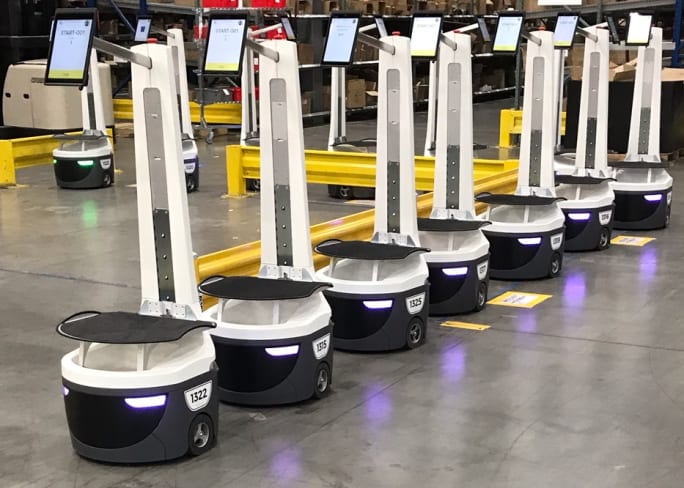
Warehouse automation was one of the technologies that increased in importance for respondents.
Photo: UPS
Both shippers and 3PLs say they are taking steps toward labor alternatives to fill the void. Eighty-three percent of 3PLs and 70% of shippers report actively implementing or researching and reviewing innovative technologies and automation to help offset the talent shortage.
The study revealed respondents believe the right intelligence can optimize operations, improve real-time visibility, and enable rapid decision-making. The expectations for innovative technology have increased across supply chains. In fact, 65% of shippers reporter higher expectations, as do 78% of 3PLs.
Respondents also reported a bright side to workforce challenges. New opportunities are arising, as 73% of 3PLs and 46% of shippers say companies look to 3PL partners to offset labor shortages.
2. Outsourcing on the Rise
Outsourcing and shipping consolidation drive changes in supply chains. Just over half of shippers — 55% — report increasing their use of outsourced logistics services. That figure is on par with the previous survey.
However, when asked whether they were consolidating the number of 3PLs used, 71% of shippers agreed. That is strikingly different from the 57% reported in last year’s study, and the report authors say this may indicate an effort by shippers to return back-to-basics and focus their 3PL operations on a smaller number of providers.
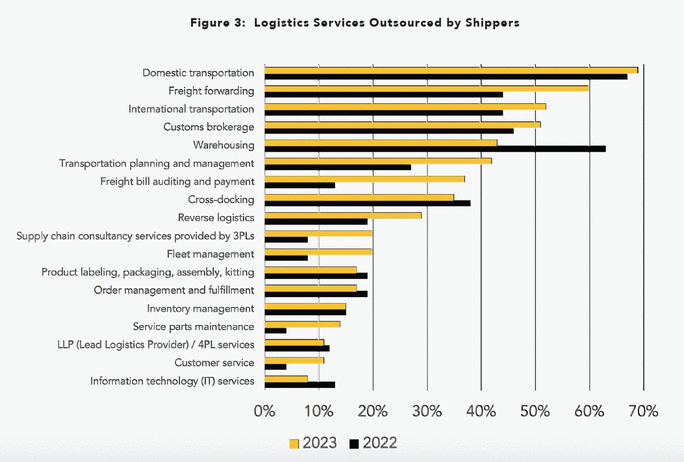
Outsourcing domestic transportation increased slightly to 68%.
Source: Third-Party Logistics Study, “Back to Basics.”
The survey shows more respondents are outsourcing operational, day-to-day activities, functions, and processes in their supply chains. A notable trend is a focus on freight forwarding, with its use moving to 60% from 44% the year prior. “This may be because of the difficulties of shipping products in a constrained supply chain,” the study said. “Shippers may look for additional expertise and connected freight forwarders who can make a material difference in getting their goods flowing.”
Outsourcing domestic transportation increased slightly to 68%, while outsourcing international transportation shifted from 44% to 52%. Fleet management also increased, moving from under 10% to 20% this year.
Companies and shippers share that using 3PLs has improved customer service and that 3PLs have stepped up with new and innovative ways to improve logistics effectiveness and supply chain costs. But they also reported reducing or consolidating the number of 3PLs with which they were involved.
3. 3PLs Need to Up Their IT Game
The study always includes an update on the information technology gap. This year, just 54% of shippers indicated they are satisfied with their 3PL’s IT capabilities. The results for 2023 show a continuing need to understand specific types of 3PL-provided or managed information technologies that create value for shipper customers.
Using execution and transaction-based technologies also increased over the previous year. These include:
transportation management planning (62%)
transportation management scheduling (57%)
warehouse/distribution management (48%).
Advanced analytics and data-mining tools, transportation sourcing, warehouse automation, global trade management, and network modeling and optimization technologies also increased in importance for respondents. This may reflect “increased interest on behalf of shippers to seek advice from 3PLs on potential network improvements for their supply chains,” the report suggests.
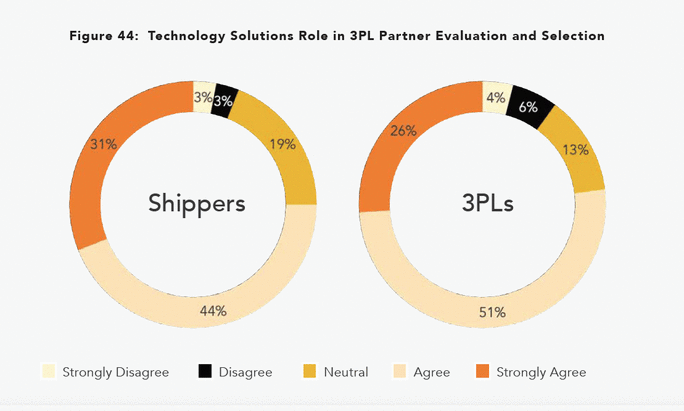
The expectations for innovative technology have increased across supply chains.
Source: Third-Party Logistics Study, “Back to Basics.”
4. Remember Reverse Logistics
Reverse logistics is defined as moving goods from their final destination back to the supplier. It is most often used for defective or surplus products, or returns from customers, and it is an often neglected part of the supply chain equation.
However, the report found that reverse logistics is becoming a more integral part of the B2B and B2C buyer experience and an area for shippers and 3PLs to focus on.
Seventy-five percent of shippers rated the returns experience as “extremely important” to consumer loyalty, while 65% of consumer-focused shippers and 60% of business-focused shippers noted return expectations are growing. In fact, 61% of consumer-focused shippers expect to see increased volume of returns over the next three years while just 43% of business-exclusive shippers expect increased volumes.
And 87% of 3PLs expect shippers to outsource a greater portion of their reverse logistics to them.
But 3PLs may miss out on this opportunity if not careful. Among 3PLs currently providing reverse logistics services, 59% stated reverse logistics services are only “slightly to moderately important” to their future offerings, and roughly 15% stated they were “not important at all,” according to the report.
5. Cold Chain Capabilities
The research finds demand for cold chain services continues to increase, presenting another opportunity for 3PLs. Eighty-two percent of shippers and 84% of 3PLs believe demand for cold chain capacity will increase in the next three years.
In response to increased demand, around 60% of shippers and 3PLs report expanding their capabilities in the past year. Also, 67% of shippers and 72% of 3PLs say they will continue to expand their cold chain capacity and capabilities over the next three years. And both shippers (67%) and 3PLs (75%) expect more outsourcing of cold chain needs over the next three years.
Technology advances will be needed to support increased cold chain expectations in the future, the report noted. Adoption of technology will provide agility and resilience to cold chains. Important technology advances cited in the research include IoT and sensors for tracking and monitoring; smart platforms, such as camera-assisted picking; reusable packaging to reduce waste; and blockchain for risk and compliance.
“Pre-pandemic strategies are no longer sufficient for today’s cold chains. Increased consumer demand, rising competition and advances in technology all articulate the need for agile cold chains to meet the needs of tomorrow,” the report concluded.
6. Emerging ESG
Interest in environmental, social and governance (ESG) efforts continues to increase. However, though identified as “critically important” in supply chain, only 22% of shippers and 17% of 3PLs rate themselves as leaders in ESG. In fact, 45% of shippers and 41% of 3PLs put themselves as average in meeting ESG targets.
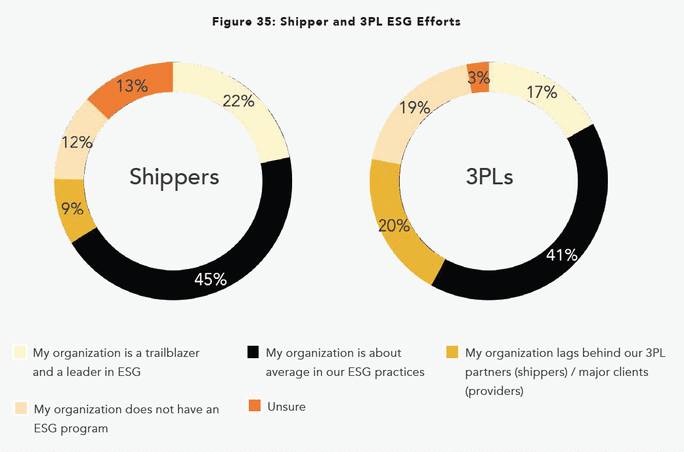
Only 22% of shippers and 17% of 3PLs rate themselves as leaders in ESG.
Source: Third-Party Logistics Study, “Back to Basics.”
But as ESG initiatives take on greater importance to meet consumer, investor and regulatory demands, shippers and 3PLs will need to up their game. “Companies will increasingly look to supply chain partners to provide solutions,” the report said.
This will include moving toward clean transportation via emission-reduction commitments and a shift toward electric vehicles. A report from the North American Council for Freight Efficiency finds 100% of medium-duty trucks are targets for electrification. But challenges remain for the heavy-duty and long-haul segment, and advances in technology and range will be needed before electric vehicles become widespread.
More Fleet Management

Why Private Fleets Are Taking More Freight
Private fleets are putting their own trucks on demanding customers and high-cost lanes as companies seek greater control over service, costs, and capacity.
Read More →
Sponsored•September 16, 2026
Color Match Smarter: Tools That Restore & Perform
For fleet managers and collision repair professionals keeping heavy-duty trucks on the road, getting the color right the first time isn't just about appearance — it's about efficiency, turnaround time, and bottom-line results. Discover how today's digital color tools are transforming the repair process from guesswork to precision.
Read More →
FMCSA Pauses Biennial-Update Enforcement Amid Motus Transition
Carriers whose updates were due on or after June 1 have more time, while FMCSA works to stabilize its new registration system and warns of phishing sites impersonating its new carrier registration system, Motus.
Read More →


Sponsored•September 14, 2026
2026 Blueprint for Countering Smarter Supply Chain Theft
Cargo theft is no longer just the cost of doing business. It's a multi-billion-dollar criminal enterprise exploiting vulnerabilities across your fleet, drivers, and supply chain.
Read More →
Sponsored•September 1, 2026
How Telematics Improves Visibility, Control, and Performance in Refrigerated Fleets
Explore how telematics help refrigerated fleets improve visibility, uptime, efficiency, compliance, and cargo protection across connected cold chain operations.
Read More →
What the U.S.-Canada Trade War Means for Trucking
Escalating U.S.-Canada tariffs could disrupt cross-border freight, reduce truck volumes, raise costs, and create new uncertainty for carriers on both sides of the border.
Read More →
What Are Trucking’s Top Concerns for 2026?
The American Transportation Research Institute wants to know what's worrying trucking fleet managers, drivers, and other stakeholders in its annual Industry Issues survey.
Read More →
American Trucking Associations Looks for a New Leader
ATA President and CEO Chris Spear abruptly left his job at the association on August 21, at a pivotal time for the trucking industry.
Read More →
Public Wi-Fi Cybersecurity Risks: How Truck Drivers and Fleets Can Protect Their Data
Public Wi-Fi can expose truck drivers and fleets to credential theft, malware, and other cyber threats. Here’s how to reduce the risk on the road.
Read More →
For Nicky Cupp, Fleet Innovation Starts With Frustration
HDT Truck Fleet Innovator Nicky Cupp turns everyday pain points at Fraley & Schilling into opportunities for better technology and smarter processes.
Read More →