



“A good decision is based on knowledge and not on numbers,” the Greek philosopher Plato once said.
 MENU
MENU SEARCH
Let’s examine the top three CSA violations for both vehicles and drivers across the industry and discuss practices that can help bring the numbers down.
“A good decision is based on knowledge and not on numbers,” the Greek philosopher Plato once said.
Too bad he wasn’t around when the government was coming up with CSA.
Now four years old, the safety enforcement program known as Compliance, Safety, Accountability relies on almost nothing but numbers. And as numerous studies keep telling us — and as many trucking professionals already know — those numbers are not always reliable.
At the top of the list are your CSA scores, perhaps flawed but visible to the world and used to decide if the DOT needs to pay you a visit, or at least send you a letter.
Pull the curtain on those scores and you can find a mass of interesting and (arguably) more reliable data: the raw numbers coming in from enforcement personnel on the front lines.
Besides giving insight into your CSA scores, the enforcement data can reveal important clues about your drivers and overall safety management. It can tell you where to focus your compliance efforts.
Let’s examine the top three CSA violations for both vehicles and drivers across the industry and discuss practices that can help bring the numbers down.
The truck
Violation: Lighting
Ironically, broken lights are among the most “visible” of all violations. Maybe that’s why a whopping 28% of all roadside vehicle violations last year, out of 2.4 million inspections, dealt with lights or reflective materials.
A broken or missing light, reflector, or reflective tape is like an “Inspect Me!” sign and can result in a loss of six severity points in CSA for each violation (Three points for reflective tape).
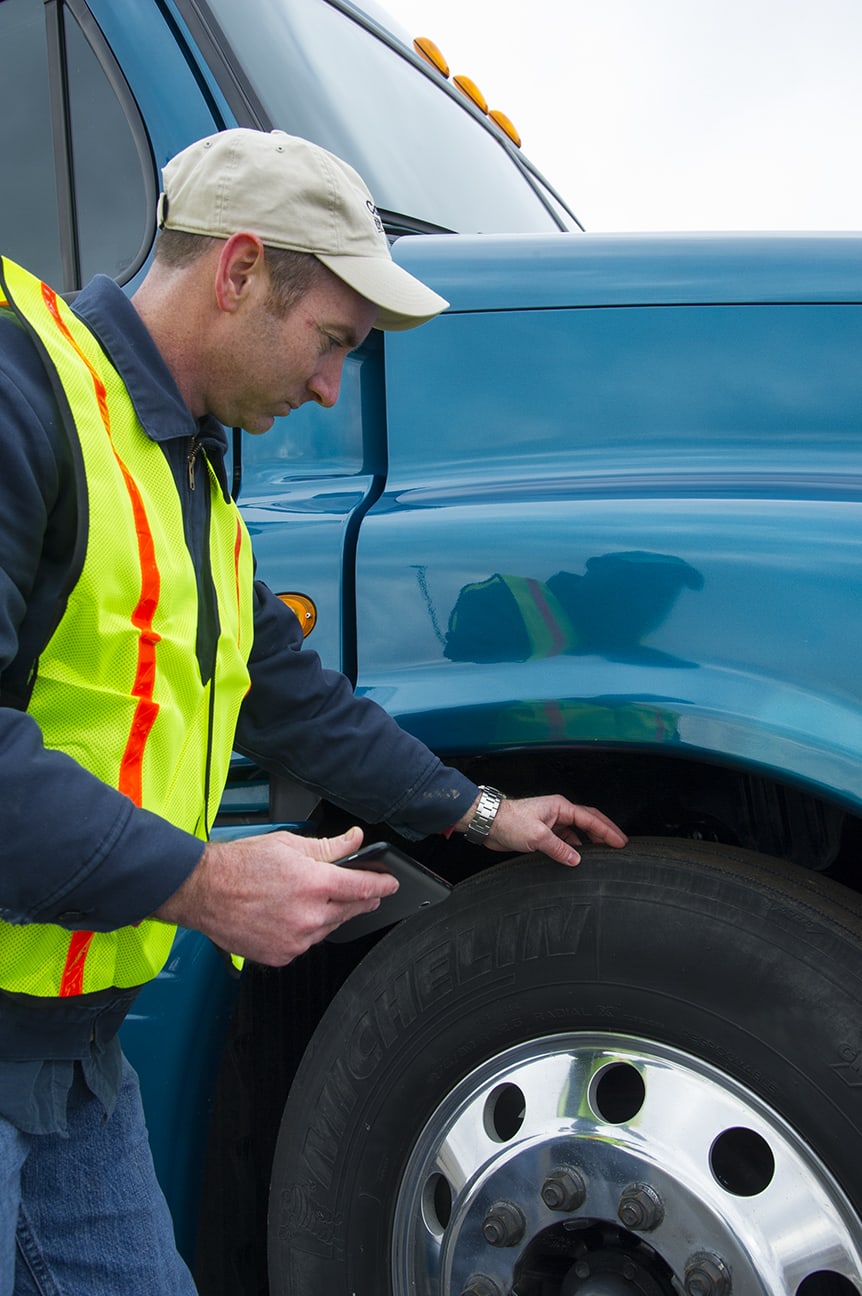
Prevention: Drivers and maintenance personnel need to be aware that every light and reflector listed in Sections 393.11 and 571.108, even the license-plate lamp, needs to be operational at all times. The only way to verify compliance is to inspect the vehicle on a regular basis.
By conducting adequate pretrip and post-trip inspections and reporting what they find, drivers should be able to spot violations — and get them fixed — before an inspector does. Carrying spare fuses is required, and spare bulbs can help too. Non-required lights do not have to be working, but any broken lamp can draw attention.
Violation: Brakes
One-fourth of all vehicle violations are for brakes, with over 1 million brake violations last year, each with four CSA points.

As with lights, brakes need to be inspected before and after every trip, but drivers need to be fully trained and qualified before doing any brake adjustment.
Prevention: Training is key. Make sure drivers know what to look for and when to get assistance with their brakes. The only way to find a brake adjustment problem is to carefully measure the stroke, and adjusting a brake that has an automatic adjuster won’t fix the problem (and may make it worse).
Violation: Tires
As with lights, bad tires are a sure-fire way to be stopped and inspected. The biggest culprit: tread depth. Overall, 11% of vehicle violations are for tires (half for tread depth), with a CSA severity of eight points.
Steer tires must have 4/32 inch of tread depth; other tires must have 2/32 inch.
Prevention: A comprehensive maintenance program that includes regular tire inspections is a must, including pretrip and post-trip inspections. Drivers need to know how and when to check inflation (with a gauge!) and when it’s time for a replacement.

Drivers
Violation: Logs
So-called “form & manner” and “log not current” violations make up one-fourth of all driver violations at the roadside, far and above any other violation. A form/manner violation carries just one CSA point, but a log that isn’t current is worth five.
These violations are often frustratingly obvious and easily correctable.
Drivers need to fill out all required information on their logs and keep them current to the last time their duty-status changed.
Prevention: First, make sure your drivers know what’s required and what’s not required on their logs (see Sec. 395.8), and when it has to be filled in. When a driver is stopped for an inspection, the log must be current up to the time at which the driver got behind the wheel.
Make sure your policies reinforce these requirements. Review your CSA data to find the worst offenders and re-educate them on the rules.
Finally, investigate two things that can help eliminate many of these violations: pre-printing of common log entries (address, etc.), and electronic logs (which will be mandatory soon enough).

Violation: Medical issues
One in eight driver violations is related to medical issues, often a failure to have a valid medical certificate. These carry a low CSA point value of one or two, although driving while physically ill is a 10-point violation.
Prevention: Track the expiration of your drivers’ medical cards and make sure they get updated, placed in drivers’ files, carried in the vehicle and turned in to the state licensing agency. Make sure drivers know exactly what’s required of them, and have consequences in place for those who fail to comply.
Some of these violations may go away once we have the National Registry of Medical Examiners, and once interstate CDL drivers no longer have to carry their medical cards (in Feb. 2015).
Violation: English ability
This violation has been surging in recent years, currently at 9% of all driver violations and carrying four CSA points.
Compliance is complicated because there is no yes/no standard. Key for a roadside inspection is being able to fill out paperwork, speak with officers and answer their questions, all in English.
Prevention: Your hiring practices should filter out drivers who simply cannot meet the standard. Use training and practice to help drivers know how to respond to typical questions about their logs, their trips and cargo, their insurance, registration, license and their vehicle.
Even if you don’t pull the curtain on your CSA scores, a little training on these common violations may go a long way in improving them.
Daren Hansen is a Senior Editor – Transportation Safety for J.J. Keller & Associates. Contact him at transporteditors@jjkeller.com.

Heavy Duty Trucking is searching for forward-looking leaders at trucking fleets as nominations for HDT’s Truck Fleet Innovators 2026. Deadline is May 15.
Read More →
Detroit’s next-generation ABA6 safety system adds cross-traffic detection and enhanced side guard assist with left-turn protection, targeting high-risk urban scenarios.
Read More →
The American Transportation Research Institute will examine driver coaching, regulatory impacts — including the "Beyond Compliance" concept —and weather disruptions that shape trucking operations.
Read More →
New requirements add firm deadlines and independent review steps, addressing long-standing complaints about inconsistent rulings and slow response times.
Read More →
Five states still aren't ready to accept commercial driver medical exam information directly from the medical examiner's registry.
Read More →
Heavy Duty Trucking's Top 20 Products awards recognize the best new products and technologies. Check out the award presentations at the 2026 Technology & Maintenance Council annual meeting.
Read More →
The Detroit® Gen 6 engine platform proves that real progress doesn’t require a complete redesign. Built on 20 years of trusted technology, these engines are designed for efficiency, stronger performance, and greater reliability than before. And they do it all while complying with 2027 EPA standards on every mile.
Read More →
Aperia Technologies introduced a new automatic tire inflation system for steer axles and a partnership with Fontaine Fifth Wheel to integrate coupling status into its Halo Connect platform.
Read More →
Fleetworthy and HAAS Alert expanded their partnership to deliver real-time digital alerts that warn motorists when commercial trucks are stopped roadside and notify truck drivers when approaching emergency responders.
Read More →
More than 100,000 new trucking companies enter the industry each year, but regulators manage to audit only a fraction of them. That churn creates opportunities for inexperienced startups — and for “chameleon carriers” that shut down after safety violations and reappear under new identities. Read more from Deborah Lockridge in this commentary.
Read More →