





Related: FMCSA Proposes Changes to CSA
Crashing Against Common Sense
ATRI's latest CSA Research Piece found that excluding “non-preventable crashes” from data decreased the Crash Indicator BASIC by nearly 15% among over a dozen carriers studied.
November 10, 2015

3 min to read

No one who owns a car would expect their insurance rate to go up because of damage inflicted by a deer jumping in front of it or by someone slamming into it when running a light or by someone causing a few other types of accidents that can only be classified as non-preventable.
Perhaps that common sense expectation is what led the American Transportation Research Institute to analyze how the Federal Motor Carrier Safety Administration calculates motor-carrier safety performance via CSA Crash Indicator BASIC measures.
ATRI said on Nov. 10 that its latest CSA research piece, Assessing the Impact of Non-Preventable Crashes on CSA Scores, reveals that excluding “non-preventable crashes” from that data decreased the Crash Indicator BASIC by nearly 15 percent among over a dozen carriers studied.
Specifically, ATRI analyzed carrier crash records, mapped to FMCSA's Motor Carrier Management Information System (MCMIS) database, to identify “a small and non-controversial subset of non-preventable crashes” with these five primary causes:
Animal collision
Other vehicle hits legally parked truck
Other vehicle runs a stop light/sign and hits a truck
Driver of other vehicle was DUI
Truck-assisted suicide
Those crashes were removed to allow recalculating the Crash Indicator BASIC measure, which yielded the drop ATRI recorded in the Crash Indicator BASIC for the carrier studied. ATRI noted that it estimates the non-preventable crash costs for the 15 carriers in the study exceed $68 million.
"The trucking industry has identified a number of flaws in FMCSA's calculation of carrier safety performance through the CSA BASICs and perhaps none is more egregious than the inclusion of non-preventable crashes in the Crash Indicator BASIC,” said Scott Mugno, a member of ATRI's Research Advisory Committee and vice president of Safety and Maintenance for FedEx Ground.
“ATRI's latest analysis, using a very conservative definition of non-preventable crashes, demonstrates just how skewed FMCSA's BASIC calculations can be," he added.
The study’s authors, ATRI Research Analyst Caroline Boris and ATRI Vice President, Research Dan Murray, contend that the results “demonstrate that even a conservative approach to defining and assessing preventability can impact a carrier’s Crash BASIC measure significantly.”
They also stated that the analysis found that:
Non-preventable crashes comprise the majority of the sample. “Therefore, a broader definition of preventability than the five primary causes used in this report, such as the one utilized by the FMCSA, would likely result in dramatic changes to Crash BASIC measures.
Small differences in Crash BASIC measures result in significantly different percentile rankings, with our sample having a maximum range of 11 percentage points for the same FMCSA-provided score.
The composition of preventable and non-preventable crashes varies across carriers. A Crash BASIC that only considers preventable crashes would affect carriers differently.
Small changes in Crash BASIC measures result in significant changes to Crash BASIC percentile rankings, given the range of percentile rankings resulting from a single FMCSA-reported score and the varied composition of preventable and non-preventable crashes across carriers.
Assigning preventability could also rectify issues beyond the Crash BASIC, such as carrier costs, insurance premiums and driver safety records.
The authors added that ATRI, to better quantify the impact of non-preventable crashes on the trucking industry, will continue its work with trucking and insurance industry stakeholders “to identify and mine additional crash and financial data sources. This Phase 2 activity will attempt to develop a cost/benefit analysis on an expanded population of non-preventable crash types.”
A copy of the report is available from ATRI.
More Fleet Management

What the U.S.-Canada Trade War Means for Trucking
Escalating U.S.-Canada tariffs could disrupt cross-border freight, reduce truck volumes, raise costs, and create new uncertainty for carriers on both sides of the border.
Read More →
What Are Trucking’s Top Concerns for 2026?
The American Transportation Research Institute wants to know what's worrying trucking fleet managers, drivers, and other stakeholders in its annual Industry Issues survey.
Read More →
American Trucking Associations Looks for a New Leader
ATA President and CEO Chris Spear abruptly left his job at the association on August 21, at a pivotal time for the trucking industry.
Read More →
Public Wi-Fi Cybersecurity Risks: How Truck Drivers and Fleets Can Protect Their Data
Public Wi-Fi can expose truck drivers and fleets to credential theft, malware, and other cyber threats. Here’s how to reduce the risk on the road.
Read More →
For Nicky Cupp, Fleet Innovation Starts With Frustration
HDT Truck Fleet Innovator Nicky Cupp turns everyday pain points at Fraley & Schilling into opportunities for better technology and smarter processes.
Read More →
Adam Buttgenbach’s Approach to Electric Trucks: Start With Where They Fit
HDT Truck Fleet Innovator Adam Buttgenbach helped PepsiCo build one of North America’s largest EV fleets by focusing on where electric trucks make operational sense.
Read More →
Deen Albert: Let Automation Do the Math, People Make the Decisions
HDT Truck Fleet Innovator Deen Albert makes sure people are still at the heart of operations at Grand Island Express, even while adopting artificial intelligence tools. AI-assisted dispatch helped boost revenue 25% with the same number of trucks.
Read More →
Trimble’s New AI Agent Takes Aim at Fleet Back-Office Busywork
Arc Agent works across Trimble TMS products to automate repetitive tasks such as freight orders, maintenance, invoices, fuel costs and more.
Read More →
How HDT’s 2026 Truck Fleet Innovators Are Rethinking Fleet Operations
Meet five trucking leaders who are challenging assumptions, solving operational problems, and putting innovative ideas to work.
Read More →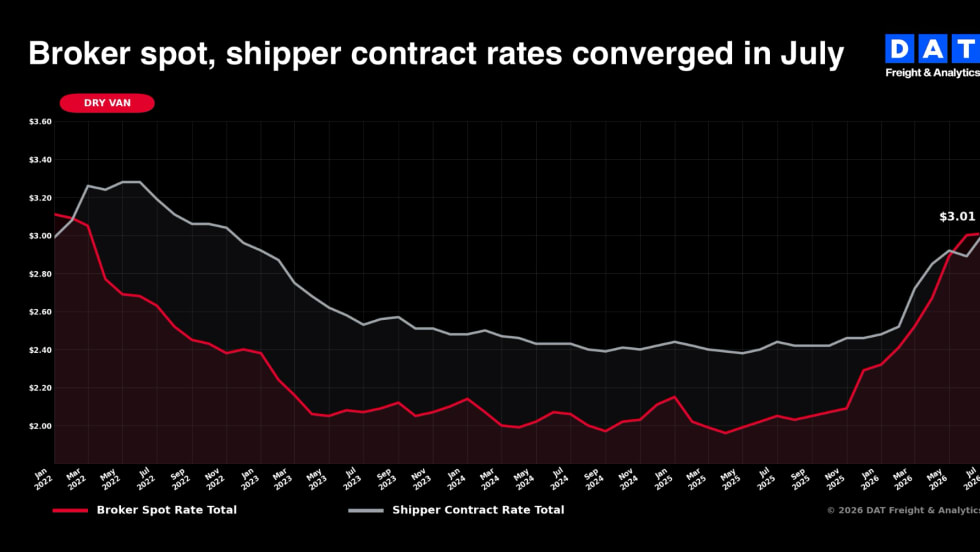
Tight Trucking Capacity Pushes Rates Higher Even as Freight Volumes Fall
“Spot rates moving ahead of contract rates have historically signaled a tightening market, but we haven’t seen a capacity-driven market quite like this one,” said DAT's Dean Croke.
Read More →