




What You Can Learn From Tires When You're Ready to Scrap Them
Scrap piles call tell a lot about how fleets are using their tires and help reduce tire costs and improve miles to removal.

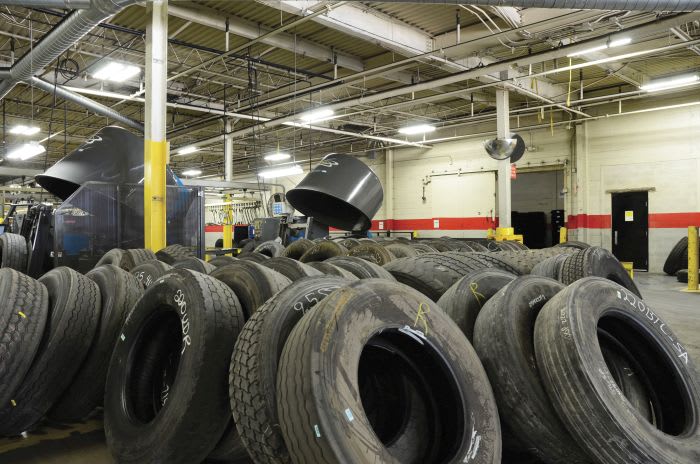
By the time a tire gets to the retreader, its unit number and wheel position information may be lost forever. It’s best to inspect the tire as it comes off the truck.
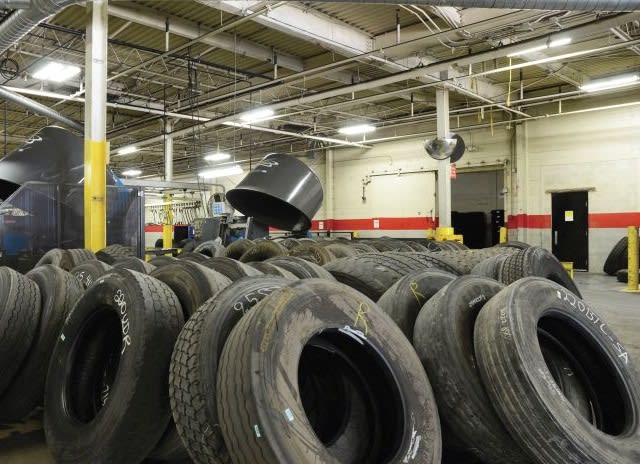
By the time a tire gets to the retreader, its unit number and wheel position information may be lost forever. It’s best to inspect the tire as it comes off the truck.
If your BlackBerry or iPhone suddenly quit working, would you just chuck it and buy another one without first figuring out what killed it? Then why do the same with your tires?
Every day, thousands of tires come off trucks and are heaped into scrap piles without careful analysis. Fleets can reduce tire costs and improve miles-to-removal if they know why tires are coming off early — and tires do tell tales of what killed them.
For example, a tire with serious feather wear, often attributed to poor alignment, may be telling you that you have a chassis or steering system alignment problem. Simply removing the tire without identifying the truck and the wheel position it came from almost guarantees that the next tire installed there will experience the same problem.
In a less obvious example, a tire with serious flat-spotting, usually indicative of a prolonged skid, may be a warning that the anti-lock braking system on the truck it came from is not working. It could also mean that the driver may have pulled away with a frozen or seized brake. In either case, not checking to see where the tire came from and why the condition arose is a costly mistake.
“Tires talk to you,” says Darry Stuart, president of DWS Fleet Management Service. “They just happen to do it in sign language. If you can look at every tire that comes off a truck on a daily basis, you’ll start to see what’s hurting the tires, and you can then take steps to correct the problem and improve your return on investment.”
According to Paul Crehan, director of product marketing for Michelin Americas Truck Tires, all tires coming out of service should be evaluated for damage and tracked. He says the out-of-service evaluation serves two functions: It can help with future tire selection questions relative to position, application and service life, and it can identify underlying problems with the current tire selection or perhaps the truck itself.
“This analysis could point to application, pressure, vehicle alignment as well as many other issues that might be shortening tire life,” he says.
“Irregular wear, flat spotting, bead damage, sidewall damage, improper mounting, improper pressure, numerous nail punctures and tire life can all tell a specific story in scrap analysis, which in turn can tell the fleet manager a lot of things,” he explains. “Perhaps the techs aren’t taking the time to ensure the tires are mounted properly, or drivers aren’t doing thorough inspections. Or maybe tire selection may not be suitable for the conditions in which it’s operating.”
Some tires will naturally come out of service due to age and natural causes. But a disproportionate number of tires coming out of service for similar reasons tell a story. Therefore, written records are an essential part of the process to capture the data.
Norberto Flores, marketing manager, Goodyear Commercial Tire Systems, recommends creating a spreadsheet to keep the tire data in one place and for easy comparison. The spreadsheet can be as elaborate or simple as necessary. Identifying the wheel position as well as the unit number and its application will provide a better picture of the service the tire saw.
The final entry for each tire on the spreadsheet should be details about its condition at removal time, such as the reason for removal.
The telltale signs
A trained eye can spot tire-killing problems at a glance. Consult your dealer if you don’t have the expertise in house, or use TMC’s Radial Tire Conditions Analysis Guide.
Fleets without a resident tire expert should seek help from their tire supplier. Expert insight in analyzing scrap tires can be very useful. Flores suggests a couple of people tackle the job.
“It’s much more efficient to have at least one person move the tires around and another to write down data,” he says. “Make sure everyone involved wears appropriate clothes and leather gloves to protect their hands against cuts and scrapes.”
Flores recommends having at least one large awl available for digging into cuts, nail holes and loose belts. Other useful tools include long-nose pliers, flashlights, tire crayons and tread depth gauges.
Be on the lookout for unusual tread wear patterns and for tires suffering damage that is obviously not related to a puncture or an impact.
“Issues like irregular wear can offer glimpses into a fleet’s tire maintenance practices,” Crehan says. “For example, too many tires with big differences between the wear on one side of the tread compared to the other could indicate that alignment issues are not being addressed, or tire inflation check practices are not what they should be.”
Were you to notice, for example, an excessive number of RRO trailer tires with sidewall damage, it might be time for a talk with the drivers. Some RRO damage is inevitable, but willful neglect should not be tolerated.
“If there is a lot of damage, it is crucial to determine the source of the damage,” Crehan says.
Key to the evaluation are tire manufacturer, tire design, tire size, ply rating, age, number of retreads, casing condition, tread depth, load distribution and alignment. If the problem is accurately diagnosed, changes and new practices can be implemented to correct the issue.
The most common scrap tire conditions include run flat, air infiltration, pinch shock, impact damage and fatigue related damage.
The American Trucking Associations’ Technology & Maintenance Council’s Radial Tire Conditions Analysis Guide can be a huge help when trying to determine why tires fail. Not only does it have tons of useful photos for comparison, it also includes probable causes for the conditions shown. It’s available for purchase on the TMC website.
“A scrap tire analysis should be able to help tell a fleet what is working and what isn’t,” says Flores. “Scrap tire analysis can also help fleets choose tires with the right tread designs for their applications. In the transportation business, knowledge is power, and there is a tremendous amount of knowledge sitting in a scrap tire pile.”
More Equipment

PlusAI Going Public to Fund Autonomous Truck Launch
A SPAC deal could provide PlusAI with up to $300 million as it works toward a 2027 commercial launch of factory-built autonomous trucks.
Read More →
NHTSA Moves to Rewrite Truck Fuel-Economy Rules
The National Highway Traffic Safety Administration says it lacks authority to regulate medium- and heavy-duty truck engines separately from complete vehicles, but the existing standards have not yet been eliminated.
Read More →
Detroit Opens Orders for EPA 2027 Engines
Detroit isn’t starting from scratch to meet EPA 2027 diesel emissions standards. Its Gen 6 DD13 and DD15 engines keep much of today’s platform while updating the fuel and aftertreatment systems.
Read More →
Carrier Transicold Adds All-Electric TRU for Stationary Cold Storage
Carrier Transicold’s new Vector 8200 all-electric transport refrigeration unit gives fleets a diesel-free option for temporary refrigerated and frozen trailer storage.
Read More →
A Closer Look at Kenworth’s Electric T880E Vocational Truck [Video]
Learn more about Kenworth's T880E battery-electric vocational truck at the Paccar Technical Center, including its range, applications, upfitting considerations, and PTO options, in this HDT Spotlight video.
Read More →
Kenworth T880E Brings EV Power to Vocational Trucks
A closer look at the Kenworth T880E’s range, charging, powertrain and upfit options — and where fleets are showing the most interest.
Read More →
What the U.S.-Canada Trade War Means for Trucking
Escalating U.S.-Canada tariffs could disrupt cross-border freight, reduce truck volumes, raise costs, and create new uncertainty for carriers on both sides of the border.
Read More →
Autonomous Truck Testing Moves Ahead in California as Teamsters Challenge Rules
California has begun permitting heavy-duty autonomous truck testing, with Aurora and Kodiak among the first to receive approval, as the Teamsters sue the DMV over the new regulations.
Read More →
Behind the Wheel of the New Mack Anthem [Video]
HDT takes the new Mack Anthem around Mack’s Pennsylvania test track to see how its driver-focused design, technology, visibility and handling perform from behind the wheel.
Read More →
DTNA Plans New U.S. Truck Plant as Manufacturing Footprint Shifts
Daimler Truck North America is evaluating sites for a new assembly plant expected to open in 2029 while winding down operations at its longtime Portland manufacturing facility.
Read More →