




Getting the Most Out of Your Tire Program
What to track in a tire program to make sure you’re getting the most out of every day they spend on the road.

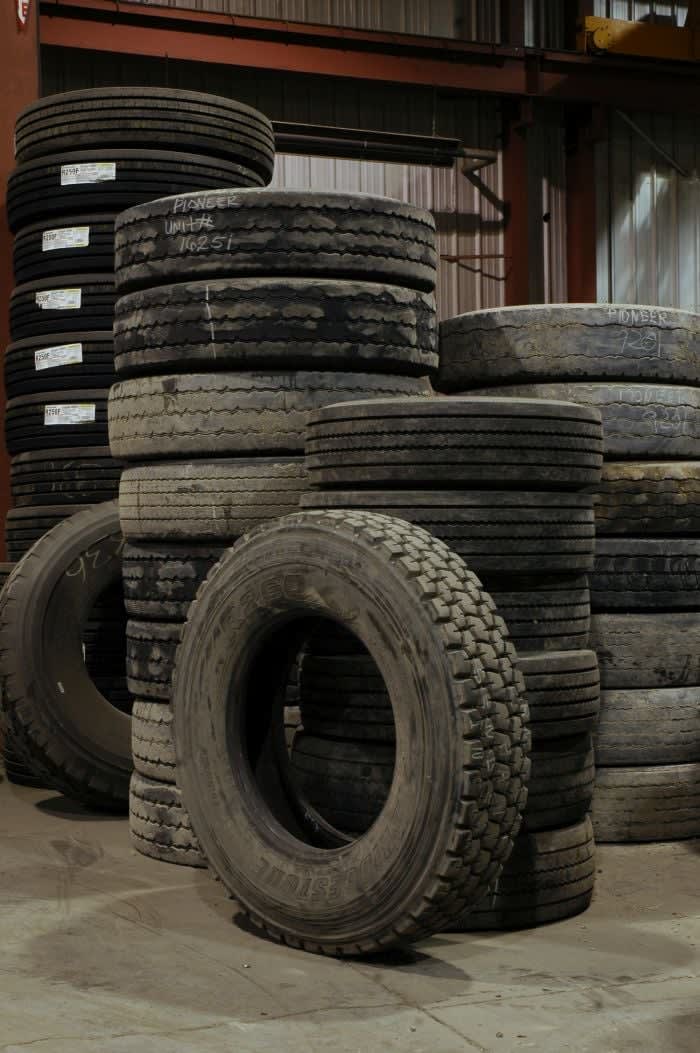
Comprehensive tire management can turn a pile of beat-up rubber into a pile of gold.
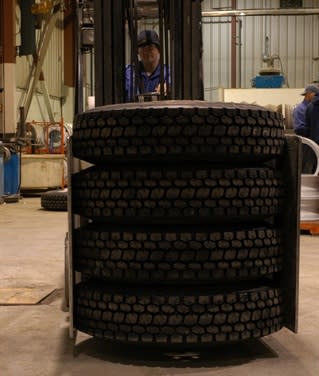
Putting a new tire onto a truck that prematurely killed the previous tire is consigning the new tire to an early grave. You have to know what killed the first tire to prevent it from happening again.
How you manage your tire program isn’t as important as what you get out of the management exercise. Really sophisticated management tools and practices will produce tons of information. How valuable that data is to the operation is very much the question.
You’ve heard the expression, drinking from a fire hose; that’s what happens when you micro-manage a tire program. You need to be able to separate the useful data from the noise lest you become overwhelmed and frustrated with the process. There’s another expression you’ve probably heard: keep it simple, stupid. That’s probably where most small fleets should be in tire management.
You have to make sure you are not spending more time and energy tracking your tires than the return you see from the process.
“The only group that I know of that really tracks tires well are the leasing companies; they track tires by vehicle, because that’s how they make their money,” notes Darry Stuart, president of DWS Fleet Management Service, and a self-described rebel when it comes to some maintenance practices — tires being one of them.
Stuart notes that big leasing companies can tell you to the 32nd of an inch when a Bridgestone steer tire or a Michelin drive tire will come due for replacement. They can tell you to the fraction of cent what a tire’s lifetime cost will be with two or three retreads run at two or three different wheel positions.
“That’s great for an operation that makes its money on the spread between what they charge a customer for a full-service lease program and what it costs them to keep the truck on the road,” he says. “Frankly, there are many instances where that level of management in a trucking fleet is excessive, and really isn’t worth the effort.”
Ryder Systems is one fleet that successfully micro-manages tires. They have to; it’s their bread and butter. Scott Perry, vice president of Supply Management and Fleet Management Solutions, says as much data as they can gather on tires is put to use every day.
Perry says it starts with how they spec the truck for its intended application, including the specific model of tire. Over time, they have collected data on similar trucks in similar applications with similar tires.
“Throughout the course of the life of that tire, we capture performance stats and we monitor the number of miles that the vehicles operate, but we’re also capturing tire pressure and tread depth readings as that vehicle comes in for a maintenance inspection,” he says. “Virtually any time that vehicle pulls into any of our shops for any type of service, we put data from that truck and its tires into our shop maintenance system. That gives us a picture of that vehicle’s performance and how many miles per thirty-second of tread depth we’re able to achieve within that application.”
Armed with that amount of information, Ryder can manage life expectancy of the tire, and determine whether they have the correct tire on the truck.
“Sometimes we make one assumption on the application a vehicle was going to be in, then the customer changes their business model,” he observes. “If we see something unexpected, maybe accelerated wear, then that tells me we might need to look at a different type of tire.”
But for all the diligence in data collection and analysis, Perry acknowledges that getting better value from your tires comes down to three things: pick the correct tire for the job, keep it running straight, and keep it inflated.
Tood Cotier, director of maintenance at Hartt Transportation in Bangor, Maine, has had some success with his tire program using what might be described as the 5,000-foot approach. He watches his tires closely, but not daily.
He has been running the same two brands of single wide tires since 2005, and the mileage he sees from those tires is pretty predictable. Any significant variation from that number gets his attention.
“We expect to get 230,000 miles from the low-rolling-resistance wide-base tires before we pull them from drive axles at 6/32nds” he says. “After that we put them on the trailer and I stop tracking them.”
Cotier says it’s just not worth the trouble.
“We don’t run hubodometers on our trailers and we’ve got three-and-a-half trailers for every power unit,” he says. “It would be too complex to track them beyond that point, and it’s hardly worth the effort.”
While that management approach would not fly with Scott Perry, it’s just fine with Darry Stuart.
Stuart is of two minds on that depth of tire tracking. At one end of the spectrum, for fleets that have the wherewithal to pull it off, tire accounting can produce a very robust cost model. But it seldom gets past stage one because of the complexity.
“Generally speaking, most fleets manage tires by what I call general ledger accounting,” he says. “They take total tire cost and then divide it by the miles traveled — either book miles, satellite, miles or whatever measurement they use. The average, and even above average fleet doesn’t measure tires very well, because the majority of them will charge the tire going on, but they won’t credit the tire coming off if it has any value.”
He cites an example where a fleet put three sets of tires on a steer axle over a short time because a driver was complaining about them. The fleet will charge a thousand dollars each time to install the tires, but never credit the tire coming off even though it’s only partially worn.
For example, three brand-new steer tires go on with 23/32 of tread. They come off three weeks later with 22/32. The problem is, many fleets don’t have the architecture in their accounting systems to credit the tire coming off with all that rubber still on it.
Comprehensive tire management can turn a pile of beat-up rubber into a pile of gold.
“If those tires are moved to another position or another tractor, there’s a good chance it will go on at no cost because the tire can’t be charged twice,” says Stuart. “It’s an accounting problem, but it costs the fleet the ability to track the tires by vehicle.”
He says fleets using general ledger accounting are missing opportunities. With this approach, the tire’s second or third life often goes unaccounted for. If the tire is moved to a trailer, and the fleet has a 3-to-1 or 4-to-1 trailer to tractor ratio, there’s a lot of 32nds of rubber that are never accounted for. If that’s the case in your fleet, Stuart says you probably don’t have a really good handle on your tire costs.
“I charge them going on by 32nd, and credit them coming off by 32nd. It’s cumbersome, but the vehicle costs can be tracked much more closely,” he advises.
According to Stuart, the best method for a smaller fleet to manage tires is to treat each one of them as an asset. You have to study each tire that comes off a vehicle.
“Tires talk,” he notes. “They do it in sign language, but analysis can help determine what, if anything cut its life short, or why it ran out to 400,000 miles. Getting right down to basics, if you keep the right amount of air in a tire and you run it straight, you’ll get the best possible value out of the tire provided you paid the right price for the tire in the first place.”
Whether you micro- or macro-manage your tires, you’ll still see value in a management program. All you really need to do is keep a close eye on the tires, and that sometimes seems to be the biggest hurdle to successful tire management.
More Maintenance
The Maintenance Checks Trucking Fleets Should Prioritize Before Fall Freight Picks Up
Making it through August isn’t the same as being ready for the next several months of operation. Find out what systems may have suffered from summer heat and need to be checked out before fall.
Read More →
What Three Fleets Are Doing Differently When Buying Truck Parts in 2026
With freight improving but costs still climbing, fleet maintenance executives explain how they're balancing price, quality, and supplier relationships.
Read More →
Paccar Recalls 2027 Trucks Built This Summer for Possible Electrical Problem
The nearly 6,000 Kenworth and Peterbilt trucks in the recall could potentially lose engine power, among other things.
Read More →
Will API PC-12 Oil Change Trucking Fleet Maintenance?
The new API PC-12 heavy-duty engine oil category reflects the changing demands of modern diesel engines. But fleets like Foodliner are looking to getting their own data before making decisions on adopting the new oils and questions such as extending oil drain intervals.
Read More →
Brake Safety Week to Focus on Drums and Rotors
Commercial vehicle inspectors are focusing on truck brakes during CVSA's Brake Safety Week, August 23-29.
Read More →
Possible Battery-Cable Fires Prompt Recall of 15,000+ International MV and HV Trucks
On the recalled vehicles, manufacturing variations can cause the battery interconnect cable to contact the auxiliary stud and hold down the bracket.
Read More →
Rush, MCT Team Up to Grow Refrigeration Service Network
The joint venture will operate MCT's network of Carrier Transicold dealerships and mobile service locations, with the companies promising greater service capacity and uptime for refrigerated fleets.
Read More →
ConMet Expands Aftermarket Brake Drum Lineup With TruCast
A new heavy-duty truck brake drum option in the aftermarket gives customers more flexibility within the ConMet product family.
Read More →
Mack Expands Premium Service Contract Coverage to Medium-Duty MD
With a service contract, inspections, preventive maintenance and repairs can be handled in a single visit instead of multiple ones.
Read More →
Maintenance in the Messy Middle Part 5: Battery-Electric Trucks
No oil changes. No diesel exhaust fluid. No exhaust aftertreatment. But NACFE battery-electric trucks still require specialized maintenance procedures.
Read More →