




What Do Final Mile Trends Mean for Equipment and Maintenance Managers?
As urban centers increasingly battle problems with pollution and congestion while e-commerce grows by leaps and bounds, we’ll see changing technologies in last-mile logistics – and changing maintenance challenges.
March 8, 2018

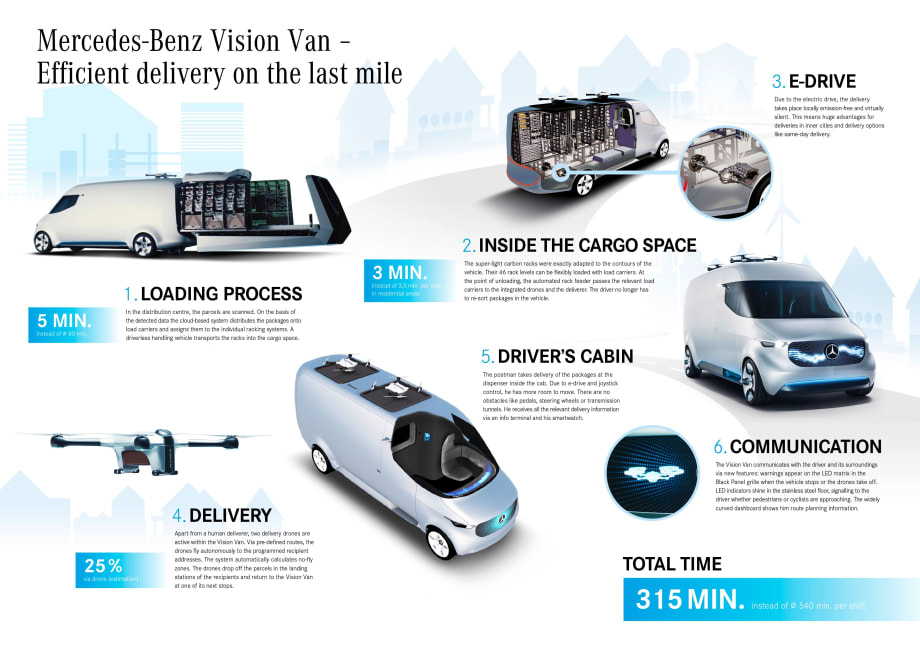
Mercedes Benz vans has developed potential logistics concepts involving electric vans, robots, drones, and smart autonomous loading systems. Photo: Mercedes-Benz
6 min to read

As urban centers increasingly battle problems with pollution and congestion while e-commerce grows by leaps and bounds, we’ll see changing technologies in last-mile logistics – and changing maintenance challenges.
In a session at the Technology & Maintenance Council’s annual meeting in Atlanta, panelists explored the issue of last-mile delivery trends.
Nick Tempelhoff shared a possible future vision developed by Mercedes-Benz vans, starting with smart, autonomous loading systems, and using drones and small wheeled robots that would deploy from a “mothership” van – one powered by electricity.
In fact, much of the session centered around electric-powered last-mile delivery vehicles, either full battery electric or hybrids.
The near future of last mile delivery
“The writing is on the wall” for alternative powered vehicles in last-mile delivery, said Mike Hasinec of Penske Truck Leasing. “When you look at the routes, at the stop density, the infrastructure is very feasible.”
Already, he said, technologies such as compressed natural gas, liquefied natural gas, propane, hybrid and some electric vehicles are in operation. “However, the population is very small and has remained so for many years,” because they are mostly in niche application such as buses and small delivery trucks. OEMs have not heavily pursued alternative power vehicle production, he said, and customers aren’t necessarily willing to buy these vehicles in large numbers, so there are few economies of scale to be had. Leasing companies such as Penske have been able to invest in larger numbers and provide these technologies to fleets.
Tim Dollmeyer, director of technology and engineering for Cummins Electrified Power, showed slides of various hybrid and electric vehicles from the past decade or so – most of which are no longer around. It took government incentives to help develop and deploy them.
“Something different is happening now,” he said. “The change is really coming from the needs of the urban areas, this is where the bulk of last-mile activity happens.” City governments, he said, are increasingly putting into place policies and regulations to address problems with congestion, air quality, and noise pollution, creating a demand for these technologies. At the same time, he said, “we are seeing that the economics are starting to be positive in some applications.” That’s already happening for urban buses, and should be the case for medium-duty delivery vehicles by early in the next decade.
Charging is a big challenge, Dollmeyer noted. Without extensive electric charging infrastructure, “it’s a lot harder to carry the energy with you that you’d like to have.” Fast-charging systems can reduce battery life. There’s no standard for charging connections. And there are real estate challenges.
“We’ve got to actually charge these things, and it’s going to have a big and varied impact on our ability to deploy these things,” Dollmeyer said as an example. While commercial vehicles consume between 0.8 and 2.5 kWh per mile, their batteries are expected to store between 50 and 500 kWh.
The charging needs alone will affect the layouts of shops and fleet yards. “The vehicles actually need to sit by the charger, and quite often the electricity and the available charging isn’t in the same spot,” Dollmeyer explained. To compound matters, there are already four different styles of connectors for the vehicles, and they are not all compatible with one another.
He doesn’t expect internal combustion engines to disappear anytime soon, and in fact predicted increasing use of hybrids to allow for vehicles that can run on electricity in the cities but have extended range for operating outside of low-emissions zones. He noted that there is increasing activity to work to develop fuel cells, “because that allows us to carry more energy with us.”
Maintenance challenges with alternative powered last-mile trucks
Penske’s Hasinec outlined a number of challenges when it comes to maintenance of alternative fuel and powertrains, noting that there have been improvements in some of these areas in recent years:
Tooling availability
Diagnostics
Training
Facility design
Charging infrastructure
Willingness to invest
OEM support
Reliability
The good news, Dollmeyer said, is we expect there to be less maintenance for battery-electric vehicles. There are simply fewer parts to maintain or repair. Hybrids, however, can do the opposite, adding systems that mean more things to break down – although a well-integrated hybrid system can reduce stress in some parts of the drivetrain, he said, noting that many hybrids in the past created a lot of maintenance headaches. Newer systems may benefit from better engineering as well as from sensors and sophisticated onboard diagnostics that weren’t around for early generations of hybrids.
In addition, there’s safety training involved. “This stuff’s dangerous in a new way,” Dollmeyer said.
The UPS experience

One company probably has more experience with alternative-powered last-mile delivery trucks than any other: UPS. Its “rolling laboratory” of alternative fuel and advanced technology vehicles is about 9,000 around the world, from electric bicycles to renewable natural gas and propane. It recently announced plans to deploy 50 plug-in electric delivery trucks designed from the ground up as part of a collaboration with Workhorse Group.
UPS has more than 300 electric vehicles deployed in Europe and the U.S., and nearly 700 hybrid electric vehicles. The company recently ordered 125 new fully electric Semi tractors to be built by Tesla in 2019, the largest pre-order to date. Last year, UPS also announced it will become the first commercial customer in the U.S. to start using three medium-duty electric trucks from Daimler Trucks' Fuso brand, the eCanter.
Duane Lippincott oversees training for UPS’ maintenance personnel at more than 1,400 shops in the U.S. with more than 5,000 technicians. Natural gas vehicles require shop modifications that can range from the bare minimum needed to “palaces.” Shop modifications for the electric and hybrid package cars are minimal, although he agreed with other presenters when it comes to charging, saying, “the charging infrastructure is a whole different story.” For the new Class 8 electric trucks, he’s not sure yet what modifications may be needed, “but we know we’re going to need to make some changes.”
“Every time we get a new technology, there’s a new tool list, and new software for the computer,” he said. More space may be needed for additional parts inventory.
“Training is of escalating importance,” Lippincott said. “We must be moving forward faster and faster than we ever have before.”
This may mean we develop different ways of training and of running shops.
“It’s going to be very difficult to hire enough technicians and have highly technical people” in all your tech positions, he said. Perhaps we’ll need a hierarchy, with an entry-level tech handling basic jobs like oil changes and tires on one end, and a highly skilled, trained, and technical expert on the other end of the scale.
“Maybe we develop a call in number where less skilled techs call in and the highly skilled ones help diagnose the problem by phone. We don’t need virtual reality glasses for that; we can do that today, every one of us, with an iPhone, just using Facetime, so you can show him the problem you’ve got.”
Showing a slide of a fleet of electric trucks that UPS ran in the 1930s, Lippincott said, “What’s old is new, but the new is new in a whole new technological way. If I depended on the training from the 1930s vehicles for today’s shop, it wouldn’t work too well.”
Subscribe to Our Newsletter
More Equipment
Cummins Adjusts 2027 Engine Rollout After EPA Proposal
The engine maker will gradually introduce its new Model Year 2027 diesel engines while continuing to offer current models during the transition, citing the EPA's proposed emissions rule changes.
Read More →
Aurora Rolls Out Next Generation of Driverless Trucks for Commercial Freight
Aurora's latest autonomous trucks it's rolling out with International feature lower-cost hardware designed for a million miles as the company expands commercial driverless freight operations across the U.S. Sun Belt.
Read More →
Peterbilt 589 Spotlight: A Close Look at a Custom Working Truck [Video]
There's more to this customized Peterbilt Model 589 and Great Dane refrigerated trailer than chrome and stainless (although there's plenty of that too!) A veteran driver explains the design choices and practical features behind this working truck.
Read More →
Continental Expands Retread Lineup With New ContiTread HDL 5 EP
New long-haul drive retread is designed to improve fuel efficiency, extend tread life, and lower fleets' cost per mile.
Read More →
EPA Proposal Could Ease 2027 Truck Costs and Buying Uncertainty
The proposal doesn't change the tougher NOx standard, but it would revise key implementation requirements that manufacturers say have driven up costs and complicated fleet purchasing decisions.
Read More →
Cummins, Paccar Ease DEF Derates After EPA Guidance
Updated diesel engine software gives truck operators more time to address emissions-system issues while staying compliant with EPA emissions standards.
Read More →
America at 250: How the Truck Helped Connect a Continent
America was founded on revolutionary ideas, but it was built by movement. For 250 years, the nation has depended on ever-better ways to move people, products, and prosperity across a vast continent. No machine has carried that mission further — or more faithfully — than the truck.
Read More →
Mack Unveils America 250 Tribute Truck to Celebrate Nation's Semiquincentennial
Just in time for the Fourth of July! Mack unveils a brand-new patriotic, limited-edition, red, white, and blue truck wrap.
Read More →
Sponsored•July 1, 2026
Enhance Fleet Performance with High-Efficiency Auxiliary Power Units
Drive sustainable cost savings while increasing driver comfort during short- and long-haul logistics operations.
Read More →
Rush Expands Gulf Coast Peterbilt Network With Louisiana Acquisition
The expanded Rush network gives fleets additional sales, service, leasing and collision repair support across Louisiana's major trucking markets.
Read More →