




Understanding Lithium Battery Chemistries and Their Roles in Trucking
Found everywhere from smartphones to electric vehicles, lithium-ion batteries could revolutionize the heavy-duty trucking industry.

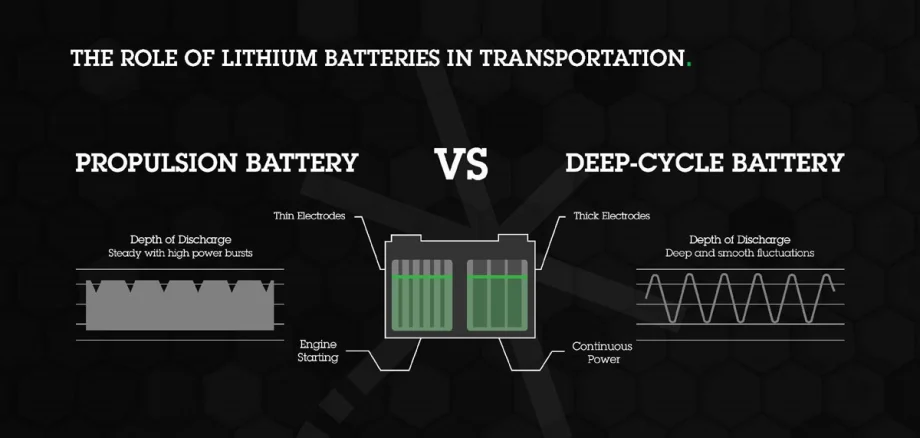
Electric propulsion batteries supply energy for vehicle movement. Deep cycle batteries are used for auxiliary power units.
Source: Dragonfly Energy
Found everywhere from smartphones to electric vehicles, lithium-ion batteries could revolutionize the heavy-duty trucking industry.
Their higher energy density (more power per unit space), lighter weight, and discharge/charge characteristics compared to lead-acid batteries have optimized performance and reduced environmental impact in other sectors. They have the potential to do the same for heavy-duty trucking.
How do the diverse chemistries of lithium batteries affect how they can be used in trucking?
Exploring the Spectrum of Lithium Battery Chemistries
Beneath the seemingly simple label “lithium-ion battery” lies a diverse landscape of chemistries. Each boasts unique strengths, carefully crafted to fulfill specific needs.
Unlike their lead-acid predecessors, lithium batteries are not one-size-fits-all solutions. Researchers and engineers balance factors such as energy density, power output, longevity, and cost to achieve optimal performance in the chosen application:
Energy density: The amount of energy stored per unit volume or mass.
Specific energy: How much total energy a battery can store.
Specific power: How quickly a battery can deliver stored energy.
Rate of charging and discharging: The rapidity with which the battery absorbs and releases energy.
Temperature performance: The battery’s resilience to extreme heat or cold without compromising performance or safety.
Longevity (cycle life): The number of charge-discharge cycles the battery can endure before experiencing significant capacity loss.
Cost: Striking the optimal balance between affordability and desired performance.
Material availability: Ensuring a sustainable supply of battery materials is critical for long-term viability.
Safety: Minimizing fire explosion risks is paramount, including meeting or surpassing the safety regulations for lithium batteries.
This process results in a spectrum of specialized lithium battery types, each tailored for its intended purpose.
What Are the Most Common Lithium Battery Types in the Transportation Industry?
Among the most prevalent seen in the transportation industry are:
NMC (Lithium Nickel Manganese Cobalt Oxide). These offer high energy density but degrade faster, have thermal stability concerns, and use cobalt, which has raised ethical questions about how it’s mined.
NCA (Lithium Nickel Cobalt Aluminum Oxide). Similar to NMC in performance, but with slightly lower energy density and improved safety due to reduced cobalt. However, the thermal instability and higher cost of NCA limit its widespread adoption.
LCO (Lithium Cobalt Oxide). These boast the highest energy density but suffer from limited lifespan, safety concerns, and significant cobalt dependency.
LFP (Lithium Iron Phosphate). Also referred to as LiFePO4, these come with lower energy density but offer longevity, durability, and thermal stability, making them ideal for applications demanding reliability and safety.
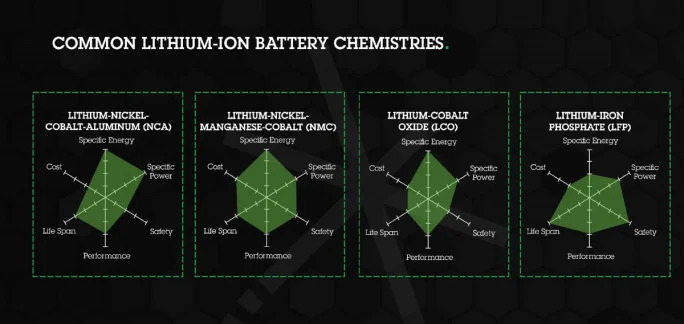
Beneath the seemingly simple label “lithium-ion battery” lies a diverse landscape of chemistries.
Source: Dragonfly Energy
Lithium Batteries in Transportation
Highlighting differences in both chemical composition and designated purposes, lithium batteries play two primary roles in transportation: powering propulsion and supplying auxiliary power.
Electric propulsion batteries supply energy for vehicle movement.
Deep cycle batteries are used for auxiliary power units (APUs), delivering electricity for onboard amenities without tapping into the propulsion battery or requiring the engine to idle.
While different in their makeup and purpose, each energy source is crucial, possessing distinct characteristics tailored to its application demands.
EV Batteries: A Shifting Paradigm
NMC has traditionally dominated the electric vehicle space due to its high energy density, enabling extended range and top performance. However, this lithium chemistry (NMC) has its drawbacks, most notably a higher risk of thermal runaway, which can lead to fires and explosions.
As a result, manufacturers are actively exploring alternatives suited for the demanding needs of this unique application.
LFP batteries emerge as a promising contender, with lower cost, longer lifespan, and remarkable thermal stability. This translates to reduced fire risk and potentially lower maintenance costs.
However, its lower energy density currently limits range, a crucial factor for long-haul trucks. Looking down the road, solid state batteries hold immense potential, offering unmatched energy density and faster charging, addressing range limitations while further enhancing safety. Although still in development, they represent a possible future of EV technology, including in electrified heavy-duty trucks.
All-Electric APUs: LFP Leads the Charge
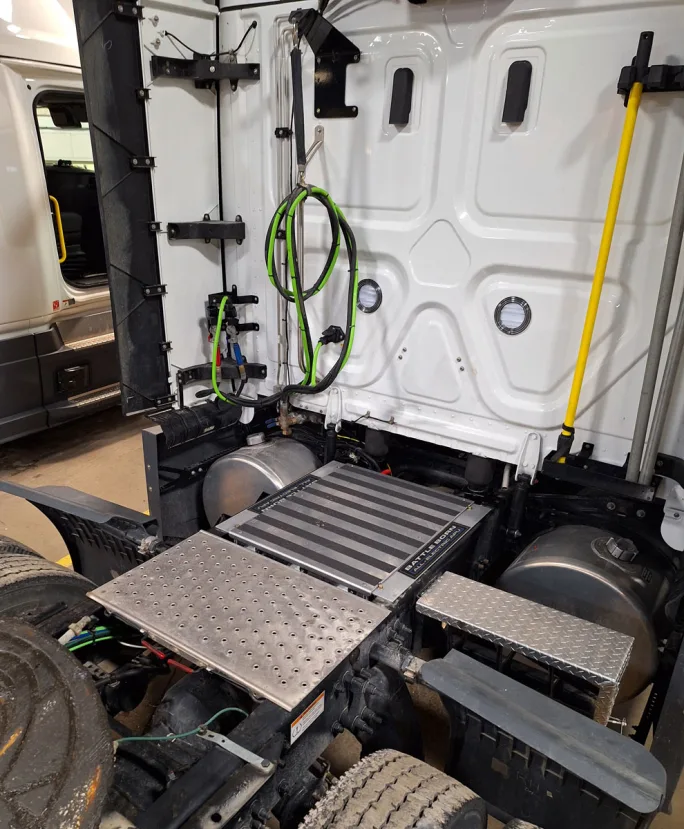
Dragonfly Energy's Battle Born all-electric APU uses lithium battery technology.
Photo: Dragonfly Energy
Seeking to reduce a reliance on idling, diesel and battery-electric auxiliary power units have become prevalent in heavy-duty trucking.
However, units reliant on diesel fuel have had problems with sustainability, reliability, and cost-effectiveness.
Electric APUs have drawn complaints from drivers that they can’t keep the truck cool long enough for a full sleep cycle, especially in hot climates.
Lithium batteries for electric APUs, specifically LFP chemistry, prove to be well-suited for the application due to LFP’s safety, economic viability, longevity and reliability.
Choosing the Right Lithium Chemistry for Heavy-Duty Trucking
What function do you foresee a lithium solution fulfilling within a fleet?
Understanding the capabilities offered by various lithium battery chemistries is important as the trucking industry looks to optimize performance, mitigate environmental impact, and positively impact the financial bottom line of fleets.
While the electrification of trucking may capture headlines, lithium-ion batteries offer possibilities beyond powering electric vehicles. Applications such as all-electric auxiliary power units can help fleets with green initiatives and cost savings.
Let’s not wait for tomorrow’s headlines. The future of battery technology is here, and it's time to explore its potential for the benefit of our fleets and the environment.

About the Author: Wade Seaburg is chief revenue offers of Dragonfly Energy. He was behind the recent introduction of the Battle Born All-Electric APU to the heavy-duty trucking industry, which received an HDT Top 20 Products award. Seaburg has a BS in Industrial Engineering from Purdue University.
This contributed guest article was authored and edited according to Heavy Duty Trucking’s editorial standards and style to provide useful information to our readers. Opinions expressed may not reflect those of HDT.
More Fuel Smarts

Why Diesel Price Relief Efforts May Fall Short
Diesel prices have eased from September’s record high, but doubts about additional Russian supply and limits on dyed-diesel tax relief mean trucking fleets still face expensive fuel. And prices could go higher.
Read More →
Why Small Fuel Savings Matter in Trucking
Can better fuel economy help pay for driver raises? In this podcast, GP Transco explains how small efficiency gains create room to reinvest in its people.
Read More →
How GP Transco Cuts Trucking Fuel Costs, a Tenth of a Gallon at a Time
What’s another tenth of a mile per gallon worth? GP Transco shares how equipment upgrades and driver coaching turn small gains into meaningful fuel savings.
Read More →
Electric Yard Tractors Move Beyond Pilots
Operating-cost savings have overtaken sustainability goals as the leading reason surveyed fleets are adopting battery-electric terminal tractors, according to new NACFE research.
Read More →
Geotab Links Fleet Card to Vehicle Data
The new card combines fuel discounts with telematics-based purchase controls. Geotab’s analysis also points to potential savings from choosing lower-priced fuel stops.
Read More →
Fleet Economics Shape Electric Truck Outlook
ACT Research expects costs, charging infrastructure, and technology improvements to drive zero-emission commercial vehicle adoption as federal regulations and incentives retreat.
Read More →
Wex Adds Cardless Fuel Payments for Over-the-Road Customers
A new fuel card feature for Wex customers offers convenience and security.
Read More →
New California Law Could Shed Light on Electric Truck Prices
Why do battery-electric Class 8 trucks remain so expensive? A California bill signed by Gov. Gavin Newsom would give fleets and state agencies more visibility into what manufacturers charge.
Read More →
How Volvo Updated Its D13 for EPA 2027 [Watch]
Volvo’s updated D13 promises lower emissions without sacrificing performance or fuel economy. Take a closer look at what changed inside the engine in this HDT Spotlight video.
Read More →
Diesel Price Spike Shortens Payback for Natural Gas Trucks, Report Says
Energy Vision estimates fleets could recover the higher purchase price of an RNG-fueled Class 8 tractor in 1.3 to 2.8 years under current fuel-price scenarios.
Read More →