Tweak Heavy-Duty Truck Engine Settings To Save Fuel
Dialing in some basic fuel-economy parameters to your truck's engine settings can easily save 5% in fuel. Dig a little deeper into the ECM and even more savings are possible.
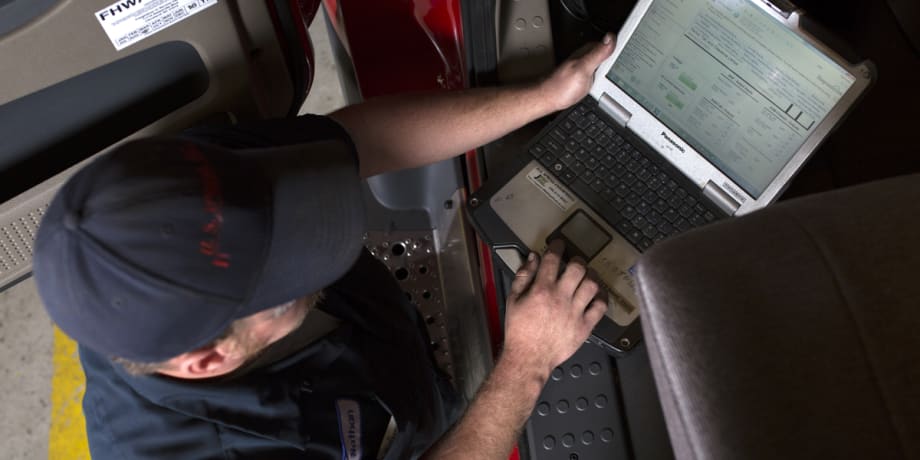
Engine parameter settings can still be made manually, but saved templates and over-the-air updates have vastly simplified the process.
Photo: U.S. Xpress
6 min to read
If configuring your privacy settings in Windows 10 makes you nervous, diving into your truck’s electronic control module to optimize your fuel economy settings might tip you over the edge.
Ad Loading...
It’s not that difficult if you first consult with the dealer to learn what various parameters do and how they affect drivability, performance, and fuel consumption. Like your privacy settings, however, going too far can affect the performance of the truck, which could be off-putting to drivers.
Part of the challenge is understanding the impact various changes can have on the truck. And if you operate a mixed fleet, there’s the added challenge of learning the nomenclature from the different engine makers. Automakers use 20 different names for adaptive cruise control. They have 40 different names for automatic emergency braking.
Ad Loading...
It’s not that bad in trucks – yet – but it’s happening here too, according to Don Freeman, corporate Mack sales manager at Bruckner’s Truck and Equipment of Tulsa, Oklahoma.
“Different OEMs have different names for what are essentially the same features or options,” he said, speaking during a study group session at last year’s annual meeting of the American Trucking Associations’ Technology & Maintenance Council. “A Cummins may behave differently than a Mack with what sounds like the same parameter, predictive cruise control for example.”
But that’s no reason to stay on the sidelines. Your dealer can help configure the settings the way you’d prefer, or at least guide you through the process. Jason Lambert, a fleet account exec with Cummins, says your service rep will be able to explain the settings in about 60 to 90 minutes.
“That’s something I try to do with my customers every year to get them up to speed on all the updates and the latest features,” he says.
“That takes about an hour and half. But the good thing is, once you have built a template for the fleet, it takes only about 10 seconds to send the update out to all the trucks in the fleet through PowerSpec. It used to take several minutes.”
Ad Loading...
Many fleets use a template to assign identical parameter settings to every group of identical vehicles purchased, according to NACFE. When new trucks with different specs are purchased, a new template must be created. For example, a fleet transitioning to automated transmissions would need to change engine speed parameters in order to place more responsibility for optimized shifting onto the transmission.
Photo: Jim Park
Over-the-air updates are now possible in most cases, making frequent updates to a truck’s software less taxing that it once was.
In fact, earlier this year, Mack and Volvo said they would allow customers to make unlimited over-the-air parameter updates, allowing them to make changes to improve efficiency and productivity for different geographies and operating conditions.
“Mack wanted to make it easier for customers to implement parameter updates, since some need to do so on a frequent basis depending upon their specific applications,” said David Pardue, vice president of connected vehicle and contract services for Mack Trucks, in the announcement.
Lambert says Cummins offers more than 300 customer-programmable settings, but not all fleets choose to change all of those. In many cases, the factory default settings are fine.
Most of the time, fleets are looking to manage road speed and idle time, and to take advantage of some of the optional features of packages that improve fuel efficiency. In certain cases, these can be set to limit acceleration when lightly loaded, or to encourage the driver to use cruise control rather than the throttle pedal.
Ad Loading...
“When you make an adjustment, it can have a positive or negative effect on the performance of the truck, and it will have an impact on the driver,” he cautions. “They will notice the changes, so make sure you get with your drivers and explain what has changed and why you did it.”
Common parameter changes
While it’s not possible to drill down into all the possible parameters fleets might want to tinker with, we polled a few OEMs to see which ones customers commonly change.
Ashley Murickan, Volvo Trucks North America product marketing manager, says vehicle speed settings (road speed limit, cruise speed limit, gear down vehicle speed, engine brake engage in cruise settings, cruise control speed settings) were the most commonly set parameters on Volvo trucks, followed by predictive cruise control settings and idle shutdown time.
“Fleets seem to prefer five minutes or less of idle time,” she says.
At Navistar, the favorites were predictive cruise control positive and negative offsets, and load-based torque control – fuel economy adjustment factor (on Cummins products).
Ad Loading...
“As engine controls become more advanced, new parameters get introduced to fine-tune their effectiveness in fleet operations,” says Aaron Peterson, chief performance engineer for the Heavy Product Platform at Navistar, noting that is the case with the load-based torque control and the predictive cruise control offsets.
“Ambient temperature-controlled idle shutdown timer has been around for years but is still relatively underutilized as a means of reducing fuel consumption in fleets that typically allow drivers to idle their vehicles for cabin comfort,” he adds.
Stu Russoli, Mack Trucks highway product manager, says fleets can adjust cruise control parameters to allow a higher speed than the set cruise speed. Similarly, they can change parameters to limit road speed in lower gears while allowing faster speeds in top gears, encouraging drivers to keep the truck in top gear longer and allowing higher speeds while helping to save fuel.
Things to keep in mind
Not to throw cold water on the idea of customizing the truck for fuel efficiency, but there are few things to watch for.
Randy Obermeyer, director of maintenance at Indiana-based Online Transport, opened the same TMC study group session where Lambert and Freeman spoke with a few revealing anecdotes.
Ad Loading...
He said his previous employer would order 25 trucks at a time, but they rarely arrived with the settings programmed as specified.
“It wasn’t until we put a truck on the road that we’d notice there were sometimes some inconsistencies,” he said. “Drivers complained that some of the trucks were slow to shift, some lost speed on hills, and one had back-of-cab back-up lights that wouldn’t stay on when the truck was reversing. They were programmed to turn off at too low a speed.”
Obermeyer advises fleets to check the parameters when taking delivery of the truck and get with the dealer on any needed updates.
“One of the bigger challenges is the different generations of the technology with varying model years. Sometimes the settings on the older trucks just can’t be updated to the latest version.”
It can seem like a game of whack-a-mole at times, but the results are usually positive. A North American Council for Freight Efficiency 2015 Confidence Report suggests that savings of 3-5% above the defaults may be available to fleets that simply set the parameters of their new trucks in a few key areas such as vehicle speed and idle reduction.
Ad Loading...
A fleet that truly optimizes the parameters by tailoring them to specific operations could see gains of 5-8% over default. In some extreme cases, the report notes, “fleets have reported mpg gains for certain individual trucks of as great as 20%."
If you haven’t considered all the possibilities, talk to your dealer or OEM rep for a parameter deep dive and see what you might be leaving on the table.
Efficiency parameters to consider
With four heavy-duty truck engine makers producing more than a dozen different engines, it’s difficult to find a single source of information on how all those customer-programable parameters could affect fuel economy, performance, and driver satisfaction.
The North American Council for Freight Efficiency published a Confidence Report in 2015 that, despite its age, comes close. The report looks at more than a dozen commonly set parameters and explains the impact of changing those parameters.
There are probably dozens of new features added since the report came out that are not covered, but for fleets looking for guidance on what parameters to set and how to set them, it’s still a good source on what they stand to gain from diving into their electronic control modules.
It also digs into barriers to adoption, such as the sheer number of programmable parameters, variations in OEM terminology, and negative reactions from drivers.
NACFE recommends exploring these six categories of parameters for the best impact on fuel economy:
Vehicle speeds
Vehicle configuration information
Engine speed and torque limits
Idle reduction
Driver rewards
Miscellaneous mpg-related features
NACFE is in the process of updating and revising many of its Confidence Reports, this one included.
This article first appear in the June 2021 issue of Heavy Duty Trucking.
Volvo’s updated D13 promises lower emissions without sacrificing performance or fuel economy. Take a closer look at what changed inside the engine in this HDT Spotlight video.
The Michelin X Multi Energy D2 is a regional haul drive tire engineered to help fleets improve fuel efficiency, durability and traction in demanding stop-and-go operations.
ZF is expanding its North American commercial-vehicle presence with new transmission applications, electrification, trailer technology and autonomous-driving systems.
Could Tesla’s camera-only autonomous driving technology work on an 80,000-pound Semi? In this commentary, HDT's Deborah Lockridge takes a look at Tesla, Cybercab, and how autonomous trucks see the road.
The U.S. Department of Transportation issued a new automated-vehicle strategy that outlines plans for driverless-truck regulations, cross-state freight corridors, and federal safety standards.
The Port Authority of New York and New Jersey announced millions in incentives for zero-emission drayage trucks, yard tractors, and new charging hubs near the port.
The National Highway Traffic Safety Administration says it lacks authority to regulate medium- and heavy-duty truck engines separately from complete vehicles, but the existing standards have not yet been eliminated.
Detroit isn’t starting from scratch to meet EPA 2027 diesel emissions standards. Its Gen 6 DD13 and DD15 engines keep much of today’s platform while updating the fuel and aftertreatment systems.