




Tire Report: Wheel-End Problems -- Beyond the Obvious
We focus on tires here, mostly, but wheels and hubs, and the other gear that attaches tires to trucks, deserve attention too. Wheel-ends function as a system:

We focus on tires here, mostly, but wheels and hubs, and the other gear that attaches tires to trucks, deserve attention too. Wheel-ends function as a system:
the spindle, hub, and rim (or wheel), as well as the bearings and the fasteners, all work in concert to keep the wheels in place and the tires running straight and true. If one part of the system is out of whack, the results will be seen and felt elsewhere in the system - usually at the tires themselves. When that happens, tire dealers often get angry phone calls - though the problem usually has nothing to do with the tire. It's just a victim of circumstance.
From irregular wear caused by negative camber on a trailer axle to non-concentric tire mounting, how you maintain your chassis and wheel-ends, and how you install your wheels and tires, will have a greater impact on tire wear than any defect that might be present in the tire. I'm not letting the tire people off the hook easy here, but few manufacturing defects are found in tires anymore. The process is highly managed and tightly controlled to ensure product consistency. There are poor quality tires that don't wear well, and there are tires used in applications they were not designed for, but bum tires are probably not to blame for your irregular wear problems.
I'll note here that both alignment and wheel balance have a great impact on tire life too, but we won't delve deeply into those in this issue. We'll be writing on tire balance in the November issue, and have an alignment story scheduled early in the new year.
Prevention at the wheel-end
Beginning with the components farthest back in the system, axles, spindles, and hubs affect tires in not-so-subtle ways. Loose axle U-bolts or worn bushings can allow axles to wiggle and shimmy as the vehicle travels. Any movement other than straight forward simply scrubs rubber off the tire. Worn shock absorbers can play havoc with tire wear, too.
"Any component that allows a tire and wheel assembly to wander off center or run any way other than vertically true will affect tire life," says Guy Walenga, director of engineering-commercial products for Bridgestone Bandag Tire Solutions. "A little preventative maintenance at the axle and wheel-end will improve tire life in most cases."
The same applies to the hub and the wheel bearings, though perhaps to a lesser extent. Loose wheel bearings allow for poor alignment between the cone and the cup, which causes the hub to wiggle on the spindle. That allows the wheel to run off center - perhaps only by a tenth of a degree or so, depending on how loose the bearing is. Mike Becket of M.D. Alignment Services in Iowa says toe adjustments should be set to within 1/32 of an inch. "If steer axle wheel bearings are loose, the toe setting can vary by as much as 1/4 inch," he says.
"Bearing adjustment is a sensitive issue and one where we often see disagreement," Becket says. "Some bearing manufacturers' specs allow for a little too much tolerance in my opinion - and TMC's too - at up to 15 thousandths of an inch of spindle endplay. TMC (the ATA's Technology and Maintenance Council) says one to five thousandths, and I think that's the way to go."
Becket says as long as the endplay is within the bearing manufacturers' tolerance, you're okay. "I set bearings in the one- to three-thousandths range when I can."
Another approach Becket endorses is to torque all bearing adjustments to 50 foot-pounds without backing off. He does the same for axles with wide-single tires, but torques them to 75 foot-pounds and doesn't back them off.
"That's necessary because the weight of the wheel, drum, and hub assembly takes more load to center them on the spindle," he notes.
Check with your wheel-end suppliers if there's any doubt about this, and see also TMC's soon-to-be revised recommended practice guide on wheel ends, RP 644.
With axles and wheel-ends firmly mounted and going in the same direction, tires will wander less, and you'll see less cupping on the tire shoulders. As well, loose wheel bearings are suspect in many cases of advanced shoulder wear in wide-single tires.
"Loose bearings allow for some degree of negative camber, which will wear the inside shoulder of an inside dual tire or a wide-single tire," says Walenga.
When wheels wobble
Even if your wheel bearings are perfectly torqued, and all your bushings and U-bolts are tight, if your wheels aren't round or if they wobble on the hub, they aren't going to roll properly.
Lateral run-out, or a wobble, is more common on spoke wheels where the wedges have seated unevenly, pulling one part of the wheel closer to the hub than its opposite side. On disc wheels, it could indicate either a bent rim, improper seating, or some foreign material has lodged between the rim and the hub face.
It's easy to detect. Jack the wheel up and spin it, using some object (preferably a runout gauge or a dial indicator) placed close to the tire to mark the gap between it and the wheel. As the wheel spins, the gap should be the same all around the tire. If not, retighten the nuts on a spoke wheel, allowing the wedges to seat properly before torquing them down to the final setting.
You can check radial runout the same way, except you measure between the tread face and the object. If the gap differs, the wheel is out of round or bent, or the tire is not concentrically mounted.
You can check the rim by measuring across its face at several points. The diameter should be equal anywhere you measure. Take the rim out of service if it's bent, or check with the wheel manufacturer for runout tolerances.
You can check for non-concentric tire mounting by observing the mold ring near the tire bead. It's located about 1/4 of an inch from the edge of the rim with the tire mounted. Observe any change in the distance between the ring and the rim by examining the bead area all around the tire.
"If the rim checks OK, and the tire you're working with is a new one, you can try rotating the tire 90 or 180 degrees on the rim to see if you can match the minor variations of the tire and rim better to get an acceptable assembly," advises Becket.
To prevent non-concentric mounting, a bead lubricant should be used to ease the bead onto the rim. It should be inflated to 25 psi or so while sitting flat on the floor, not standing vertically, leaning against a wall, or with the rim sitting raised on some other object. The pressure will push equally in all directions from within the tire, forcing it away from the rim equally in all directions. If it's vertical or leaning against a wall, the weight of the rim inside the tire will cause it to seat off center.
Once the tire is seated, place it in a tire cage and continue inflating to 120 psi. Then, deflate the tire to your standard operating pressure and the tire will seat itself properly.
These steps alone are no guarantee that your wheels will run true and trouble-free, but seeing the wheel end as a system rather than a collection of parts headed in the same direction can help troubleshoot some tire wear problems.
From the October 2010 issue of Heavy Duty Trucking magazine.
More Maintenance

Truck Drivers Need More Than Another Alert
Fleets have more visibility into truck health, safety events, and driver activity than ever. The next challenge is turning all that information into useful guidance for the person who has to decide what to do next.
Read More →
The Maintenance Checks Trucking Fleets Should Prioritize Before Fall Freight Picks Up
Making it through August isn’t the same as being ready for the next several months of operation. Find out what systems may have suffered from summer heat and need to be checked out before fall.
Read More →
What Three Fleets Are Doing Differently When Buying Truck Parts in 2026
With freight improving but costs still climbing, fleet maintenance executives explain how they're balancing price, quality, and supplier relationships.
Read More →
Paccar Recalls 2027 Trucks Built This Summer for Possible Electrical Problem
The nearly 6,000 Kenworth and Peterbilt trucks in the recall could potentially lose engine power, among other things.
Read More →
Will API PC-12 Oil Change Trucking Fleet Maintenance?
The new API PC-12 heavy-duty engine oil category reflects the changing demands of modern diesel engines. But fleets like Foodliner are looking to getting their own data before making decisions on adopting the new oils and questions such as extending oil drain intervals.
Read More →
Brake Safety Week to Focus on Drums and Rotors
Commercial vehicle inspectors are focusing on truck brakes during CVSA's Brake Safety Week, August 23-29.
Read More →
Possible Battery-Cable Fires Prompt Recall of 15,000+ International MV and HV Trucks
On the recalled vehicles, manufacturing variations can cause the battery interconnect cable to contact the auxiliary stud and hold down the bracket.
Read More →
Rush, MCT Team Up to Grow Refrigeration Service Network
The joint venture will operate MCT's network of Carrier Transicold dealerships and mobile service locations, with the companies promising greater service capacity and uptime for refrigerated fleets.
Read More →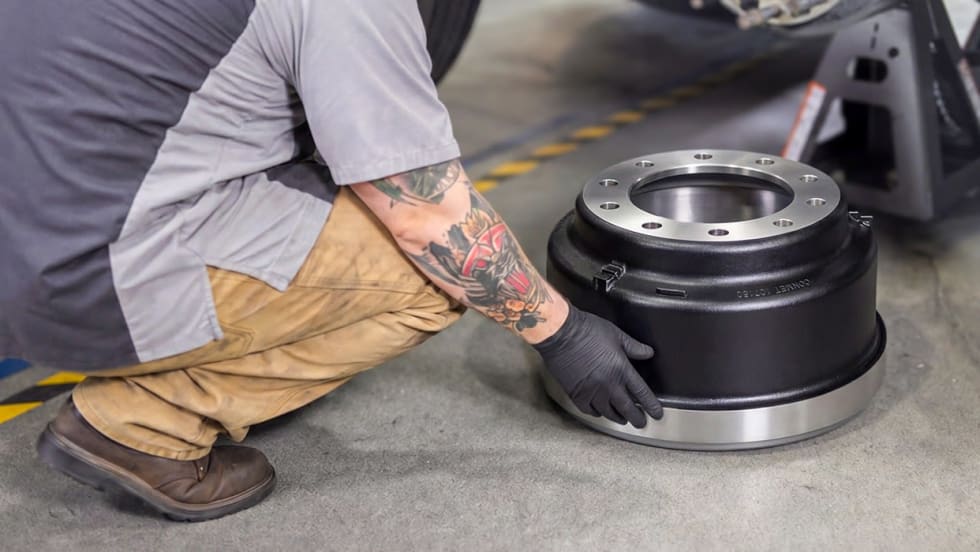
ConMet Expands Aftermarket Brake Drum Lineup With TruCast
A new heavy-duty truck brake drum option in the aftermarket gives customers more flexibility within the ConMet product family.
Read More →
Mack Expands Premium Service Contract Coverage to Medium-Duty MD
With a service contract, inspections, preventive maintenance and repairs can be handled in a single visit instead of multiple ones.
Read More →