





“At the moment, we’re not running any trucks with more than 750,000 miles in long-haul operations. But we’re getting close to the point where we’re going to have to." — Shane Sattler, Ploger Transportation
The Rise of the Million-Mile Truck?
Could you run your truck a million miles? As shortages and truck-maker backlogs mean fleets have been keeping trucks longer, some look at whether their maintenance program can handle a million-mile truck.
March 15, 2023
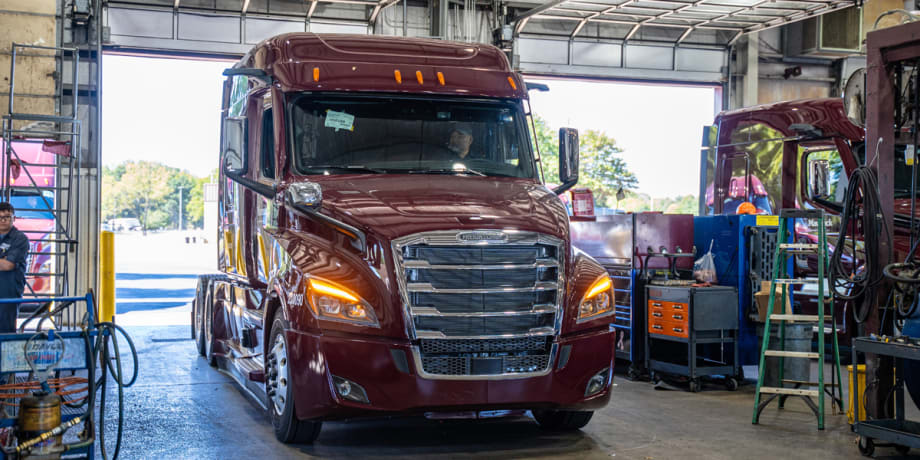
Higher-mileage trucks mean higher maintenance costs, say officials at Maverick Transportation, which is about 150 trucks behind where it wanted to be on its trade schedule.
Photo: Maverick Transportation
7 min to read
Maverick Transportation is about 150 trucks behind on its trade schedule.
“Being that far behind puts our average age of trucks higher than we like to see,” says John Julian, asset manager for the flatbed carrier out of North Little Rock, Arkansas. “Obviously, higher-mileage trucks are going to cost us more on maintenance.”
Maverick is just one example of the trucking fleets that have struggled with not being able to get new trucks in the past couple of years. The COVID-19 pandemic upended manufacturing and caused massive supply chain issues. As a result, many products, from small microchips all the way up to Class 8 trucks, are still difficult to purchase — especially in large numbers. This means that fleets are running trucks longer, and racking up more miles on them, than ever before.
Bruce Stockton, president of fleet consulting firm Stockton Solutions, says the majority of fleets he talks to and works with have had to either downsize their fleet or attempt to increase the life cycle of their trucks because they have been unable to buy at a rate equal to the maturation rate of their existing fleet.
“From what I’ve seen, in most cases, only the exceptional fleets with long-standing strong OEM and dealer relationships have been able to maintain or reduce their average truck age over the last three years.”
Keeping trucks longer has other downstream effects on fleet operations as well, Stockton says.
“I’m seeing fleets having to subsidize driver compensation and offer other perks to keep good drivers in older trucks,” he says. “And, of course, if you’re running older trucks, you’re going to suffer more downtime, and probably had to reduce your profitability expectations — all the while hoping that we’ll be returning to normal (pre-Covid) production rates sooner rather than later.”
It’s a sentiment Julian can relate to.
“The parts shortage not only affects our new truck deliveries but also has a direct effect on driver satisfaction,” he says. “Our drivers know that once their truck gets to a certain age, they’re due for a new truck. But now they are having to stay in those older trucks longer than normal.”
Maverick also must keep more unassigned trucks in the fleet and available to fill in for trucks in the shop, Julian says.
“Lots of times we have to seat drivers in a different truck to keep them going," he says. "All of which is why we definitely hope to get back to our ‘normal’ trade schedule. Because all of these issues definitely have not persuaded us to keep trucks longer in the future.”
One Fleet Isn’t Worried
Ploger Transportation, out of Norwalk, Ohio, is a small fleet that has its sights set on growth. Although small in size, Ploger has an outsized reputation for cutting-edge — even aggressive — maintenance procedures. Shane Sattler, director of maintenance for the fleet, recalls that in 2019, he’d pull a truck out of long-haul service around the five-year mark, usually with between 550,000 and 600,000 miles on it.
“After that, we’d run it for another two years on some of our local or regional routes before selling it,” Sattler says. “At that point, the truck typically had around 750,000 miles on it.”
Ploger is trying to grow to 90 trucks and 200 trailers in its fleet, an ambition stymied by the production problems of the last couple of years. Even though the fleet has a close relationship with Volvo Trucks North America, it simply can’t get the number of new trucks it wants. And that means the ones it has are going to have to run longer.
“At the moment, we’re not running any trucks with more than 750,000 miles in long-haul operations," Sattler says. "But we’re getting close to the point where we’re going to have to."
But he says he's not worried about that prospect.
"Our maintenance program is so extensive that I don’t have any problem stretching trucks out to a million miles for long-haul service," Sattler adds.
Ploger has the maintenance record to stake out a million-mile finish line for the trucks in its fleet. But is this a reasonable standard for other fleets? It may well have to be, some say — and not just because of the pandemic-related shortages.
A Different Maintenance Reality for Trucking Fleets
Darry Stuart, president of DWS Fleet Management Services, a fleet maintenance consulting firm based in Wrentham, Massachusetts, has been in the trucking industry since before The Beatles broke up. He says there are no hard-and-fast economic rules for disposing of trucks.
“Fleets get rid of trucks when it makes economic sense to do so,” he says. “And often, that’s more of a gut decision than anything else. You look at the price of new trucks, consider the value of your used trucks, and determine the price of money — in other words, what it’s going to cost you to finance new truck purchases — and go from there.”
Stuart says that in his experience very few fleets truly can predict the best time to dispose of trucks. But, he says, it’s really simple.
“It’s not about the number of miles on the odometer,” he insists. “It all comes down to when it’s time to overhaul the truck’s engine. And that’s why so many fleets are nervous about extending truck life today. Because we’re in a different maintenance reality today.
“Years ago, rebuilding engines was an everyday thing for shops. Today, it’s rare. Most of the time, a job like that goes back to the dealer, for a variety of reasons. So many fleets today don’t have the experience needed to economically overhaul engines. But they do know that if they send it to the dealer for an overhaul, they’re looking at a $40,000 repair bill. So, there’s understandably some angst out there about going out past 500,000 miles on trucks.”
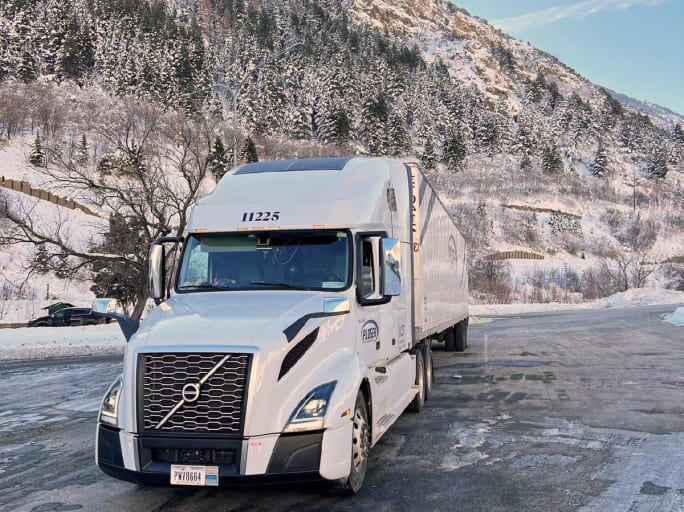
With some trucks already at the 750,000-mile mark, Ploger Transportation leadership says they're confident the company's proactive maintenance program will allow the company to push trucks out to 1 million miles.
Photo: Ploger Transportation
However, Stuart believes many trucks may not need that $40,000 overhaul.
“My theory is the only reason to have an engine overhauled is if it’s using oil,” Stuart says. “And because most fleet executives today are not mechanically savvy, they’re going to follow the dealer’s lead on the job. And that means paying for a warranty. And that means the dealer is going to want to replace pretty much everything on the engine to make sure there’s not a catastrophic failure that’s going to cause them to have to honor the warranty.
“But here’s the thing: $40,000 for an engine overhaul does not guarantee you another 600,000 miles on the truck. So why spend that much money?”
Stuart suggests skipping the warranty and just having a basic overhaul done.
“I’d re-ring the engine,” he says. “And I’d put in new rods and main bearings to avoid a catastrophic failure. Now, [the dealer is] still going to warranty the labor they do on the engine. If the technician puts the rings in upside-down, they’re going to honor that mistake and repair it. So, you’re still protected. And if you follow this path, you can get the truck back to work for around $15,000 — which is a hell of a lot better than $40,000!”
Rethinking Class 8 Truck Trade Cycles
Generally speaking, Stockton says, he’s seen fleets move from an “excellent” maintenance cost per mile of 10 to 12 cents per mile to 27 to 30 cents per mile as lifecycles increase.
“To me, 36 to 42 months, or less than 400,000 miles, is still the sweet spot, if not the maximum reliable life cycle for today’s trucks,” he says. “In my experience, anything past those points has massive — incrementally — increased costs to owning and operating the truck. And I just don’t feel those are sustainable, as inflation continues to gobble up any leveling off in prices or potential increased freight rates.”
Sattler, on the other hand, isn’t worried about taking Ploger trucks out to a million miles.
“We’re already at the 750,000-mile mark,” he says. "And we’re not afraid to go to a million miles. It’s new territory, and stuff will happen that we can’t anticipate right now. But our preventive maintenance schedule is solid. And so are the Volvos we run. So, we’re not sweating bullets if we need to go out to a million miles.”
The million-mile marker is going to be another financial decision for fleets, Stuart says.
Subscribe to Our Newsletter
More Maintenance

Sponsored•September 16, 2026
Color Match Smarter: Tools That Restore & Perform
For fleet managers and collision repair professionals keeping heavy-duty trucks on the road, getting the color right the first time isn't just about appearance — it's about efficiency, turnaround time, and bottom-line results. Discover how today's digital color tools are transforming the repair process from guesswork to precision.
Read More →
Wrong Repair Prompts Recall of Freightliner, Western Star 4x2 Trucks
DTNA is recalling more than 2,400 trucks that received an incompatible software fix instead of the hardware repair required to address brake valve corrosion.
Read More →
Truck Drivers Need More Than Another Alert
Fleets have more visibility into truck health, safety events, and driver activity than ever. The next challenge is turning all that information into useful guidance for the person who has to decide what to do next.
Read More →
The Maintenance Checks Trucking Fleets Should Prioritize Before Fall Freight Picks Up
Making it through August isn’t the same as being ready for the next several months of operation. Find out what systems may have suffered from summer heat and need to be checked out before fall.
Read More →
What Three Fleets Are Doing Differently When Buying Truck Parts in 2026
With freight improving but costs still climbing, fleet maintenance executives explain how they're balancing price, quality, and supplier relationships.
Read More →
Paccar Recalls 2027 Trucks Built This Summer for Possible Electrical Problem
The nearly 6,000 Kenworth and Peterbilt trucks in the recall could potentially lose engine power, among other things.
Read More →
Will API PC-12 Oil Change Trucking Fleet Maintenance?
The new API PC-12 heavy-duty engine oil category reflects the changing demands of modern diesel engines. But fleets like Foodliner are looking to getting their own data before making decisions on adopting the new oils and questions such as extending oil drain intervals.
Read More →
Brake Safety Week to Focus on Drums and Rotors
Commercial vehicle inspectors are focusing on truck brakes during CVSA's Brake Safety Week, August 23-29.
Read More →Possible Battery-Cable Fires Prompt Recall of 15,000+ International MV and HV Trucks
On the recalled vehicles, manufacturing variations can cause the battery interconnect cable to contact the auxiliary stud and hold down the bracket.
Read More →
Rush, MCT Team Up to Grow Refrigeration Service Network
The joint venture will operate MCT's network of Carrier Transicold dealerships and mobile service locations, with the companies promising greater service capacity and uptime for refrigerated fleets.
Read More →