





A Collection of Hybrid and Electric Trucks and Vans [Photos]
The Latest Developments in Hybrid-Electric Medium-Duty Trucks
New developments, technologies, and trends in hybrid-electric, medium-duty trucks could give fleet managers the incentive they need to take a closer look at how hybrid options could help reduce overall costs.
March 11, 2014
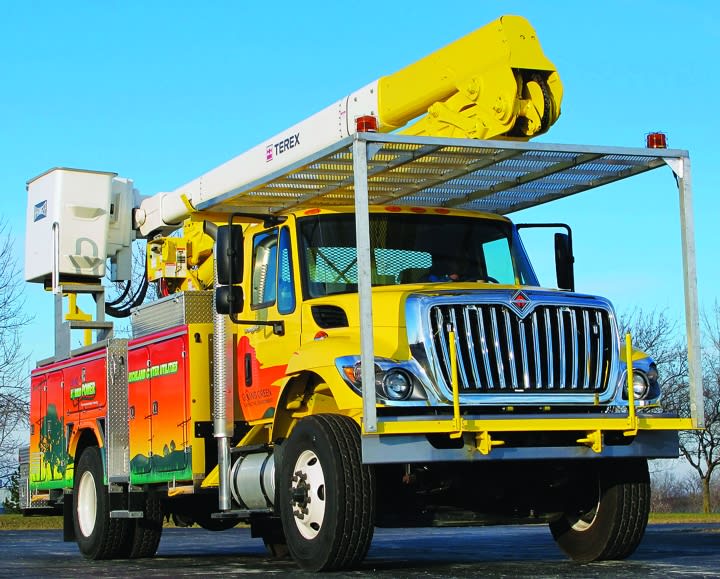
The Odyne PHEV parallel system reduces fuel consumption and emissions, and can be used in new vehicle and retrofit applications.
Photo: Odyne
6 min to read
For fleet managers looking to slash fuel costs and go green, without the “range anxiety” often associated with alternative fuels, diesel hybrid-electric trucks are gaining momentum in the medium-duty market.
According to Navigant Research, annual U.S. sales of hybrid-electric medium-duty trucks reached around 900 units in 2013 and are forecasted to exceed 4,400 trucks by 2020 — a four-fold increase.
The potential fuel savings is compelling. In the right applications, where there’s a lot of stop-and-go driving to allow for regenerative braking, which captures braking energy to restore charge to the onboard battery, today’s hybrid-electric trucks offer fuel efficiency gains as high as 40%.
But, the incremental cost is also still high, ranging from $12,000 to $40,000, depending on truck class, type of hybrid system, and battery capacity, making a reasonable payback timeframe difficult to achieve without generous government subsidies.
Fleet managers are looking to new developments, technologies, and trends to improve the business case for hybrid-electric medium-duty trucks and drive increased fleet adoption.
Comparing HEVs and PHEVs
One trend to look for is a shift from standard hybrid electric vehicle (HEV) systems, which rely exclusively on regenerative braking for recharging the battery, to more plug-in hybrid electric vehicles (PHEVs), which deploy both regenerative braking and direct electrical grid-to-vehicle charging capabilities.
According to Navigant Research, of the 900 hybrid medium-duty trucks sold in 2013, around 83 percent were HEVs, but, by 2020, market share will shift dramatically in favor of PHEVs, with 59 percent to 41 percent for HEVs.
Lisa Jerram, senior research analyst for Navigant Research, thinks that, at least in the near term, the market for HEVs will remain strong.
“Since the hybrid truck market is still struggling to improve the return on investment timeframe, many truck OEMs will want to keep the lower cost drivetrain option — that is, the standard HEV,” she said.
The advantages of PHEVs could make hybrid truck technology more acceptable to an even wider fleet market. Longer-use onsite electrical power to run heavy equipment, such as aerial platforms and cranes, without running the diesel engine, and capabilities for all-electric drive with diesel engine backup might make the shift to this new technology more attractive for department budgets.
“A PHEV that has onsite electrical power sweetens the business case — where the fuel savings benefit is as much or more from replacing idling at work sites as it is from driving [via regenerative braking],” Jerram said. “We see the plug-in market growing, especially since utilities are looking to adopt more electric vehicle technologies but may find that a pure all-electric vehicle is not appropriate for their utility vehicles. The PHEV offers more recharging flexibility and can provide some degree of all-electric driving plus the exportable power option.”
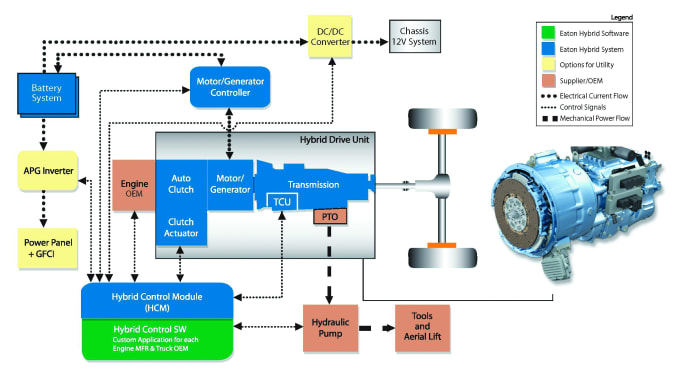
The Eaton Hybrid Drive HEV parallel system uses patented controls to blend engine torque with electric torque to move the vehicle.
Photo: Eaton Hybrids
Extending Range with Series Hybrids
The predominant hybrid technology used in today’s medium-duty truck market is the parallel hybrid, in which both the electric motor and diesel engine are linked mechanically to the drive wheels, typically through a shared transmission. Examples of parallel hybrids available today include Hino 195h, Peterbilt 330 Hybrid, and Freightliner Business Class M2e. The electric motor provides an extra “boost” to propel the vehicle from a stop or low speed, working in concert with the diesel engine, until the truck reaches a speed where the diesel engine operates on its own at optimal efficiency.
In a series hybrid, also known as an extended-range hybrid, the drive wheels are powered exclusively by the electric motor, while the diesel engine serves as a generator to keep the battery charged, with no direct mechanical link to the drive wheels. An example is the Electric Vehicles International (EVI) Extended-Range Electric Vehicle (e-REV) utility vehicle, a plug-in series hybrid that boasts 40 miles in all-electric mode with extended range in hybrid mode.
“I expect the parallel hybrid to continue to be the dominant configuration, in part because they have smaller batteries and that reduces the price premium,” Jerram forecasted. “The extended-range technology is good for certain applications, such as utility trucks that have relatively low daily mileage but cannot go all-electric because their daily routes are not totally predictable.”
Adding it All Up
A big challenge for medium-duty truck hybrids is achieving an acceptable return to justify the up-front investment, according to Brian Matuszewski, sustainability manager for ARI, a full-service fleet management firm.
“Because batteries are still very expensive, it is very challenging to get a realistic ROI without government incentives. But, in cases where generous rebates exist, and we feel the client has a good shot at obtaining those incentives, and the duty cycle is appropriate, we will consider the hybrid truck. It really all depends on those factors coming together,” Matuszewski said.
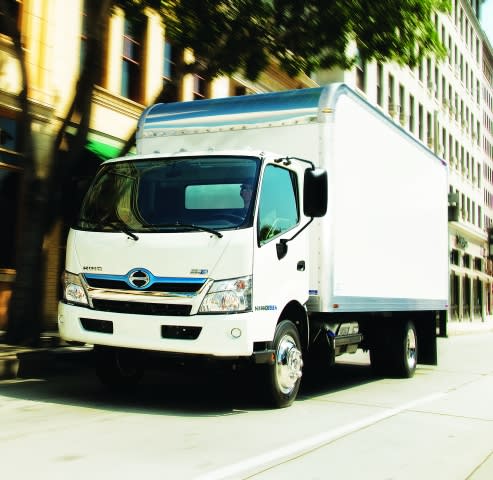
Hino’s 2014 195h cabover parallel HEV features the Hybrid Adaptive Control System, which continuously communicates with the Engine Control Unit to evaluate driving and road conditions for increased fuel economy and performance.
Photo: Hino Trucks
Adrian Ratza, marketing manager at Hino Trucks, said that, because the incremental cost for Hino’s Class 5 195h cabover, a parallel HEV, is relatively low — a $12,000 option — customers can achieve a payback in as little as five years in the right application, even without government subsidies, based on a range of 20,000 miles per year and a duty cycle with an average speed of 25 to 40 miles per hour to get the most out of regenerative braking.
However, no matter the premium, Ratza said that incentives still carry a lot of weight in driving hybrid sales. Of the roughly 400 hybrid trucks Hino has sold in the U.S. market since late 2012, the vast majority have sold in California because of the incentive money.
“I think that most alternative-fuel vehicles are running into the same issue we are,” Ratza said. “If incentives are not out there to assist the customer, there is just very little activity in regard to alternative fuel purchases. We’re keeping our eyes open on what different states are going to have in terms of incentive programs.”
Another concern for fleet managers is the uncertain residual value. Is the hybrid technology today likely to become obsolete eight to 10 years down the road? How can a fleet manager make a total cost of ownership (TCO) calculation and assessment with such uncertainty?
“It’s a risk fleet managers need to consider,” Matuszewski said. “The fact is, no one really knows what the residual value of these vehicles is going to be. And realistically, a battery can only last so long. If battery prices remain where they currently are, replacing a battery will continue to be a substantial investment and that needs to be factored into the overall decision about whether to choose a hybrid.”
As a way to deter some concern over this uncertainty, Hino adds 3 percent to its hybrid vehicle’s residual value over the manufacturer’s standard diesel product through Toyota Financial Services, based on the company’s experience with hybrids on the auto side, according to Ratza.
Looking Down the Hybrid Truck Road
Despite the risks, several market forces — such as emissions regulations, anti-idling policies, the rising popularity of corporate sustainability programs, and escalating fuel costs — are driving greater interest in hybrids in the medium-duty truck market, said Matuszewski.
For Jerram with Navigant, the linchpin for widespread fleet adoption of medium-duty hybrids is the battery, the most expensive component for the hybrid drive system.
As battery cost decreases and capacity increases, the payback time frame for hybrid trucks will become more attractive, offering a more compelling business case to make the switch.
Subscribe to Our Newsletter
More Fuel Smarts

How Volvo Updated Its D13 for EPA 2027 [Watch]
Volvo’s updated D13 promises lower emissions without sacrificing performance or fuel economy. Take a closer look at what changed inside the engine in this HDT Spotlight video.
Read More →
Diesel Price Spike Shortens Payback for Natural Gas Trucks, Report Says
Energy Vision estimates fleets could recover the higher purchase price of an RNG-fueled Class 8 tractor in 1.3 to 2.8 years under current fuel-price scenarios.
Read More →
Calstart Becomes Catalyst Mobility, Reflecting Broader Focus
Calstart is now Catalyst Mobility, reflecting the nonprofit’s growing national role in clean transportation, including zero-emission trucks, infrastructure and incentive programs.
Read More →

Record Diesel Prices Squeeze Trucking Fleets
Average U.S. diesel prices have climbed to nearly $6 a gallon, surpassing the 2022 record as tight refinery capacity and Middle East disruptions keep fuel costs elevated.
Read More →
Sponsored•September 9, 2026
How Fuel Delivery Shapes Engine Performance
Fuel delivery depends on more than what happens at the injector. For fleet, maintenance and technical professionals, looking at the full path from pump to injector can provide useful context for understanding engine performance.
Read More →
East Coast Port Launches $45M Electric Truck Push
The Port Authority of New York and New Jersey announced millions in incentives for zero-emission drayage trucks, yard tractors, and new charging hubs near the port.
Read More →
California Bill Could Shed Light on Electric Truck Prices
Why do battery-electric Class 8 trucks remain so expensive? A California bill headed to Gov. Gavin Newsom would give fleets and state agencies more visibility into what manufacturers charge.
Read More →
Detroit Opens Orders for EPA 2027 Engines
Detroit isn’t starting from scratch to meet EPA 2027 diesel emissions standards. Its Gen 6 DD13 and DD15 engines keep much of today’s platform while updating the fuel and aftertreatment systems.
Read More →
Zero-Emission Truck Corridor Planned for West Coast
California, Oregon, Washington, British Columbia and Baja California are coordinating plans for truck charging and hydrogen fueling from Canada to Mexico.
Read More →
A Closer Look at Kenworth’s Electric T880E Vocational Truck [Video]
Learn more about Kenworth's T880E battery-electric vocational truck at the Paccar Technical Center, including its range, applications, upfitting considerations, and PTO options, in this HDT Spotlight video.
Read More →