




The Impact of Small Verdicts on Trucking Companies
"Death by 1,000 cuts," is how two attorneys characterized the impact small verdicts can have on trucking companies. Here's what fleets need to know about today's litigious environment.

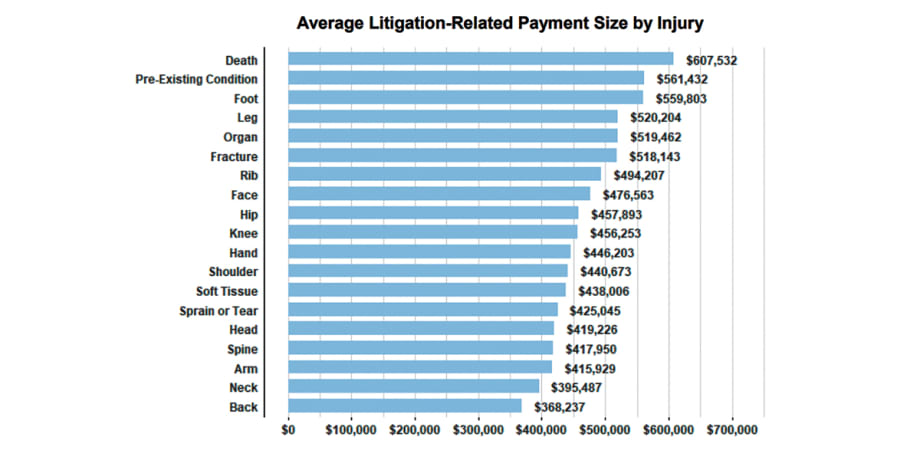
Cases that did not have a fatality had an average payment of approximately $428,000.
Source: American Transportation Research Institute
If you pay attention to local radio and television ads, you may notice attorneys, big and small, seeking to represent those involved in accidents with a truck. Why? Because there’s big money in it for them.
“Even the smallest guys out there, one-man, two-man lawyer shops, are putting out these ads, and trucking fleets are the target. That’s absolutely true,” explained Steve Stanaszak, partner at transportation law firm Scopelitis, Garvin, Light, Hanson & Feary, during a session at HNI Risk Advisors’ DeRiskathon executive leadership conference in June. “They know that [trucking fleets] all have big policies; you all have assets. This is big money. They’re trying to attract it.”
While “nuclear verdicts” — awards millions of dollars more than the damages suffered in an accident — are a reality in the trucking industry, what’s even more concerning is that the litigious environment the industry is in now means plaintiff attorneys are attempting to maximize value on all lawsuits, explained Stanaszak and fellow Scopelitis partner Jay Starrett.
The smaller claims — the ones that happen thousands of times a day and result in non-catastrophic injuries such as neck, back and shoulder problems and soft-tissue injuries — are now raking in more money than ever before. There are cases where what used to be a $200,000 claim turned into a $750,000 verdict. Bluewire Founder and CEO Steve Bryan said juries now have a “numbness to the numbers.” (Bluewire uses a data-driven approach to help motor carriers protect themselves against “false narratives.”)
The cost of doing business for those claims is skyrocketing, and fleets should pay attention.
“There is, from jurisdiction to jurisdiction, no continuity about how these cases are coming back,” Starrett said, calling the environment erratic and unpredictable. “What’s happening is this: People have become politically divided. People have cocooned themselves during the pandemic. People are getting their information from limited sources. People are coming into jury pools no longer as sort of a community, but as … individuals who have their own ideas about what’s right and what justice means.”
The average size of a settlement payment for a soft-tissue injury in a case with one or two injuries was $331,000, according to a November 2021 American Transportation Research Institute report, “The Impact of Small Verdicts and Settlements on the Trucking Industry.”
Starrett said the environment the industry is in now is a whole new monster.
“We have a history of being able to put a number on [the case files that come across our desk], and Steve and I do this every single day,” he said. “Our job is to evaluate claims. Our job is to find the value of what those claims are. I can tell you that within our office we’re checking each other on a daily basis, because what we thought we always knew, we’re not sure anymore. You know, I’m more unsure about putting a number down today than I probably have in the last 20 years in my career.”
All cases are more valuable than they used to be, he said. Although part of that is the rising cost of medical care, what’s really leading to unpredictable settlements is the cost of pain and suffering.
“Even when you get a case that you think is a relatively minor case, do the due diligence as you would on a major case, because these smaller cases are becoming more and more expensive,” Starrett said.
Starrett advised fleets to have an expert witness, such as an engineer or doctor, on retainer, because expert witnesses have been shown to result in a 25% reduction in average verdict size. He also said fleets should have, and closely follow, corporate policies.
“A good plaintiff’s lawyer is not necessarily going after your driver. That’s kind of the easy part,” Starrett said. “Frankly, a good plaintiff’s lawyer is going after you and your practices, seeing whether or not you follow your own internal rules and procedures. When your driver gets on the witness stand, he looks like everybody else. Your driver looks like somebody trying to put food on the table, pay the mortgage … looks like everybody else on the jury. But the big corporation raking in millions of dollars a year, that doesn’t follow its own procedures or doesn’t follow all the Federal Motor Carrier Safety regs? That’s the target.”
This article appears in the July 2022 issue of Heavy Duty Trucking magazine.
More Safety & Compliance
PrePass, Kodiak Connect Driverless Trucks to Roadside Enforcement
The system will allow enforcement agencies to verify Enhanced Inspection information and decide whether Kodiak’s autonomous trucks can bypass roadside screening sites.
Read More →
From One Generation to the Next: How Mentorship Builds Safer Truck Drivers
After three decades in trucking, Harold Perry shares what he's learned about driver safety, mentorship, and helping the next generation build confidence behind the wheel.
Read More →
FMCSA Pauses Biennial-Update Enforcement Amid Motus Transition
Carriers whose updates were due on or after June 1 have more time, while FMCSA works to stabilize its new registration system and warns of phishing sites impersonating its new carrier registration system, Motus.
Read More →
ZF Expands Commercial Vehicle Push in North America
ZF is expanding its North American commercial-vehicle presence with new transmission applications, electrification, trailer technology and autonomous-driving systems.
Read More →
Truck Drivers Need More Than Another Alert
Fleets have more visibility into truck health, safety events, and driver activity than ever. The next challenge is turning all that information into useful guidance for the person who has to decide what to do next.
Read More →
Tesla Wants a Self-Driving Semi. Are Cameras Enough?
Could Tesla’s camera-only autonomous driving technology work on an 80,000-pound Semi? In this commentary, HDT's Deborah Lockridge takes a look at Tesla, Cybercab, and how autonomous trucks see the road.
Read More →
What DOT’s Automated Vehicle Strategy Means for Trucking
The U.S. Department of Transportation issued a new automated-vehicle strategy that outlines plans for driverless-truck regulations, cross-state freight corridors, and federal safety standards.
Read More →
NYC Expands Speed, Pedestrian Safety Tech Across Fleet
New York City is expanding intelligent speed assistance and pedestrian-alert systems across its municipal fleet, moving the technologies from pilot programs into vehicle procurement and retrofit requirements.
Read More →
FMCSA Removes 110 Truck Driver Training Schools from Certified ELDT List
Federal regulators also are targeting more than 160 additional training providers and launching a nationwide audit of third-party CDL skills testers as part of a broader crackdown on trucking fraud.
Read More →
Beyond DOT Compliance: What Makes a Trucking Fleet Truly Safe?
A trucking fleet can follow every rule and still make unsafe decisions. The real test comes when safety conflicts with freight, productivity, or cost.
Read More →