




The Future of Trucking Telematics
Telematics is already a powerful management tool for trucking fleets — and one that is constantly evolving. Heavy Duty Trucking asked industry experts what they think the near future of fleet telematics will look like.

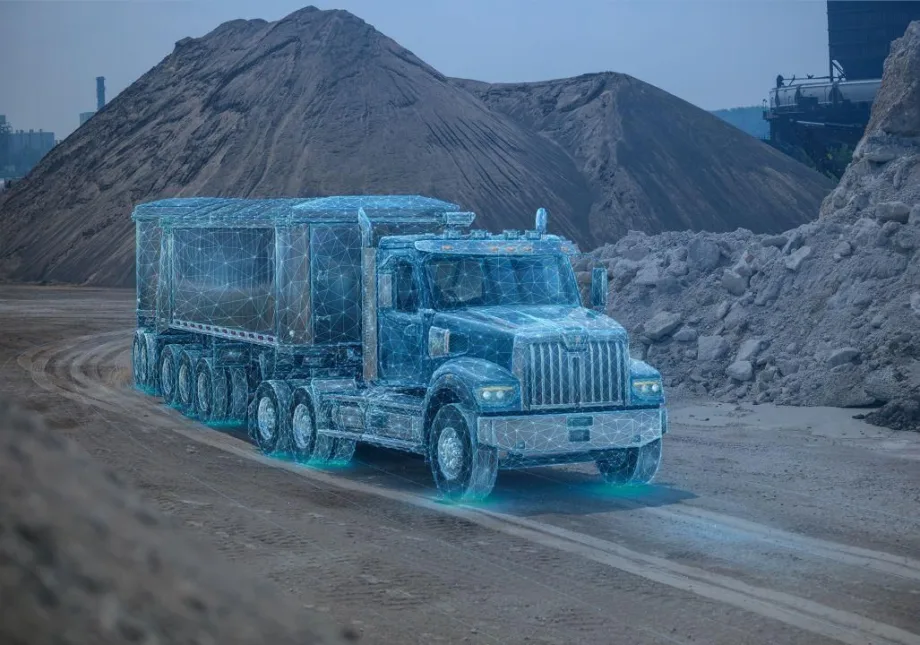
Commercial vehicle telematics systems grow more powerful every day. But what does the next generation of this remarkable technology promise fleets?
Photo: Daimler Truck North America
The future of telematics in commercial vehicles dates back farther than most people realize. Omnitracs began experimenting with early, satellite-based systems in the mid-1980s. The early focus was on vehicle location and communications with drivers. But it was obvious that sensor-based diagnostics held a lot of potential for fleet customers, as well.
Those early systems required a physical connection between the vehicle’s CAN bus and a computing device.
But by the early 2000s, with mobile devices and cellular networks growing by leaps and bounds, the future of fleet telematics seemed assured.
Increasingly robust and capable sensors began appearing on numerous vehicle systems and components – a trend that continues today.
Since those early efforts, telematics have become increasingly sophisticated and reliable. Today’s systems allow over-the-air (OTA) software updates that can enhance a vehicle’s performance without so much as opening its hood.
And telematics systems have become integrated with virtually every aspect of modern fleet operations.
While the initial focus was on location and then maintenance, today’s telematics help fleets manage safety, driver training, route efficiency, purchasing decisions, spec’ing vehicles, and so much more.
Were Telematics Giving Truck Fleet Managers Too Much of a Good Thing?
But there also have been problems with telematics technology. In most cases, it’s really been a matter of too much of a good thing.
Telematics systems can pull millions of data points off a single vehicle every day. Fleet managers often found themselves overwhelmed with data. Much of it was simply not pertinent to daily operations or solving specific problems.
Moreover, for understandable reasons, each telematics provider wanted to direct users to their own proprietary interface portals and data management systems.
For many fleet managers, managing telematics is an ongoing struggle to simplify the amount of data coming in and the systems used to process it. In addition, fleets are seeking to effectively direct data distribution to the people who need it and convert it into actionable intelligence.
Will AI Be the Trucking Telematics Game-Changer?
To their credit, telematics providers understand these frustrations. Over the past few years, many telematics developers have been working diligently to streamline the data generated by vehicles and direct the right information to the relevant managers in a format that allows them to act quickly.
And many experts say artificial intelligence will be the game-changer that enables telematics to finally reach its true potential.
That’s because AI can crunch numbers, spot patterns, deal with repetitive processes, draw conclusions, and make recommendations at speeds far beyond human capabilities.
It is clear that telematics are growing more powerful and capable. It's equally clear that the full potential of telematics will not be realized until fleet managers can make optimal use of incoming data in a timely, efficient manner.
Will the next generation of telematics finally fulfill that potential?
To find out, HDT asked leading commercial vehicle experts from around the globe on what fleet managers can expect to see from telematics systems in the near future.
Here’s what they had to tell us.
Leveraging Telematics Data with Generative and Agentic AI
Dominic Hand, VP, digital, Thermo King Americas

Photo: Thermo King Americas
Connecting fleets enables remote data, visibility, and control. The next step is leveraging this data with generative and agentic AI for actionable insights and automation.
Fleets that excel at this will cut costs and improve performance, giving them a competitive edge. Rapid AI advances will make autonomous operations more achievable when combined with expertise in fleet management, equipment and maintenance.
Telematics Offer Enhanced Focus on Predictive and Proactive Maintenance
Maddie Sullivan, product marketing manager, Volvo Trucks North America
I think the next major evolution in truck telematics will be focused more on predictive/proactive maintenance. The more connected we can make our vehicles, the easier we can avoid unnecessary maintenance or identify potential problems.
Trucking Telematics Enable Automated Decisions and Seamless Action
Kerry-Leigh Goodier, director, digital market strategy and management, Cummins

Photo: Cummins
As the commercial vehicle industry accelerates toward greater digitization, the next leap in telematics won’t be about collecting more data — it will be about turning that data into automated decisions and seamless actions.
For fleet operators, that means moving from reaction to orchestration — across the entire vehicle, not just the engine.
The future isn’t just about optimizing individual components; it’s about synchronizing the entire system.
As telematics matures, the engine, transmission, aftertreatment, and even the trailer will increasingly operate as a digitally connected ecosystem, capable of coordinating in real time.
That means service events won’t just be triggered by a single fault code. Instead, the vehicle could recognize broader patterns, like how terrain, payload, and driver behavior are impacting performance, and suggest maintenance before a failure happens.
The result? Fewer surprises, better planning, and a more predictable maintenance schedule.
These capabilities are the building blocks of the software-defined vehicle (SDV), a platform where new value-oriented capability gets added constantly through software updates.
Ultimately, the next evolution in truck telematics is about empowering fleets with systems that think, respond, and adapt in real time — across the powertrain and beyond.
From predictive diagnostics and OTA updates to SDV architectures, Cummins is here to support this with intelligent, dependable technology that helps Fleets make the most of every mile, every asset, and every day on the road.
The Quest for an All-in-One Telematics Platform
Kenworth Trucks spokesperson
The next major evolution in truck telematics will be the creation of an integrated all-in-one platform.
Paccar’s strategic partnership with Platform Science will bring a new dimension of adaptive ingenuity to trucks, empowering operators to tap into a broad suite of solutions that precisely meet their fleets’ needs.
Kenworth customers will benefit from a standardized technology environment that reduces the number of telecommunication devices required to ultimately redefine fleet management and operational efficiency.
Integrated Information Solutions

Photo: Eaton
Tim Bauer, vice president, global aftermarket, Eaton
Fleets are prioritizing technologies that not only boost fuel efficiency but also support their drivers on the road.
Today’s smart cruise control systems are designed to optimize routes, manage speed, and fine-tune acceleration and braking — enhancing driver comfort, reducing fatigue, and delivering measurable fuel savings.
These integrated solutions empower drivers while helping fleets meet their performance and sustainability goals.
When Heavy-Duty Trucks Can Make Decisions on Their Own

Photo: Eaton
Bobby Robinette, manager, digital service solutions, Eaton
The next telematics revolution is trucks that don’t just report — they decide.
Secure‑by‑design networks, one governed data gateway, and OEM‑led data stewardship set the foundation.
On‑vehicle edge AI will turn faults and raw data into next‑generation diagnostics, predictive maintenance, and remaining useful‑life guidance — delivering answers and actions that drive first‑time fixes, cut unplanned downtime and lower TCO.
Deep-Dive Telematics Integration from Day One
Nirav Patel, VP, product marketing, Samsara
The next major evolution will be characterized by the deep, native integration of market-leading telematics and safety solutions directly into the original equipment manufacturer in-vehicle systems.
This shift will streamline fleet operations and accelerate the time-to-value for new assets by minimizing the overall vehicle downtime traditionally allocated to coordinating and executing separate hardware deployments.
This seamless, 'day-one' readiness will deliver immediate return on investment and simplify the management lifecycle for fleet leaders.
The Future of Freight is in the Trailer
Mark Wallin, general manager and SVP of product, Phillips Connect
The future of automation and intelligence in freight begins in the trailer. The trailer is becoming the most valuable source of untapped intelligence in transportation.
Smart trailer technology is turning the lights on, capturing and interpreting data that fleets have
never been able to see before.
Every component of the trailer will be connected, with sensors monitoring health, performance, and cargo while communicating seamlessly with the tractor, driver, and back office.
With AI and machine learning analyzing real-time inputs from these systems, fleets can understand cargo volumetrics, detect load shifts, monitor brake and tire health, and predict maintenance needs before they’re a
cause for downtime.
This growing intelligence will shape the next generation of fleet operations, powering optimization, safety, and reliability. What is an advantage for fleets today will soon become a requirement in the era of autonomous trucking.
True automation depends on this visibility and learning. The more fleets connect and understand what’s happening inside their trailers, the closer the industry moves toward a fully autonomous, data-driven future.
Are There Telematics Data Fees on the Horizon?

Photo: Decker Truck Line
Brent Ellis, vice president, business systems and processes, Decker Truck Line
While I’d like to see a more open platform that would allow the telematics device to easily connect to other systems (APU meters, TPMS, trailer sensors, etc.) in a plug-and-play situation, I feel like the next evolution won’t be in our favor.
I believe the OEs will determine the minimum ECM data required for ELDs to meet the standard, and any other data will have fees associated with it.
Telematics as the Backbone of Trucking Fleet Operations

Photo: Mack Trucks
Ashish Sadhu, services director, Mack Trucks
Today, telematics is no longer a bolt-on black box. It is built into the truck’s DNA, linking every stakeholder in the value chain and redefining the economics of uptime.
The coming decade will see telematics complete its evolution from add-on black boxes to the backbone of fleet businesses.
What once displayed dots on a map will soon operate as a distributed control layer, sensing, deciding and coordinating across vehicles, depots, grids and road infrastructure.
Three major trends will be:
5G/6G networks and low-earth-orbit satellites delivering continuous, high-fidelity data streams across global operations.
V2X communications and automated braking will make connected safety a cooperative, data-driven function.
Electrified powertrains, megawatt charging and software-defined uptime will fuse energy management with operational intelligence.
Together, these forces will redefine telematics as the fleet’s operating system rather than an auxiliary toolset.
With richer data and lower latency, telematics will evolve from descriptive dashboards to prescriptive intelligence – driven by edge analytics.
Processing data at the source, edge systems will classify faults, predict component life and automatically generate work orders aligned to parts and bay capacity.
Over-the-air (OTA) updates will go beyond firmware to deliver optimized parameters, idle thresholds, torque curves and thermal limits, allowing vehicles to continuously self-calibrate.
The result: remote-first maintenance, fewer unplanned derates and shorter, smarter shop visits.
If the past decade was about connection and compliance, the next will be about coordination and choreography. Trucks will roll off the line with digital identities, subscribe to data services based on their duty cycles, self-schedule maintenance, coordinate charging with the grid, and talk to intersections as naturally as they do to dispatch.
Generative AI (GenAI) will serve as the cognitive accelerator of this transformation, turning telematics data into intelligence that learns, adapts and creates.
While traditional telematics analyzes structured signals, GenAI will fuse sensor data, service logs, and video into a contextual, human-like understanding.
GenAI will interpret diagnostic patterns, summarize fleet health, and generate maintenance recommendations such as, “Injector efficiency trending 12% low, schedule service within 1,200 miles.”
AI assistants will allow drivers and fleet managers to ask, “Show me Unit xx’s fault history and part availability,” and receive synthesized responses from telematics, inventory and repair systems.
AI models will analyze fleetwide telemetry to propose OTA calibration updates, improving efficiency and emissions performance in real time.
Personalized feedback delivered through voice or app will guide drivers on acceleration, braking, and energy use, blending behavioral science with telematics data.
Generative AI will elevate telematics from connected to cognitive, enabling fleets to understand themselves in real time and act before failure occurs.
AI-Powered Predictive Analytics
Spokesperson, Daimler Truck North America
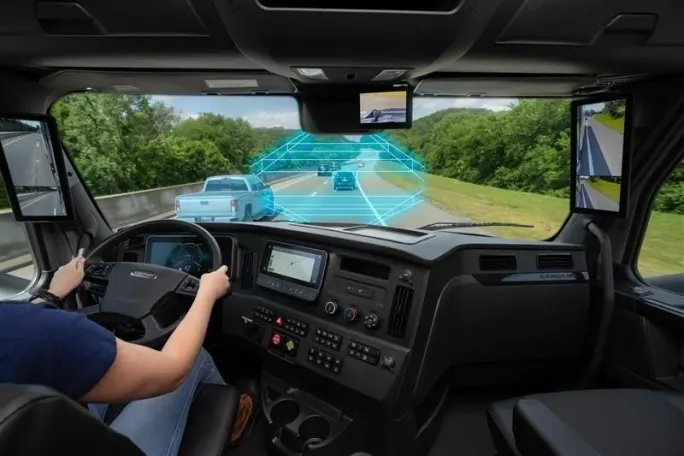
The next generation of truck telematics will feature combining cloud-based data platforms with advanced edge computing, according to Daimler Truck North America.
Photo: Daimler Truck North America
We see the next big leap in heavy-duty truck connectivity coming from AI-powered predictive analytics. By combining cloud-based data platforms with advanced edge computing, sensors, cameras, and digital driver displays, we’re enabling predictive maintenance, optimizing energy efficiency, and advancing driver safety monitoring, all of which will ultimately improve uptime, support compliance, and boost profitability for our customers.
A Big Demand to Know More
Mark Gauer, program manager, Hendrickson Vehicle Technologies Group

Photo: Hendrickson
We see the next big leap in heavy-duty truck connectivity coming from AI-powered predictive analytics.
By combining cloud-based data platforms with advanced edge computing, sensors, cameras, and digital driver displays, we’re enabling predictive maintenance, optimizing energy efficiency, and advancing driver safety monitoring, all of which will ultimately improve uptime, support compliance, and boost profitability for our customers.
There's a demand in the market to know more. The challenge is really in the next phase: how do you make those insights actionable?
A big part of what we're doing is asking, do you have smart sensors? Do you have good insights? How do I create smart experiences in the right hands?
And everybody's talking about that.
We need to tell a driver the things that are relevant to them. We need to tell them their needs. And part of that is our effort to make a smarter app for those particular people. So, it's fit for purpose and served up in a way that the driver can act on it, and the dispatcher can act on it.
So I think you're starting to see more connected equipment. You're seeing better smart interfaces, and more abundance of platforms that are really bringing all this together to solve some of the challenges that fleets have, and making sense of it, doing it at scale.
More Fleet Management

Color Match Smarter: Tools That Restore & Perform
For fleet managers and collision repair professionals keeping heavy-duty trucks on the road, getting the color right the first time isn't just about appearance — it's about efficiency, turnaround time, and bottom-line results. Discover how today's digital color tools are transforming the repair process from guesswork to precision.
Read More →
FMCSA Pauses Biennial-Update Enforcement Amid Motus Transition
Carriers whose updates were due on or after June 1 have more time, while FMCSA works to stabilize its new registration system and warns of phishing sites impersonating its new carrier registration system, Motus.
Read More →
2026 Blueprint for Countering Smarter Supply Chain Theft
Cargo theft is no longer just the cost of doing business. It's a multi-billion-dollar criminal enterprise exploiting vulnerabilities across your fleet, drivers, and supply chain.
Read More →


How Telematics Improves Visibility, Control, and Performance in Refrigerated Fleets
Explore how telematics help refrigerated fleets improve visibility, uptime, efficiency, compliance, and cargo protection across connected cold chain operations.
Read More →
What the U.S.-Canada Trade War Means for Trucking
Escalating U.S.-Canada tariffs could disrupt cross-border freight, reduce truck volumes, raise costs, and create new uncertainty for carriers on both sides of the border.
Read More →
What Are Trucking’s Top Concerns for 2026?
The American Transportation Research Institute wants to know what's worrying trucking fleet managers, drivers, and other stakeholders in its annual Industry Issues survey.
Read More →
American Trucking Associations Looks for a New Leader
ATA President and CEO Chris Spear abruptly left his job at the association on August 21, at a pivotal time for the trucking industry.
Read More →
Public Wi-Fi Cybersecurity Risks: How Truck Drivers and Fleets Can Protect Their Data
Public Wi-Fi can expose truck drivers and fleets to credential theft, malware, and other cyber threats. Here’s how to reduce the risk on the road.
Read More →
For Nicky Cupp, Fleet Innovation Starts With Frustration
HDT Truck Fleet Innovator Nicky Cupp turns everyday pain points at Fraley & Schilling into opportunities for better technology and smarter processes.
Read More →
Adam Buttgenbach’s Approach to Electric Trucks: Start With Where They Fit
HDT Truck Fleet Innovator Adam Buttgenbach helped PepsiCo build one of North America’s largest EV fleets by focusing on where electric trucks make operational sense.
Read More →