




The Downspeeding Learning Curve
Today's "downsped" drivetrains can improve fuel economy, but high torque and low axle ratios can create all sorts of havoc with drivetrain components.


Rolling two-lane roads are no place for a downsped driveline. If you’re considering a downspeeding axle spec, application and terrain must be considered. Photo: Jim Park

Rolling two-lane roads are no place for a downsped driveline. If you’re considering a downspeeding axle spec, application and terrain must be considered. Photo: Jim Park
Reduced engine speed at cruise, or downspeeding, is a proven fuel-saving strategy for fleets that meet the required operational profile. But high torque and low axle ratios can create all sorts of havoc with drivetrain components.
Downspeeding first hit the radar screen in 2011, with engine speed lowered to about 1,150 rpm at 65 mph. Today there’s talk of downspeeding over-the-road truck engines to as low as 900 rpm at highway cruise speed. That sends as many shudders through the engineering departments of the driveline suppliers as it does through the driveline itself.
The potential for trouble revolves around the multiplying effect of a transmission’s gear ratios and the ratios of the rear axles. In tests conducted a few years ago, Meritor’s engineers found that an engine producing 1,550 lb-ft of torque was actually putting 21,600 lb-ft of torque through the driveshaft and back to the rear axle. That was an astonishing 58% more torque than they had expected, and well above the rated maximum torque values of certain drivetrain components.
The reasons for the increase stem from the rapid torque rise typical of the generation of engines designed to meet EPA-2010 emissions rules and the very low axle ratios required to facilitate downspeeding.
But there’s more. In order to maintain decent startability with a numerically low axle ratio, you need a direct drive transmission, which doesn’t have the torque-damping effect associated with overdrive transmissions.
The end result is potentially too much torque for a conventional driveline to handle without some external mechanism, such as electronically limiting engine torque at low speeds or using really beefy driveshaft and U-joints, as is done now.
Compounding the problem, some fleets discovered the hard way that their routes weren’t as ideally suited for a downsped drivetrain as they initially believed. Downspeeding works best when the transmission spends most of its time in the top two gears, where the near one-to-one ratios keep the transmission torque output value much closer to the torque input value and well within a safe operating range for the driveline.
“The early days of downspeeding was a perfect storm of everybody getting caught off-guard,” says Karl Mayer, Meritor’s director of product line management for axles. “A downsped driveline is a very specific spec for a very specific application. There was a bit of a learning curve for everyone involved in getting it right.”
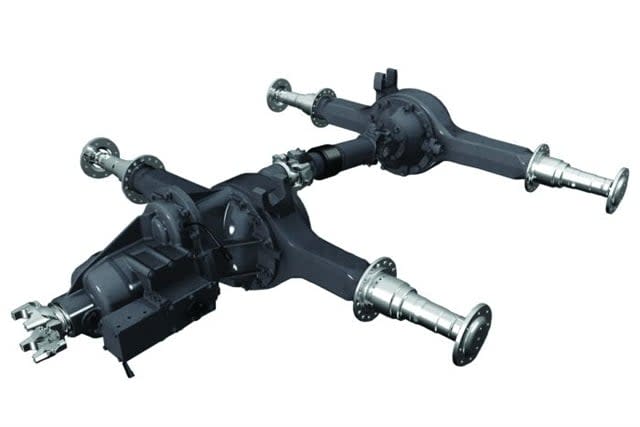
Dana Spicer’s AdvanTek 40 Dual Range Disconnect axle system lets you run as a 6x4 and a 6x2, leveraging all the benefits both options offer.
Most people see downspeeding as going to a super-fast axle ratio with a direct drive transmission. Mayer says there are two ways to get there: something like a 2.47:1 with a direct drive transmission, or using a close-couple overdrive transmission with a numerically higher axle ratio. Both will give you the low engine speed you desire at cruise.
The difference between the two, says Mayer, is that if you’re going to run a very fast axle ratio (2.26:1 - 2.47:1, for example) with a direct drive transmission, you have to run strictly on-highway in appropriate terrain.
“That’s 60,000-plus miles per year, an absolute minimum number of starts and stops with 80% to 90% on-highway,” he says. “The other critical part is terrain. Most of that time has to be spent in the top two gears, so that sort of limits to truck to flat terrain to shallow rolling hills. I’m not saying that truck can’t go through mountains, but the majority of the time had better be on flat land.”
On the other hand, Mayer suggests the close-coupled overdrive transmission with a slightly higher axle ratio (2.79:1 - 2.85:1, for example) offers a little more flexibility.
“That set-up still gives you the benefit of lower engine speed at cruise, but it doesn’t limit the truck to strictly linehaul service,” says Mayer. “You could also use that truck for regional work with more starts and stops and it will be more tolerant of increased time in the lower gears, such as when climbing hills or driving in the city.”
Suddenly, your axle spec’ing exercise demands a very comprehensive review of the kinds of work the trucks do to determine if they are suitable candidates for a downsped drivetrain. Your traditional transmission spec could be up for re-evaluation and even your tire and wheel size might need review. In a super-fast driveline, any factor that multiplies torque or creates the need for high-torque operation could potentially compromise the driveline.
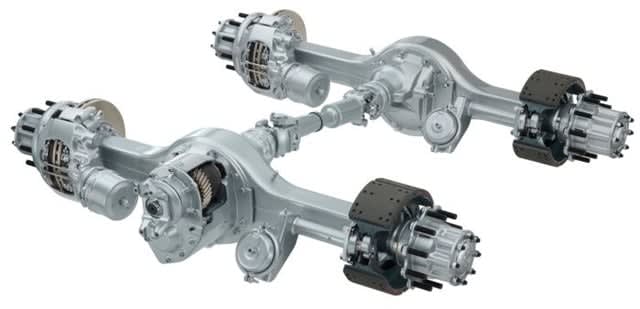
Meritor’s 14X Tandem drive axle is now available with a super-fast 2.28:1 ratio enabling lower engine rpm at highway cruise speed in a downsped driveline.
A path around the problem
Fleets, laser-focused on efficiency, are pushing OEMs and their suppliers, such as Meritor, Dana, Eaton and others, to turn over every stone in the pursuit of lower fuel consumption without performance compromises. The equipment manufacturers are responding with novel ideas, some with even the tiniest gains that cumulatively become measurable advantages.
Synthetic lubricants, for example, help to reduce churning losses in the differential housings and transmissions and can produce efficiency gains of 0.25% to 0.50%. Even design of the rear axle carrier, the cut of the gear teeth and altering the driveline angles can help in small ways. Mayer says Meritor is working on some designs that could offer gains in the 1% range.
“It all adds up,” he says. “When you look at the incremental gains, a quarter percent here, a half percent there, we’re still producing a package that can save fleets something in the range of $600 per year with fuel at $4 per gallon.”
It’s astonishing how a small change can affect both the efficiency and durability of, for example, and crown-and-pinion gear set. Dana’s director of global product planning, Steve Slesinski, says engineers try to reduce the amount of friction between the gear teeth by adjusting the angle at which they come together, called the hypoid offset. Changing that angle too much one way or the other can increase the angles between moving, load bearing components, such as U-joints.
“You have to weigh the sliding friction between the gear teeth with the bending stresses,” he says. “As you begin to increase your driveline torque, you need that hypoid offset to handle the impact loads.”
That’s a lot to bear in mind when considering a downsped driveline. Fortunately, it’s not something the fleet has to worry about. That’s the engineers’ job. What fleets need to do is to be cognizant of the application in which the truck will see service. A downsped drivetrain is like a thoroughbred horse. It’s great in one very specific type of service, but like the horse, don’t try plowing a field with it.
More Fuel Smarts

How Volvo Updated Its D13 for EPA 2027 [Watch]
Volvo’s updated D13 promises lower emissions without sacrificing performance or fuel economy. Take a closer look at what changed inside the engine in this HDT Spotlight video.
Read More →
Diesel Price Spike Shortens Payback for Natural Gas Trucks, Report Says
Energy Vision estimates fleets could recover the higher purchase price of an RNG-fueled Class 8 tractor in 1.3 to 2.8 years under current fuel-price scenarios.
Read More →
Calstart Becomes Catalyst Mobility, Reflecting Broader Focus
Calstart is now Catalyst Mobility, reflecting the nonprofit’s growing national role in clean transportation, including zero-emission trucks, infrastructure and incentive programs.
Read More →

Record Diesel Prices Squeeze Trucking Fleets
Average U.S. diesel prices have climbed to nearly $6 a gallon, surpassing the 2022 record as tight refinery capacity and Middle East disruptions keep fuel costs elevated.
Read More →
How Fuel Delivery Shapes Engine Performance
Fuel delivery depends on more than what happens at the injector. For fleet, maintenance and technical professionals, looking at the full path from pump to injector can provide useful context for understanding engine performance.
Read More →
East Coast Port Launches $45M Electric Truck Push
The Port Authority of New York and New Jersey announced millions in incentives for zero-emission drayage trucks, yard tractors, and new charging hubs near the port.
Read More →
California Bill Could Shed Light on Electric Truck Prices
Why do battery-electric Class 8 trucks remain so expensive? A California bill headed to Gov. Gavin Newsom would give fleets and state agencies more visibility into what manufacturers charge.
Read More →
Detroit Opens Orders for EPA 2027 Engines
Detroit isn’t starting from scratch to meet EPA 2027 diesel emissions standards. Its Gen 6 DD13 and DD15 engines keep much of today’s platform while updating the fuel and aftertreatment systems.
Read More →
Zero-Emission Truck Corridor Planned for West Coast
California, Oregon, Washington, British Columbia and Baja California are coordinating plans for truck charging and hydrogen fueling from Canada to Mexico.
Read More →
A Closer Look at Kenworth’s Electric T880E Vocational Truck [Video]
Learn more about Kenworth's T880E battery-electric vocational truck at the Paccar Technical Center, including its range, applications, upfitting considerations, and PTO options, in this HDT Spotlight video.
Read More →