




The Digital Shop: Maintenance Management Software
With the economy in a recession and the trucking industry suffering through what Stifel Nicolaus analysts now say is a freight depression, trucking companies are all looking to cut costs to survive.

With the economy in a recession and the trucking industry suffering through what Stifel Nicolaus analysts now say is a freight depression, trucking companies are all looking to cut costs to survive.
But you can't truly cut costs unless you have a way to track those costs in the first place.
So if you don't have computer software in place to manage, track and analyze your maintenance operations, you should take a close look at it - whether you have 10 trucks or 10,000.
And if you do have such software, this is the time to make sure you're using its capabilities fully.
"Almost no other investment a fleet can make today will have such a dramatic effect on controlling costs, reducing expenses and managing the fleet better,"says Charles Arsenault, president of Arsenault Associates, a 30-year-old company that sells Dossier fleet maintenance management software. "Return on investment is very fast, usually six months or so, sometimes even faster. And that's not just my program, but this kind of software in general."
Ric Bedard, president and founder of Cetaris, another longtime maintenance software provider, goes so far as to say if you're not using maintenance management software today, you're at a competitive disadvantage.
"Your competitors who have it know their cost per mile," Bedard says. "They can analyze cost differences between year, make and models of vehicles. They can see chronic repair problems. They can anticipate failures before they happen."
Saving Money
There are several areas where a good maintenance program can save money, including increasing uptime, improving shop productivity, saving on inventory, warranty recovery, and identifying problem equipment.
1. Increase uptime: Maintenance management software can help you schedule preventive maintenance and repairs efficiently. And by making sure preventive maintenance is done on time, you'll reduce the likelihood of expensive breakdowns on the road.
"One of the comments we hear time and time again is that once they implement the software, breakdowns decline significantly,"says Bedard. Software can allow you to analyze and understand failures, and change your PM process to keep them from happening again.
For instance, maintenance software allows you to discover if a particular part breaks down at a fairly predictable interval, so you can schedule pre-emptive replacement of the problem part.
In addition, telematics now allows trucks' on-board computers to send fault codes back to the home office, alerting fleet managers of the need to schedule a repair before a costly roadside breakdown.
And if you're able to significantly reduce breakdowns, you may be able to run your fleet more efficiently, needing fewer extra "spare"units on hand.
2. Improve shop productivity. TMW Systems, which offers TMT fleet maintenance software, says it's possible to increase the utilization of mechanics' time from less than 80 percent direct labor to 98 percent direct labor, through improved planning tools and information at their fingertips. When a vehicle comes in for service, technicians have all the vehicle information and its repair history in their hands.
Before Pennsylvania-based Venezia Bulk Transport went to TMT's maintenance program, they used a homegrown hybrid paper/computer system, where mechanics gave data entry people repair orders to enter. "The repair orders would be incorrect or the data entry people couldn't read them," says J.P. Venezia, fleet manager, "and parts weren't being charged out of inventory."
Although there initially were concerns that technicians would spend too much time on the computer rather than working on trucks, Venezia, says - "We wanted them turning wrenches, not typing on the computer," in reality, they realized both time savings and accuracy improvements in switching to a computer-based system.
In addition, maintenance software gives managers a window into what their technicians are doing, even in remote locations.
"I can view the wash bays and shops and tell exactly what these guys are doing at any point in time, instead of waiting for five days for the paperwork," Venezia says.
When you're able to document who's doing what, you can learn which of your technicians are effective and which are not - which ones might need more training or even need to be let go. If trucks keep coming in for rework and you can identify which technicians or techniques need improvement, Arsenault says, "you can reduce rework, bring it to its knees, within six to nine months after implementing fleet maintenance management software."
3. Save on inventory. The right software can help make sure you have the parts needed for scheduled repairs to improve productivity. But it can also help cut total inventory carry costs by allowing you to identify and remove non-movers, and adjust inventory levels on slow movers.
"It's not unusual to see 30 percent or more savings in parts inventory values" when inventory management software is implemented, Arsenault says.
Republic Services Inc., a 5,500-truck solid-waste fleet based in Ft. Lauderdale, Fla., discovered it was carrying more than $2 million in parts that were obsolete or hadn't been used in a year when it implemented Arsenault's Dossier system throughout its operations. Some of the parts were traded among company locations; others were returned to vendors for credit. The company's parts inventory was cut from $9 million to $7 million.
Before they started using TMT software at Venezia Transport, their inventories were off 25-30 percent. "Now we hold our shops to less than 1 percent error," Venezia says.
And once you have control of your inventory, you can get better prices on the parts you buy.
When Marshall Babbitt came to Lester Coggins Transportation as director of maintenance in 2004, he decided it was time for the company to implement the Dossier software it had purchased but never used.
"We were paying $68 for a brake drum four years ago," he says. "Today, we pay $54." Babbitt explains that he looks at everything the fleet's shops bought and who they bought it from. "I look at what was bought from each individual vendor, so I know exactly how much business we do with each one." When he sits down with vendors, that makes it easier to negotiate discounts.
In addition, he says, each year they take the top 100 items purchased through the year and put them out to bid, with the lowest bidder becoming the fleet's preferred vendor for that part.
"Of the top 100 items during 2007, 51 of them came back with lowered prices," he says.
4. Maximize warranty. If you install a part with a one-year warranty and go to replace it six months later, maintenance software will let you know it's still under warranty. This way the part is replaced by the vendor instead of being purchased again.
Before they started using TMT software, Venezia says, "we only knew if it was covered under warranty if the guy working on the truck knew." With the software, he says, they're recovering 20 times what they were. The system has paid for itself with the warranty recovery alone.
"There's a huge opportunity today for fleets in warranties," Bedard explains, "If you ask the average fleet today how well they do in service replacement warranty, they'd say on a highly visible part they do pretty well. But if it's multiple locations and one repair's done here and another's done down the road, the likelihood of capturing that is very low. When it's all done electronically, it makes sure you get that. We have customers who have implemented our software and enjoyed year-over-year gains of double digits in warranty capture."
5. Discover and address trouble spots. Charles Arsenault says as a general rule of thumb, the worst 10 percent of your units will eat up a disproportional amount of your time and budget. But in order to accurately identify those problem trucks, you need to be able
More Maintenance
Wrong Repair Prompts Recall of Freightliner, Western Star 4x2 Trucks
DTNA is recalling more than 2,400 trucks that received an incompatible software fix instead of the hardware repair required to address brake valve corrosion.
Read More →
Truck Drivers Need More Than Another Alert
Fleets have more visibility into truck health, safety events, and driver activity than ever. The next challenge is turning all that information into useful guidance for the person who has to decide what to do next.
Read More →
The Maintenance Checks Trucking Fleets Should Prioritize Before Fall Freight Picks Up
Making it through August isn’t the same as being ready for the next several months of operation. Find out what systems may have suffered from summer heat and need to be checked out before fall.
Read More →
What Three Fleets Are Doing Differently When Buying Truck Parts in 2026
With freight improving but costs still climbing, fleet maintenance executives explain how they're balancing price, quality, and supplier relationships.
Read More →
Paccar Recalls 2027 Trucks Built This Summer for Possible Electrical Problem
The nearly 6,000 Kenworth and Peterbilt trucks in the recall could potentially lose engine power, among other things.
Read More →
Will API PC-12 Oil Change Trucking Fleet Maintenance?
The new API PC-12 heavy-duty engine oil category reflects the changing demands of modern diesel engines. But fleets like Foodliner are looking to getting their own data before making decisions on adopting the new oils and questions such as extending oil drain intervals.
Read More →
Brake Safety Week to Focus on Drums and Rotors
Commercial vehicle inspectors are focusing on truck brakes during CVSA's Brake Safety Week, August 23-29.
Read More →Possible Battery-Cable Fires Prompt Recall of 15,000+ International MV and HV Trucks
On the recalled vehicles, manufacturing variations can cause the battery interconnect cable to contact the auxiliary stud and hold down the bracket.
Read More →
Rush, MCT Team Up to Grow Refrigeration Service Network
The joint venture will operate MCT's network of Carrier Transicold dealerships and mobile service locations, with the companies promising greater service capacity and uptime for refrigerated fleets.
Read More →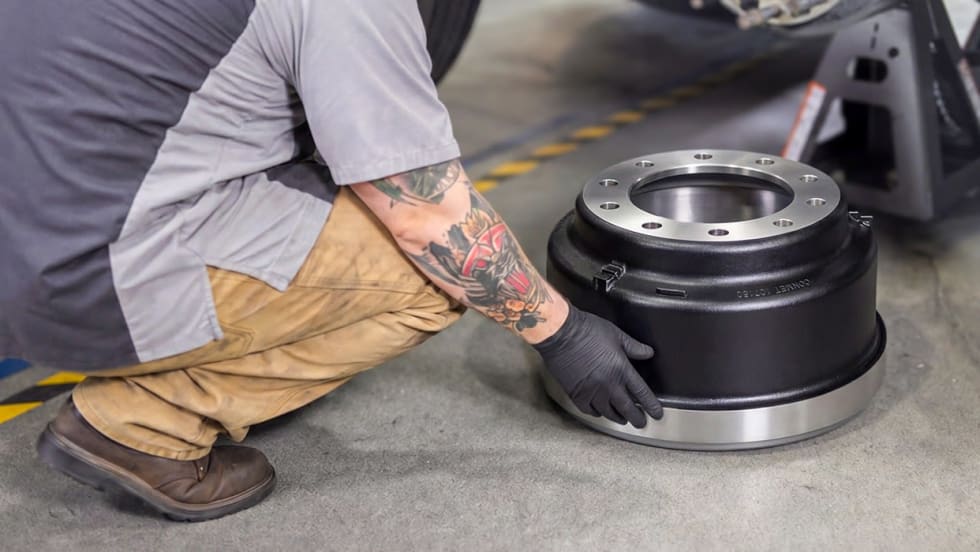
ConMet Expands Aftermarket Brake Drum Lineup With TruCast
A new heavy-duty truck brake drum option in the aftermarket gives customers more flexibility within the ConMet product family.
Read More →