




Test Drive: The Transit Connect Electric
We were stopped at a red light on 11 Mile Road, a broad, eight-lane boulevard in Oak Park, Mich., northwest of Detroit, and I eyed the cars and trucks alongside us.
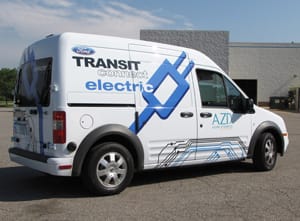
Special lettering and lack of tailpipe are all that visually distinguish this Transit Connect Electric from Ford's gasoline-powered version. (Photo by Tom Berg)
We were stopped at a red light on 11 Mile Road, a broad, eight-lane boulevard in Oak Park, Mich., northwest of Detroit, and I eyed the cars and trucks alongside us.
Their drivers seemed impatient and no doubt figured they'd blow away this small, boxy van I was driving. Ha! When the light turned green, I stepped on the go pedal, leaving 'em behind and zooming into the future.
My time machine was an all-electric version of Ford's Transit Connect compact van. Its powertrain was designed by Azure Dynamics, a specialty engineering firm that's partnering with Ford Motor Co. on this new product. Azure is qualifying certain Ford truck dealers to sell and service the Transit Connect Electric, or the TCe, as I'll call it.
The Transit Connect Electric will join increasing numbers of gasoline-powered Transit Connects bought by commercial customers who are discovering that a lighter and somewhat smaller truck can sometimes do the job of a full-size cargo van. Production will start slowly early next year, with 500 planned during 2011.
The Transit Connect Electric
Jeff Hyatt, the director of sales, is charged up over the TCe. "This is an exciting time," he said in opening an informal briefing in Azure Dynamics' Oak Park headquarters, just east of my impromptu drag strip. "There's a lot of interest in the vehicle, and in electric vehicles. The Transit Connect Electric is Ford's first electric vehicle, and it'll be dual-badged, as a Ford and an Azure." Azure Dynamics will be the manufacturer of record.
Ford will supply rolling chassis, with complete bodies, interiors and running gear but no powertrains, from its Transit Connect factory in Turkey, he explained. Azure Dynamics will have them picked up at the Port of Baltimore and hauled to a plant in Livonia, Mich. The plant is operated by AM General, which will assemble the electric vans under contract to Azure Dynamics. The TCe will remain a front-wheel-drive truck, with electric components replacing the normal gasoline engine and automatic transmission.
Components, collectively called Force Drive, include a 28-kilowatt lithium-ion battery pack, made by Johnson Controls in Holland, Mich. The 192-cell battery powers a Siemens traction motor, which runs through a single-speed Borg Warner gearbox between the front wheels. Operating voltage ranges from 260 to 380. The motor doubles as a generator to capture the truck's kinetic energy during slowing and stopping. Regeneration occurs when the accelerator is released or the brake pedal is pressed. This will do much of the stopping unless aggressive braking is needed, and then the four-wheel discs take hold.
Regeneration is run by an Azure Dynamics vehicle control unit. It talks to the electronic controls that operate Ford's standard anti-lock braking system and roll stability control, explained engineer Jim Mancuso. To ensure safety, any regen is interrupted if ABS or RSC is needed during sudden braking or maneuvering. Azure Dynamics' electronic controls nestle under a shroud beneath the short hood's lid.
All accessories are electrically driven: vacuum pump for the power brakes, coolant pump to control battery temps, cab heater and air conditioning compressor. The demo truck had a bulkhead behind the front seats to limit the space that the heater and A/C need to treat, and of course to keep any loose cargo away from driver and passenger. A/C might consume 10 to 12 percent of a TCe's range, Mancuso said.
Force Drive will operate in ambient temperatures as hot as 120 degrees and as cold as 30 below zero. The battery's non-pressurized cooling system uses a standard antifreeze solution, and includes a fan to blow off heat and a heater to warm the fluid during tough winters, Hyatt said. So it'll work fine in Minneapolis-St. Paul in the winter, and it should be fine in Phoenix in the summer.
On the Road
But neither heat nor cold bothered us on this gorgeous June morning, so the cab heater and A/C stayed off and all the Force Drive's force could be put to the wheels. When I hit the accelerator, there was enough oomph to cause a bit of torque steer, pulling the steering wheel slightly to the right, yet the powertrain was silent. The motor's output is rated as continuous and peak; the numbers are 158 to 235 Newton-meters (117 to 173 pounds-feet) and 58 to 100 kilowatts (79 to 136 horsepower). Power's about the same as a standard Transit Connect's gasoline engine, but the TCe's motor is 45 pounds-feet stronger. And while the gasoline engine has to rev to 4,750 rpm to achieve its peak torque of 128 pounds-feet, motor-made torque is available instantly.
That's why I left the motorists sittin' at that light. Their engines were just revving up while my motor was a-movin' at full output right from the get-go. I should note that with two chunky guys (Hyatt and I) up front and a set of racks and bins in the cargo compartment, the TCe was probably at two-thirds of its rated payload capacity of 1,000 pounds. That's 600 pounds less than stock, due to the heavy battery.
Under hard acceleration there was no smoke, either from the tires (I didn't try to spin 'em, though Hyatt said a company director did on a demo ride) or the tailpipe (the TCe doesn't have one). Any pollution will be at the power plant that makes the electricity that charges the battery. Even if stack emissions are dirtier than desired, the plant's being fired by domestically produced fuel, so electric vehicles like the TCe still attain the strategic goal of reducing our dependency on foreign petroleum, a Department of Energy official recently told me.
Anyway, from that traffic light we zoomed down the on-ramp to the westbound I-696 freeway and blended easily with traffic. I leveled off at 70 mph, where the truck cruised easily. It had plenty of power to stay with traffic and accelerate to take advantage of holes in the flow.
Azure Dynamics sets the top speed at 75 mph, but doesn't recommend a lot of it because speed robs range.
We started with the range gauge at almost 80 miles (the rated maximum) and ended with it down near 60 after about a half hour of driving, though most of that was above 30 mph. This included some 30- to 40-mph travel on Southfield Road (U.S. 24) where the lights are timed to give steady green lights. That's pleasing - except if you're driving an electric vehicle that needs some regenerative braking to boost the battery and extend range a little.
At home in the city
The Transit Connect Electric or any other all-electric vehicle is not something you can drive across the state, because at highway speeds you'd run out of juice pretty fast. You'd need to pause and find a recharging port, which wouldn't be easy because you'd need a 240-volt outlet. If I owned a TCe, I'd ask that the speed limiter be set at 50 or 55 mph and discourage anyone from even going on the freeways.
Transit Connect Electric is a city truck that measures its travel in blocks rather than miles, and must return home to the shop or warehouse each evening so it can be plugged in. Recharging a depleted battery from a 240-volt outlet takes six to eight hours - about 20 hours if a 120-volt outlet is all you've got, Hyatt said. He plugged it into the 240 outlet in Azure Dynamics' headquarters shop as soon as I'd parked it. Plugging in whenever possible - "opportunity charging," he called it - is wise because it adds range.
Fuel and funding
Feeding a TCe should be cheap - about one-fifth the cost of buying gasoline for a regular Transit Connect, depending on electricity rates and the price of gas - said Jay Sandler, Azure Dynamics' marketing vice president. Most maintenance or repairs associated with a gasoline powertrain is done away with. This will help offset a TCe's list price of $66,500, about three times that of a gasoline TC. And there's a $7,500 federal tax credit, plus various state and local i
More Fuel Smarts

Calstart Becomes Catalyst Mobility, Reflecting Broader Focus
Calstart is now Catalyst Mobility, reflecting the nonprofit’s growing national role in clean transportation, including zero-emission trucks, infrastructure and incentive programs.
Read More →
Record Diesel Prices Squeeze Trucking Fleets
Average U.S. diesel prices have climbed to nearly $6 a gallon, surpassing the 2022 record as tight refinery capacity and Middle East disruptions keep fuel costs elevated.
Read More →
How Fuel Delivery Shapes Engine Performance
Fuel delivery depends on more than what happens at the injector. For fleet, maintenance and technical professionals, looking at the full path from pump to injector can provide useful context for understanding engine performance.
Read More →

East Coast Port Launches $45M Electric Truck Push
The Port Authority of New York and New Jersey announced millions in incentives for zero-emission drayage trucks, yard tractors, and new charging hubs near the port.
Read More →
California Bill Could Shed Light on Electric Truck Prices
Why do battery-electric Class 8 trucks remain so expensive? A California bill headed to Gov. Gavin Newsom would give fleets and state agencies more visibility into what manufacturers charge.
Read More →
Detroit Opens Orders for EPA 2027 Engines
Detroit isn’t starting from scratch to meet EPA 2027 diesel emissions standards. Its Gen 6 DD13 and DD15 engines keep much of today’s platform while updating the fuel and aftertreatment systems.
Read More →
Zero-Emission Truck Corridor Planned for West Coast
California, Oregon, Washington, British Columbia and Baja California are coordinating plans for truck charging and hydrogen fueling from Canada to Mexico.
Read More →
A Closer Look at Kenworth’s Electric T880E Vocational Truck [Video]
Learn more about Kenworth's T880E battery-electric vocational truck at the Paccar Technical Center, including its range, applications, upfitting considerations, and PTO options, in this HDT Spotlight video.
Read More →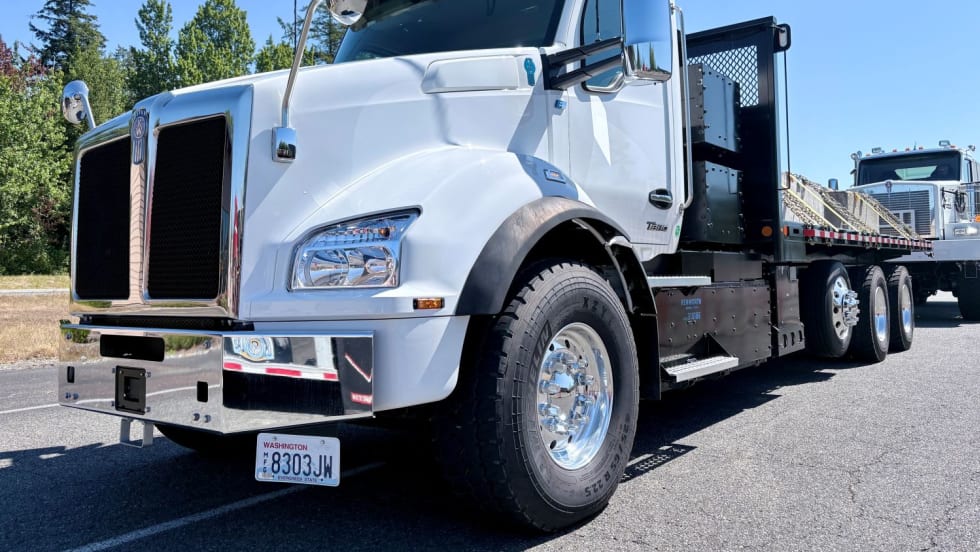
Kenworth T880E Brings EV Power to Vocational Trucks
A closer look at the Kenworth T880E’s range, charging, powertrain and upfit options — and where fleets are showing the most interest.
Read More →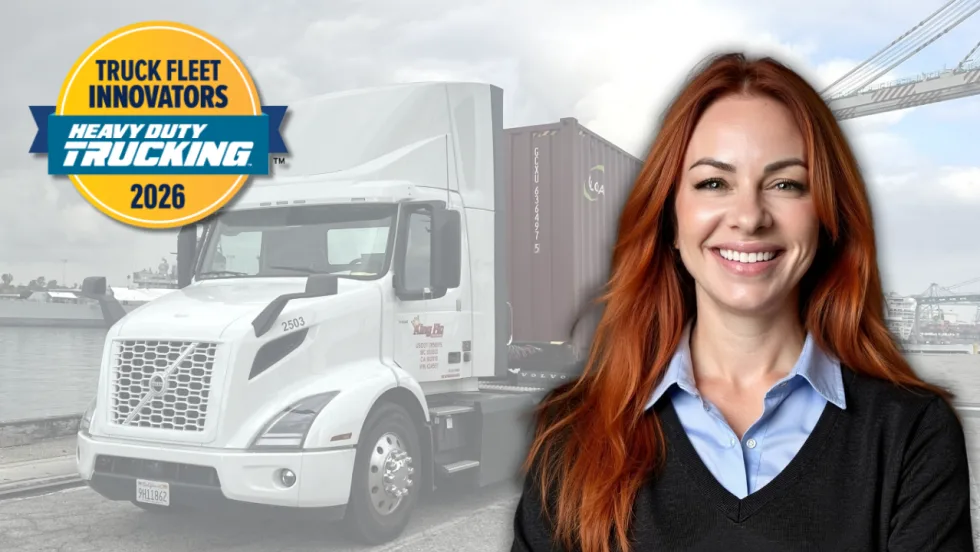
Jennie Abarca Is Proving Electric Trucks Can Do the Job
HDT Truck Fleet Innovator Jennie Abarca is building confidence in fleet electrification one load at a time while openly sharing the challenges she encounters along the way as a small-fleet owner.
Read More →