




Test Drive: Oshkosh S-Series Mixer
Precise concrete placement is a traditional feature for this front-discharge mixer, but relatively new is natural gas power.

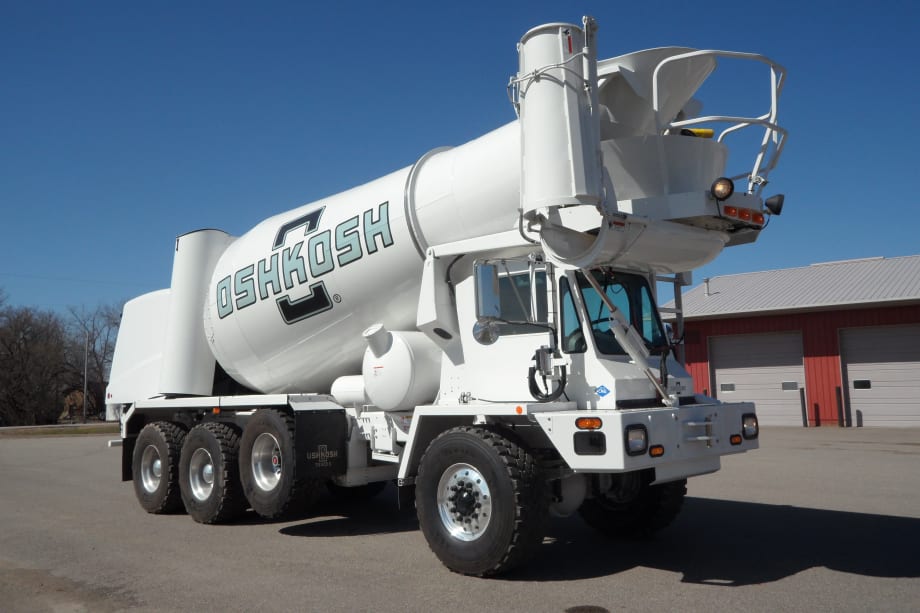
The front-facing barrel and chute on this Oshkosh S-Series allow the driver to place the concrete right where the crew wants it, and front-driving axle helps get it through sand and mud. Here the chute is stowed for travel, with its extensions flipped up.
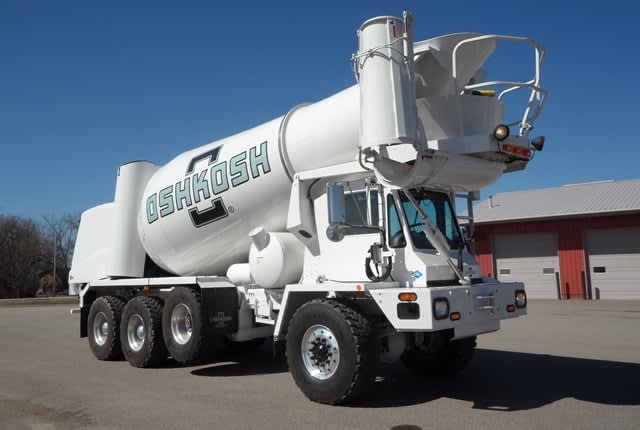
The front-facing barrel and chute on this Oshkosh S-Series allow the driver to place the concrete right where the crew wants it, and front-driving axle helps get it through sand and mud. Here the chute is stowed for travel, with its extensions flipped up.
In business, time is money, and that’s especially true in concrete hauling and placement. Concrete is perishable: A chemical reaction begins almost as soon as cement is added to aggregates and water, and the batch starts to set. Barrels on mixer trucks therefore get warm, but the rotating motion and the baffles inside keep concrete in a slurry while thoroughly combining the ingredients. Drivers must hurry to work sites and pour the concrete quickly, and exactly where contractors want it.
The fastest way to do the hauling and pouring is with a front-discharge mixer, say those who make and sell them. An example is this S-Series, made by Oshkosh Truck Corp. in eastern Wisconsin, where I went to drive it. With a powerful engine and automatic transmission, it accelerates fast and runs down the road smartly. The truck rolls right up to where the concrete is needed and its driver operates the front-facing chute with in-cab controls, moving it exactly to where the crew wants the concrete poured and at just the right rate.
Depending on the job, the contractor can eliminate one worker from his crew, so many request this type of truck for deliveries. They tend to proliferate where they’re introduced, though in some areas producers are sticking with less costly rear-discharge mixers on conventional truck chassis.
Like any truck, the S has been greatly improved over the years. The one I drove for this story has a roomy, comfortable cab, good leg room, modern suspended pedals, and a few gauges that tell the driver all he needs to know.
To the right of the steering wheel are handy controls to operate the drum and chute. Greg Steffens, a project engineer, knelt on the fender to my left and showed me how to use them. A lever activates a pair of hydraulic cylinders that unfold the chute, which is long enough for close-in pours. The driver has to get out to hang extensions if the chute needs to reach farther, and of course to clean it out and stow the extras afterwards. Climbing into and out of the cab takes some bending and crab-walking, but gets easy with practice, Steffens said.
A joystick moves the chute left or right and up or down. Push buttons speed or slow the drum to regulate the pour rate. An Allison automatic transmission is standard in the S Series, as it is in all modern front-discharge mixers. The driver punches D or R and feathers the accelerator and brake as required while moving the chute.
When the pour is done, the chute is parked at an angle to the right. It’s important that it not be swung too far or it would extend beyond legal width limits and might collide with trees, poles and other things that line a street. So a rubber bungee cord hangs down from the top of the chute as a marker, Steffens explained. When the right side of the chute touches it, the truck doesn’t exceed 8 feet wide — low-tech but effective.
This truck had the latest in power: a Cummins Westport ISX12 G natural gas engine. Natural gas is not new for Oshkosh and its McNeilus subsidiary over in Minnesota, which between them have built more than 8,000 such trucks since 2008. But this four-axle chassis was the first with two large vertical compressed natural gas tanks mounted to the left- and right-front of the rear engine compartment, instead of four smaller tanks stacked horizontally ahead of the hood. The new configuration saves about 500 pounds and allows easier access to the engine and transmission.
There was no concrete in the drum so I couldn’t practice pouring — or placing — it. However, the truck was very drivable, so I released the parking brakes, punched D and off I went. With the gas engine out back, the quietness is almost eerie. I couldn’t hear it idle, and its working growl faded away as road speed increased. Cummins Westport G engines are spark-ignited; a diesel’s compression ignition is more efficient, but produces that characteristic pounding sound. At highway speeds the chassis produced some muted mechanical whirring and tire whine, as well as the slight sound of air rushing past the mirrors and the cab’s front corners. The ride was smooth, even with a stiff front suspension and the blocky 445-series tires.
Acceleration was brisk as I departed and headed for nearby Wisconsin 26, a wide two-laner, and turned south, immediately encountering some memories. As a TV newsman many years before, I sometimes barreled north on this highway in a company car at up to 100 mph to get news film to the station in Green Bay in time for the 6 o’clock broadcast. This day I cruised at 55 to 65 mph, where the Cummins spun at 1,600 to 1,800 rpm — not wound out, but far faster than today’s low-revving diesels in road tractors.
This was the highest-rated ISX12 G, and with 400 horses, it had plenty of go-power. If it was consuming fuel at a fair rate, so what? Natural gas is much cheaper than diesel, so savings will help pay off the premium price for the natural gas fuel system.
I turned right on a county road and followed it west and north a ways. I stopped and backed into a deserted intersection to reverse course and return the way I came. Maneuvering was easy and the view out the cab’s windows and through its mirrors was fine, so I never used this truck’s rear-view camera with its mini TV screen above the windshield.
I meandered along other roads and onto city streets, and at one point did a couple of circles on a gravel parking lot. The wide tires limit wheel cut and make the turning circle a bit big, but it seemed to corner better than a conventional with a forward-set steer axle and wide tires. With Sheppard power steering, the truck didn’t require much effort to turn, even while crawling.
Upon my return, I parked it in front of the building. Recent rain had muddied a section of the back lot, where a line of new mixer and military trucks awaited transport to customers. I was tempted to jump back into the S and put its front-driving axle and lockable differentials on the rear tandem to a test, but didn’t have the heart to get the shiny white rig dirty. Besides, I’ve seen them move through mud and know they’re up to it. That’s part of what makes this a seriously mobile and productive truck.
More Fuel Smarts

How Volvo Updated Its D13 for EPA 2027 [Watch]
Volvo’s updated D13 promises lower emissions without sacrificing performance or fuel economy. Take a closer look at what changed inside the engine in this HDT Spotlight video.
Read More →
Diesel Price Spike Shortens Payback for Natural Gas Trucks, Report Says
Energy Vision estimates fleets could recover the higher purchase price of an RNG-fueled Class 8 tractor in 1.3 to 2.8 years under current fuel-price scenarios.
Read More →
Calstart Becomes Catalyst Mobility, Reflecting Broader Focus
Calstart is now Catalyst Mobility, reflecting the nonprofit’s growing national role in clean transportation, including zero-emission trucks, infrastructure and incentive programs.
Read More →

Record Diesel Prices Squeeze Trucking Fleets
Average U.S. diesel prices have climbed to nearly $6 a gallon, surpassing the 2022 record as tight refinery capacity and Middle East disruptions keep fuel costs elevated.
Read More →
How Fuel Delivery Shapes Engine Performance
Fuel delivery depends on more than what happens at the injector. For fleet, maintenance and technical professionals, looking at the full path from pump to injector can provide useful context for understanding engine performance.
Read More →
East Coast Port Launches $45M Electric Truck Push
The Port Authority of New York and New Jersey announced millions in incentives for zero-emission drayage trucks, yard tractors, and new charging hubs near the port.
Read More →
California Bill Could Shed Light on Electric Truck Prices
Why do battery-electric Class 8 trucks remain so expensive? A California bill headed to Gov. Gavin Newsom would give fleets and state agencies more visibility into what manufacturers charge.
Read More →
Detroit Opens Orders for EPA 2027 Engines
Detroit isn’t starting from scratch to meet EPA 2027 diesel emissions standards. Its Gen 6 DD13 and DD15 engines keep much of today’s platform while updating the fuel and aftertreatment systems.
Read More →
Zero-Emission Truck Corridor Planned for West Coast
California, Oregon, Washington, British Columbia and Baja California are coordinating plans for truck charging and hydrogen fueling from Canada to Mexico.
Read More →
A Closer Look at Kenworth’s Electric T880E Vocational Truck [Video]
Learn more about Kenworth's T880E battery-electric vocational truck at the Paccar Technical Center, including its range, applications, upfitting considerations, and PTO options, in this HDT Spotlight video.
Read More →