




Test Drive: Kenworth's T800 LNG Day Cab
Opportunities to evaluate natural heavy-truck gas alternative power have been few to this point
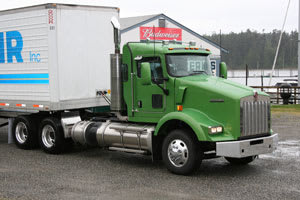
Kenworth T800 LNG day cab offers capable clean power.
Opportunities to evaluate natural heavy-truck gas alternative power have been few to this point.
So far, they have been limited to Sterling's lower power alternatives, such as the Cummins ISL-G at around 320 horsepower for the California ports. And that's OK for the drayage operations there, with Freightliner's M2 now taking over the mantle with the demise of the Sterling brand.
But for a more versatile distribution tractor, this month's test unit, a Kenworth T800 day cab with a Cummins Westport GX at 450 horsepower, seems on paper to be a lot more capable for operations that require more grunt and versatility.
The liquefied natural gas powered truck was available at the Paccar research center near Mt. Vernon, Wash. The plan was to spend the best part of a day with the tractor, pulling a loaded van trailer and grossing around 65,000 pounds on some local roads that combined a modicum of hill climbing with some open road running. The route chosen was a pretty run down Whidbey Island. This picturesque vacation spot lies off the Washington coast, joined to the mainland by the spectacular bridge over to Deception Pass State Park.
We had pulled the same route around 15 months ago, driving a then-new T660 with 550 horsepower. That gave us something of a baseline to judge the T8 against. And it showed that 450 natural gas horsepower is not the same thing as 550 diesel horses.
But we'll get to that.
The truck
This was the first time I'd experienced the Kenworth extended day cab for any length of time, and it proved to be a very comfortable, surprisingly large cab. The "extended" spec includes an extra 6 inches in the length and 5 inches in the height over the standard day cab. This brings an additional 2 inches of seat slide to get comfortable at the fully adjustable steering wheel and up to 21 degrees of seat recline. Even with all this seat adjustment, there's an available 2 cubic feet of storage space behind the driver's seat. This is a very generous cab and a very pleasant workspace, especially with the extra visibility over the shoulder through the rear corner windows.
Visibility is a very strong feature of the T800, with its sloping hood and, in this case, a one-piece windshield giving an unobscured view forward and down to the road. The pod mirrors are the same as the T660's and are absolutely first class, both in the field of view and in the adjustability of the flat glass from the driver's door-mounted switches. Add to this the DayLite doors of the Kenworth cab, and you can see really well in every direction - a big plus for a truck that'll spend most of its time in urban traffic.
Since the driving was accomplished mostly in typical Northwest spring rain, we came to appreciate the clap-hand windshield wipers that overlap in the middle to sweep a wide, clear area on the big windshield. The heater/air conditioner also proved more than adequate to keep the inside of the glass clear.
Considering it is the same cab as on the T660 and the T800, the differences are quite startling. True, there's the same dash - an excellent and appealing arrangement of gauges and well-placed switches - and the major controls have that wonderful Kenworth, thoroughly engineered feel to them, but there's the tall roof and the different-looking hood as well. And the proximity of the rear wall adds up to a different, though by no means inferior feeling - a sort of intimacy that's entirely appropriate for the different vocation of this day cab tractor.
The interior trim was the Splendor level in Slate Gray complementing the Viper Green (of course) exterior color. For the driver there's a Kenworth Air-Cushion Plus seat with armrests. The rider's seat is fixed over the battery box.
The engine
Under the sloping hood was the real subject of the test: the Cummins Westport natural gas-fueled ISX. Unlike the Cummins ISL-G we have driven before that uses spark ignition, the Westport ISX engine relies on a pilot injection of diesel fuel, immediately followed by the natural gas to create the power. Fundamental to the process is a very special Westport injector, which permits the pilot injection of the diesel fuel that ignites in the heated air charge in the normal diesel combustion event. The injector then passes high-pressure compressed natural gas, which replaces around 95 percent of the diesel fuel normally consumed in the combustion.
The gaseous fuel burns with less NOx formation, so the engines currently meet a 0.8 g per hp-hr level - about 33 percent less than today's 2007-compliant equivalent diesels (though not as clean as the 2010s will be). Exhaust-out particulates are low as well, but the engines still need the Cummins diesel particulate filter to reach the mandated 0.01 g per hp-hr.
The engine is rated at 450 horsepower with 1,650 pounds-feet of torque. The power is stated at 1,800 rpm, but in fact the power curve humps up at lower rpms, with a real peak of around 465 horsepower and more than 450 between 1,400 and 1,800 rpm. Peak torque is flat between 1,200 and 1,400 rpm, before starting to drop off. There are other ratings for the GX, including a SmartTorque 450 with 1,550 and 1,750 pounds feet, which could prove very useful.
The Westport engine does not look significantly different from the conventionally fueled ISX, since it has the dual-port injectors under the valve/camshaft cover. There's a gas fuel conditioning module, a diesel fuel pump and a hydraulic lift pump for the liquid gas fuel. On the frame rail, though, are two 120-gallon cryogenic tanks replacing the left and right side diesel tanks, with a third, 45-gallon tank on the passenger side for the small quantity of diesel fuel that must be carried for the pilot-ignition engine.
These cryogenic tanks are the expensive part of the conversion and account for much of the significant upcharge for the T800 with this alternative-fuel option. There is some payback in the potentially lower fuel costs - though less so when diesel is under $3 a gallon - and the fuel mileage is claimed to be about the same. The real reason for using the gas fuel, though, is for emissions-sensitive vocations. The first orders for the T800 as tested here have gone to the San Pedro, Calif., ports, where significant grants offset the substantially higher costs of the tractors. Further offsetting the price premium, the T800 LNG qualifies for a $28,800 IRS tax credit and can also qualify for other federal and state clean air grant programs.
Apart from the LNG fuel option, the spec of the T800 is as you would expect for a tractor intended for on-highway drayage applications. The wheelbase is a generous 210 inches and suspension a steel taper leaf up front rated at 12,000 pounds, and at the rear a Kenworth AG400L rated 40,000 pounds. This is the Kenworth four-bag, trailing arm highway suspension that is compatible with disc brakes. However, this particular T800 has Bendix drum brakes all round.
Drive axles were Dana Spicer DSP40 with a 3.36 ratio. Wheels and tires at 22.5 inches meant a relaxed 1,250 rpm at 60 mph. Accounting for the low rpm, the transmission was an overdrive 10-speed Eaton Fuller FRO with the C ratio set, giving it the wider overall ratio spread and a lighter weight than the RT transmissions.
On the road
Firing up the engine requires a diesel-only injection for a cold start. It is entirely managed by the Westport system. This transitions over automatically to the pilot injection with natural gas as the engine warms a little.
When it is running on the predominantly gas fuel, the GX has a totally different and quieter sound signature than the all-diesel ISX. It's no less urgent a sound, but most of the combustion knock has disappeared. This of course makes it quieter in the T800's cab. The overall interior sound levels are such that I had no difficulty in talking with Jeff Parietti, Kenworth's PR manager, who accompanied me for the day
More Equipment

How Volvo Updated Its D13 for EPA 2027 [Watch]
Volvo’s updated D13 promises lower emissions without sacrificing performance or fuel economy. Take a closer look at what changed inside the engine in this HDT Spotlight video.
Read More →
Michelin Tire Improves Efficiency and Durability for Regional Fleets
The Michelin X Multi Energy D2 is a regional haul drive tire engineered to help fleets improve fuel efficiency, durability and traction in demanding stop-and-go operations.
Read More →
ZF Expands Commercial Vehicle Push in North America
ZF is expanding its North American commercial-vehicle presence with new transmission applications, electrification, trailer technology and autonomous-driving systems.
Read More →
Tesla Wants a Self-Driving Semi. Are Cameras Enough?
Could Tesla’s camera-only autonomous driving technology work on an 80,000-pound Semi? In this commentary, HDT's Deborah Lockridge takes a look at Tesla, Cybercab, and how autonomous trucks see the road.
Read More →
Kodiak: Driverless Long-Haul Truck Launch on Track for 2026
Kodiak AI says its driverless long-haul safety case is 93% complete and it remains on track to begin commercial operations by year-end 2026.
Read More →
What DOT’s Automated Vehicle Strategy Means for Trucking
The U.S. Department of Transportation issued a new automated-vehicle strategy that outlines plans for driverless-truck regulations, cross-state freight corridors, and federal safety standards.
Read More →
East Coast Port Launches $45M Electric Truck Push
The Port Authority of New York and New Jersey announced millions in incentives for zero-emission drayage trucks, yard tractors, and new charging hubs near the port.
Read More →
PlusAI Going Public to Fund Autonomous Truck Launch
A SPAC deal could provide PlusAI with up to $300 million as it works toward a 2027 commercial launch of factory-built autonomous trucks.
Read More →
NHTSA Moves to Rewrite Truck Fuel-Economy Rules
The National Highway Traffic Safety Administration says it lacks authority to regulate medium- and heavy-duty truck engines separately from complete vehicles, but the existing standards have not yet been eliminated.
Read More →
Detroit Opens Orders for EPA 2027 Engines
Detroit isn’t starting from scratch to meet EPA 2027 diesel emissions standards. Its Gen 6 DD13 and DD15 engines keep much of today’s platform while updating the fuel and aftertreatment systems.
Read More →