




Solutions for a New Driver Era
With Comprehensive Safety Analysis 2010 (CSA 2010) about to become a reality, more and more fleets may soon have to face the consequences of hiring drivers with dubious credential
With Comprehensive Safety Analysis 2010 (CSA 2010) about to become a reality, more and more fleets may soon have to face the consequences of hiring drivers with dubious credentials
, believe officials at Tenstreet LLC, which supplies services and solutions that help truck fleets better manage human resources and driver pools.
As posted on the website of the Federal Motor Carrier Safety Administration, "When CSA 2010 is implemented a new Safety Measurement System (SMS) will serve as a tool to identify high-risk motor carriers requiring interventions in order to improve safety on the nation's roads."
To avoid those "interventions," Dale Reagan, vice president of sales for Tenstreet and a 30-year trucking industry veteran who has worked as a recruiter, safety manager and driver for several private and for-hire fleets, says his company - as well as others - are now supplying the trucking industry with Web-based solutions.
These include software programs that automate the collection of a potential driver's work history, background checks, and more to quickly and accurately identify quality drivers. Reagan would like to see more human resource recruiters forego the unorganized and cumbersome paper file system and multiple fax communications that are still widely prevalent today.
"Instead they need to get properly organized by using a state-of-the art online program that is flexible and versatile," he says. "You obviously want to identify and hire the best possible drivers. You want to process them and qualify them to make certain those are the drivers you're getting because unfortunately those best drivers don't stay on the market very long.
"Ideally when the better drivers contact you, or complete an application; you want that to be the last application that they make or the last phone call that they place."
Tenstreet's digital signature technology is a script signature as opposed to an electronic signature that is not allowed.
"Our customers are using these thousands of times a day, on their releases, to get employment transgressions, such as drug and alcohol violations, from previous employees," says Reagan. "This new technology eliminates the old, time-consuming and paperwork-intensive hiring practices of the past, and more and more fleets are beginning to take notice."
Tenstreet customers who have already made the transition to the Internet include FFE Transportation, CRST, Tango Transport, Best Drivers, Watkins & Shepard, Parkway Transport, Prime Inc., and more.
"Watkins & Shepard Trucking of Missoula, Mont., began using Tenstreet software in mid-2008," says Matt Grandy, director of driver recruiting. "The increased efficiency in our recruiting department has allowed us to downsize our staff by 50 percent. It has allowed us to keep our trucks full while dramatically lowering our cost-per-hire."
Reagan says Tenstreet also offers fleets the option to create a "scoring system" to help fleets weed out potential bad drivers during the application process. "It's customizable and can include anything like moving violations, accidents, weight violations and more," says Reagan. "Once a predetermined score or grade, is met, the system automatically rejects the applicant. Recruiters won't even know the guy applied. Conversely, a quality applicant is quickly identified and jumps to the top of the list."
Additional Web-based systems are widely available in the trucking industry to help fleets retain good drivers. "Hanging onto the elite drivers is going to be just as important as hiring them," adds Reagan. "Many trucking companies are so focused on how to recruit employees that they neglect to work to retain them afterwards. They need to know that programs are available to reach out to employees during vulnerable periods of their tenure and capture employees' perspective on how things are going. Opportunities for improvement are surfaced. Employees that may have slipped through the cracks can also be helped and retained."
Training is yet another discipline that is slowly making the transition from pen and paper to mouse and computer screen. Reagan believes this, too, will become all the more important as fleets search for new ways to help comply with CSA 2010.
"There's a lot of data out there when it comes to CSA 2010, so the more communication and training you have with drivers, the safer your fleet is going to be," says Tim Crawford, president of Tenstreet. "That's why we recently launched our new Communications Engine that automates and streamlines the driver management process.
"That way they could show responsiveness to the government's new safety regime. They were telling us 'CSA 2010 is really raising the stakes,' particularly because under the new system, there's going to be more data that's discoverable and admissible."
"We, of course, have been preaching for years that fleets no longer have to rely on outdated, time-consuming and labor intensive techniques to recruit, hire, keep and train their most valuable assets," says Reagan. "Now, outside influencers like CSA 2010 and a shrinking pool of drivers are practically demanding that they abandon the old ways."
From a July 2010 Tenstreet White Paper.
More Fleet Management

FMCSA Pauses Biennial-Update Enforcement Amid Motus Transition
Carriers whose updates were due on or after June 1 have more time, while FMCSA works to stabilize its new registration system and warns of phishing sites impersonating its new carrier registration system, Motus.
Read More →
2026 Blueprint for Countering Smarter Supply Chain Theft
Cargo theft is no longer just the cost of doing business. It's a multi-billion-dollar criminal enterprise exploiting vulnerabilities across your fleet, drivers, and supply chain.
Read More →
How Telematics Improves Visibility, Control, and Performance in Refrigerated Fleets
Explore how telematics help refrigerated fleets improve visibility, uptime, efficiency, compliance, and cargo protection across connected cold chain operations.
Read More →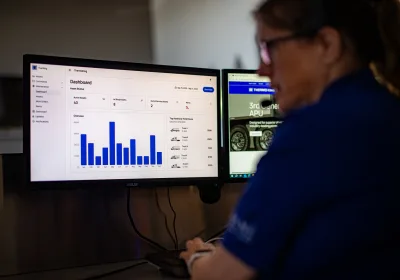

What the U.S.-Canada Trade War Means for Trucking
Escalating U.S.-Canada tariffs could disrupt cross-border freight, reduce truck volumes, raise costs, and create new uncertainty for carriers on both sides of the border.
Read More →
What Are Trucking’s Top Concerns for 2026?
The American Transportation Research Institute wants to know what's worrying trucking fleet managers, drivers, and other stakeholders in its annual Industry Issues survey.
Read More →
American Trucking Associations Looks for a New Leader
ATA President and CEO Chris Spear abruptly left his job at the association on August 21, at a pivotal time for the trucking industry.
Read More →
Public Wi-Fi Cybersecurity Risks: How Truck Drivers and Fleets Can Protect Their Data
Public Wi-Fi can expose truck drivers and fleets to credential theft, malware, and other cyber threats. Here’s how to reduce the risk on the road.
Read More →
For Nicky Cupp, Fleet Innovation Starts With Frustration
HDT Truck Fleet Innovator Nicky Cupp turns everyday pain points at Fraley & Schilling into opportunities for better technology and smarter processes.
Read More →
Adam Buttgenbach’s Approach to Electric Trucks: Start With Where They Fit
HDT Truck Fleet Innovator Adam Buttgenbach helped PepsiCo build one of North America’s largest EV fleets by focusing on where electric trucks make operational sense.
Read More →
Deen Albert: Let Automation Do the Math, People Make the Decisions
HDT Truck Fleet Innovator Deen Albert makes sure people are still at the heart of operations at Grand Island Express, even while adopting artificial intelligence tools. AI-assisted dispatch helped boost revenue 25% with the same number of trucks.
Read More →