




Self-Driving Trucks and the Platooning Stepping Stone: How Soon?
While it seems pretty certain that some forms of autonomous trucking are definitely on the way, the vision varies on just what that’s going to look like and how fast it’s going to get here. That was the takeaway from a panel discussion on platooning and autonomous vehicle technologies at the American Trucking Associations’ Management Conference & Exhibition.
October 5, 2016

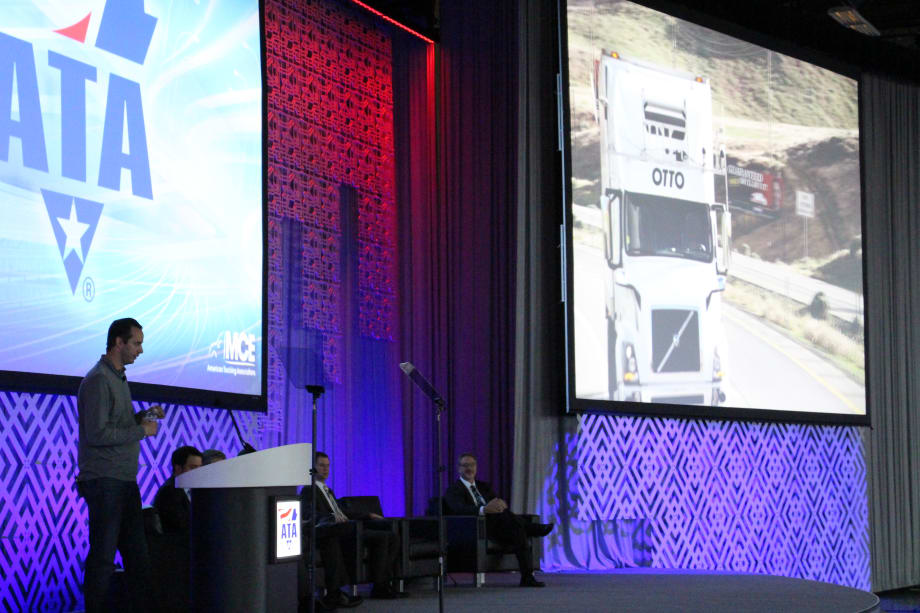
Uber's Anthony Levandowski, co-founder of the autonomous trucking startup Otto, shares video of a truck with no driver. Photo: Evan Lockridge
9 min to read
Uber's Anthony Levandowski, co-founder of the autonomous trucking startup Otto, shares video of a truck with no driver. Photo: Evan Lockridge
While it seems pretty certain that some forms of autonomous trucking are definitely on the way, the vision varies on just what that’s going to look like and how fast it’s going to get here. That was the takeaway from a panel discussion on platooning and autonomous vehicle technologies at the American Trucking Associations’ Management Conference & Exhibition.
Anthony Levandowski, co-founder of the autonomous trucking startup Otto, stood out on the panel, from his casual dress and orange sneakers to his visions of trucks being built with no cabs for drivers at all.
Levandowski, who formerly worked on Google’s self-driving car project and now heads up autonomous vehicle development of both cars and trucks for Uber after it bought Otto, said his vision for the future of transportation is liquidity and automation.
Liquidity is the ability to match carriers with shippers. If you’re delivering people, as Uber does via its ride-sharing app, why not food, why not packages, and why not freight, he asked. Uber is already doing last mile delivery for Walmart.
More specific to this panel was his second point, automation. Uber recently launched a fleet of about 14 self-driving cars in Pittsburgh. Although they still have drivers at the moment, “once you have a vehicle that can drive better than the best driver, you want to be able to put them on everything,” Levandowski said.
He showed a video of a Volvo equipped with Otto’s aftermarket system of cameras and other items driving down a freeway with no driver in sight. In the future, he says, you could have trucks that don’t need seats, windshields or HVAC and could operate nearly 24/7 without the productivity constraints of worrying about driver hours of service or fatigue.
The company is currently signing up fleets and owner-operators to beta test its technology at testdrive.ot.to.
Others had a more conservative outlook. As Sean Waters, who heads up regulatory affairs at Daimler Trucks North America, noted, at times there seem to be more questions than answers.
DTNA and parent Daimler Trucks are “constantly pushing the envelope,” he said, having demonstrated an autonomous truck in Nevada last year as well as in Germany, and autonomous trucks in a platoon earlier this year in Europe.
“We are a company of big ideas, but we can’t execute on those ideas in a vacuum,” he said. That’s why the company worked closely with Nevada regulators on its U.S. demonstration project.
Nevada was the first state to create autonomous vehicle regulations and is working hard to cut the red tape normally involved in working with government regulators. Jude Hurin, administrator, Management Services & Programs Division, Nevada DMV, said the state has worked closely with companies (such as Freightliner and Uber/Otto’s Levandowsi back when he was with Google), as well as with state and federal government, law enforcement, the insurance industry and others.
In January, Nevada’s governor set up a Nevada Center for Advanced Mobility, under the office of economic development. The idea is to partner with industry “in a common sense and safety approach,” Hurin said.
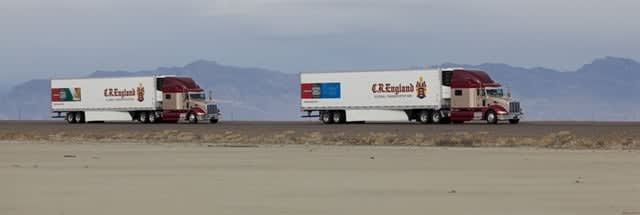
Two trucks platoon in ademonstration of Peloton Technology.Photo courtesy Peloton.
First up: Platooning
One area many agree may serve as a stepping stone toward autonomous trucks is truck platooning, which may be happening on U.S. roads as early as next year.
Jack Roberts, a freelance trucking journalist who was lead author on a recent platooning report from the North American Council for Freight Efficiency, called platooning a “pathway to autonomous vehicles,” and “a component in getting the industry used to autonomous systems and how they work.”
Platooning – the electronic linking of trucks where a lead vehicle largely controls the one following -- would save about 4% in fuel compared to a pair of rigs running separately, according to the report, which estimated a return on investment of one to two years.
Some of the challenges involved, Roberts noted, include payback, driver acceptance, platoon integrity (how the platoon works if a car cuts in between the trucks), system security, amount of viable platooning time, legislative issues, public awareness, issues on sharing fuel savings, reliability, and litigation.
Josh Switkes, president and CEO of Peloton Technology, explained in more detail how his company’s platooning system works. The basic idea is to take the active safety systems many fleets are already buying today from companies such as Bendix, Meritor Wabco, and Detroit, and connect them between a pair of trucks.
“You can think of it sort of like WiFi, but it’s an automotive standard that’s much more reliable,” he explained. This allows the second truck to “draft,” to borrow a racing term, behind the first truck at a set following distance. This differs from the regular adaptive cruise control and braking systems because it allows the second truck to respond to the first truck braking before the first truck even starts slowing or showing brake lights. It reduces braking time from 1.5 seconds to 0.03 seconds.
In this system, drivers are steering in both trucks. Unlike some recent demonstration projects in Europe, steering is not automated — although that is in the works for a future generation.
The Peloton platooning system also connects each truck to the cloud. Real-time cloud supervision from a network operations center makes sure conditions are safe for two trucks to link up.
Initially, the Peloton system will be limited to certain roads that the company has driven and verified as safe for platooning. It’s working with fleets to determine which roads to focus on first. Currently there are 10 states where platooning is legally allowed, and Peloton is working with another 20-plus states where it’s a gray area.
Regulations
And regulations are definitely a gray area. Just last month, the U.S. Department of Transportation has released the first federal guidelines for the testing and deployment of autonomous vehicles, proposing new regulatory authority and outlining a 15-point “safety assessment” process aimed at ensuring safety compliance.
Although ATA’s new president, Chris Spear, lamented in previous remarks at the show that the regulations were put together with almost no input from the trucking industry, Daimler’s Waters said although his company is still reviewing the new guidelines in detail, “it’s good that something was put down on paper…. now we know where NHTSA [the National Highway Traffic Safety Administration] stands today. They said it’s going to be an evolving document and it’s going to be a good step forward to better conversations” about regulations specific to autonomous trucks.
He said the company has already had conversations with officials at both NHTSA and the Federal Motor Carrier Safety Administration, and they “are very interested in understanding our technology and how it works.”
Nevada’s Hurin said Nevada has been very involved in the development of the NHTSA policy and pointed out that it has a fair amount of experience with autonomous trucks as well as passenger vehicles.
Waters and Hurin both said eventually national standards will be needed. “We don’t want 50 different states creating 50 different regulations,” Hurin said. “In our opinion, that stifles industry. It’s not the direction to go.”
Liability
One of the big questions often raised about platooning and autonomous vehicles is liability in the case of an accident.
Switke noted that in its agreements, Peloton fully warrants the platooning functionality, so if it were to malfunction, obviously it would be liable. “What we warrant and guarantee is that rear truck is going to react to the front truck no matter what, no matter how hard the front ruck applies the brakes… we look at the braking abilities of the two trucks and make sure the better-braking truck is in the back. If the rear truck failed to react, that would be our liability, and we’re making sure that doesn’t happen.” If the driver steers off the road, however, that would be different.
Daimler’s Waters noted that electronic data collection on its autonomous and platooning test vehicles would help sort out liability questions, saying “there’s a lot of ways we can sort out the liability picture.”
Levandowski said liability can be determined case by case much as it is today. “There’s a system in place today and we can apply the same rules. If there was a giant sinkhole in the road, maybe the road designer was at fault. If the vehicle catches on fire, maybe it was the vehicle manufacturer. If it’s a technology malfunction, the technology maker is at fault. If the driver doesn’t do something they should, the driver is at fault. And now we have more data so we can look more clearly at what actually happened and who was actually at fault.”
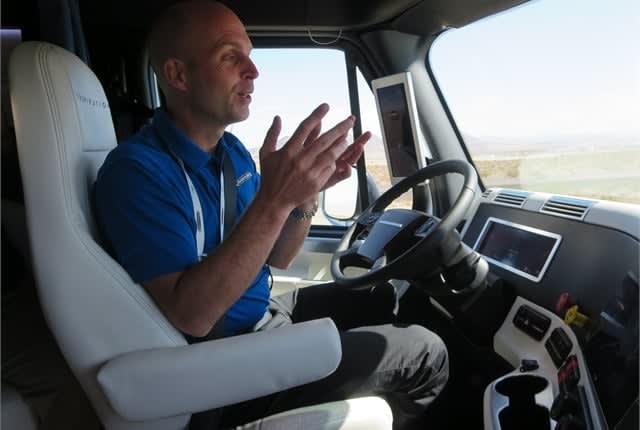
On the road in the Freightliner Inspiration Truck, an autonomous concept vehicle.Photo: Deborah Lockridge.
Driver shortage
Another big question is what autonomous and platooning technology will mean for the driver shortage. Being able to take full advantage of promised productivity gains would require changing regulations to allow vehicles with autonomous technologies to operate for more hours than currently allowed by hours of service rules.
Roberts said in his opinion, “we’re not going to make a quick jump to full automation any time soon.” However, he said, if the technology gets to a point where we’re comfortable having drivers able to FaceTime their families, Skype into a PTA meeting, or play video games while the truck is still going down the road, it could help make driving a more attractive profession. “Truck driving’s a tough job,” he said. “They’re required to be away from home and away from loved ones, so can we use this technology to hep ease that separation?”
Peloton’s Switke said even in platooning situations where the driver is still fully engaged and handling steering operations, it could help in certain ways. Similar to how automated manual transmissions have allowed fleets to bring in less-skilled drivers and achieve similar levels of fuel efficiency, he said, with collision mitigation and platooning, “you can put a new driver in there and get close to same level of safety and efficiency you’d have with an experienced driver, so that can help immediately with the driver shortage.”
How realistic?
There was little agreement on the panel about how fast this technology is coming.
One stumbling block acknowledged was infrastructure. Technologies that rely on cameras reading lane warnings, for instance, rely heavily on highways that are well maintained.
“I think that’s the missing piece of the puzzle,” said Roberts. “Right now we don’t have our system up to 1950 standards… and the Chinese are building a superhighway network from scratch to 21st century standards.”
Waters said “it’s a big problem we have to tackle. We have to design trucks that operate in the world in which we live, with the current state of infrastructure.” On the autonomous Freightliner Inspiration Truck, he noted, if lane markings disappear, the system tells the driver to take back control. If the driver doesn’t, the vehicle will automatically pull to the side of the road and stop.
Levandowski said lane markings that are correctly painted is one thing that’s needed, but discounted the idea that massive investments in vehicle-to-infrastructure communication are needed. He said self-driving trucks, without needing a driver cab, could be lighter and lessen damage caused to highways by heavy trucks.
While Waters noted that many enablers of autonomous technology are already in trucks, such as advanced collision mitigation systems and lane departure warning, “right now we have prototypes. We don’t know what the cost is going to be. There’s a huge difference between three concept trucks and going to full production. Ultimately at the end of the day if the product doesn’t provide a return on investment for our customers, it’s not going to work.”
Levandowski pointed out that “all new technology is expensive, but as it matures and gets more fashionable the cost drops. I think this is the same thing. Our goal is to prove a technology at a low cost and have it help bring automation and liquidity to future transportation.” He even suggested the company might give it away to partners in Uber freight to help build the liquidity he said is needed in the transportation system.
Subscribe to Our Newsletter
More Fleet Management

Sponsored•September 16, 2026
Color Match Smarter: Tools That Restore & Perform
For fleet managers and collision repair professionals keeping heavy-duty trucks on the road, getting the color right the first time isn't just about appearance — it's about efficiency, turnaround time, and bottom-line results. Discover how today's digital color tools are transforming the repair process from guesswork to precision.
Read More →
FMCSA Pauses Biennial-Update Enforcement Amid Motus Transition
Carriers whose updates were due on or after June 1 have more time, while FMCSA works to stabilize its new registration system and warns of phishing sites impersonating its new carrier registration system, Motus.
Read More →
Sponsored•September 14, 2026
2026 Blueprint for Countering Smarter Supply Chain Theft
Cargo theft is no longer just the cost of doing business. It's a multi-billion-dollar criminal enterprise exploiting vulnerabilities across your fleet, drivers, and supply chain.
Read More →


Sponsored•September 1, 2026
How Telematics Improves Visibility, Control, and Performance in Refrigerated Fleets
Explore how telematics help refrigerated fleets improve visibility, uptime, efficiency, compliance, and cargo protection across connected cold chain operations.
Read More →
What the U.S.-Canada Trade War Means for Trucking
Escalating U.S.-Canada tariffs could disrupt cross-border freight, reduce truck volumes, raise costs, and create new uncertainty for carriers on both sides of the border.
Read More →
What Are Trucking’s Top Concerns for 2026?
The American Transportation Research Institute wants to know what's worrying trucking fleet managers, drivers, and other stakeholders in its annual Industry Issues survey.
Read More →
American Trucking Associations Looks for a New Leader
ATA President and CEO Chris Spear abruptly left his job at the association on August 21, at a pivotal time for the trucking industry.
Read More →
Public Wi-Fi Cybersecurity Risks: How Truck Drivers and Fleets Can Protect Their Data
Public Wi-Fi can expose truck drivers and fleets to credential theft, malware, and other cyber threats. Here’s how to reduce the risk on the road.
Read More →
For Nicky Cupp, Fleet Innovation Starts With Frustration
HDT Truck Fleet Innovator Nicky Cupp turns everyday pain points at Fraley & Schilling into opportunities for better technology and smarter processes.
Read More →
Adam Buttgenbach’s Approach to Electric Trucks: Start With Where They Fit
HDT Truck Fleet Innovator Adam Buttgenbach helped PepsiCo build one of North America’s largest EV fleets by focusing on where electric trucks make operational sense.
Read More →