





Taking it Slow on the Road to Autonomous Trucks
Could House Caucus Drive Forward Self-Driving Trucks?
Video: In the Cab of Freightliner’s Autonomous Truck
Startup Says it's Developing Add-On Autonomous Truck Technology
Former employees from Google, Apple and Tesla have jumped into the “self-driving trucks” waters, saying they’ll develop a retrofittable autonomous-driving technology for on-highway commercial heavy trucks.
May 18, 2016
3 min to read
Former employees from Google, Apple and Tesla have jumped into the “self-driving trucks” waters, saying they’ll develop a retrofittable autonomous-driving technology for on-highway commercial heavy trucks.
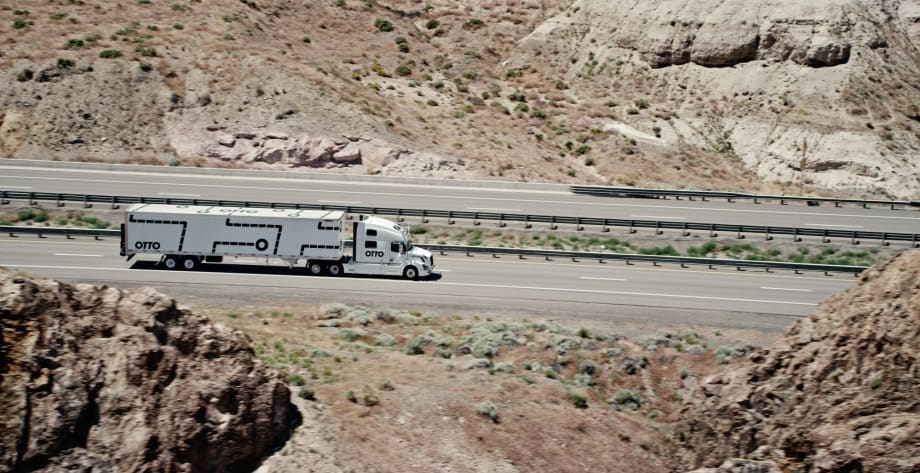
The company, called Otto, has outfitted three cabs with its automated technology and conducted its first extended test on public highways in Nevada last weekend.
Heading up the effort is Anthony Levandowski, who left his job working at Google on their self-driving car to found Otto with two other former Google employees, Lior Ron and Don Burnette, and another robotics expert, Claire Delaunay.
In a blog post, Levandowski and Ron write, “At the heart of our vision is the belief that self-driving tech is the key for creating a more sustainable, productive — and above all, safer — transportation future. … We are at Otto because we’re driven by an urgency and deep obligation to accelerate the future….
“We are developing a suite of sensors, software and truck enhancements coming together in a product that can be quickly outfitted on existing trucks.”
Otto is not the first to demonstrate autonomous truck technology. Daimler Trucks last fall in Germany ran a real-world test of what it says is the first series-production truck to operate on an automated basis on the highway. This followed on-highway demonstrations of concept vehicles, the Freightliner Inspiration truck in the U.S. in Nevada (the first autonomous truck legally licensed to travel on public highways in the country) and the Future Truck 2025 earlier in Germany.
However, even Daimler admits that there is a long road ahead to get to true “self driving trucks,” noting that It will take rewriting a sheaf of regulations and presenting a compelling business case on safety and fuel-economy gains to fleet operators before a Level 3 autonomous truck, like the Freightliner Inspiration demonstration truck, becomes a production tractor.
In an Associated Press story on the new Otto venture, Steven Shladover, program manager for mobility at the University of California's Partners for Advanced Transportation Technology, told AP Technology Writer Michael Liedtke that the technology has a long way to go before government regulators trust it to handle a rig at highway speeds without a driver in the seat.
"I don't want to be on that highway when there is nobody there to take over a truck with 80,000 pounds of cargo, and I don't think I know anyone else who would want to be," Shladover said. "The consequences of any kind of failure in any component would be too severe.”
According to AP, Otto is looking for 1,000 volunteers to have the system installed on their trucks to help fine-tune the technology. “The volunteer truckers would still be expected to seize the wheel and take control of the truck if the technology fails or the driving conditions make it unsafe to remain in autonomous mode, mirroring the laws governing tests of self-driving cars on public streets and highways.”
The New York Times reports that while California laws prohibit Otto’s vision of an autonomous truck operating with the driver snoozing in the sleeper, other state laws would allow it.
As the paper reports: “‘Right now, if you want to drive across Texas with nobody at the wheel, you’re 100 percent legal,’ said Mr. Levandowski, who as a Google engineer, helped write draft legislation that permitted self-driving vehicles, which later became law in Nevada.”
More Fleet Management

Sponsored•September 16, 2026
Color Match Smarter: Tools That Restore & Perform
For fleet managers and collision repair professionals keeping heavy-duty trucks on the road, getting the color right the first time isn't just about appearance — it's about efficiency, turnaround time, and bottom-line results. Discover how today's digital color tools are transforming the repair process from guesswork to precision.
Read More →
FMCSA Pauses Biennial-Update Enforcement Amid Motus Transition
Carriers whose updates were due on or after June 1 have more time, while FMCSA works to stabilize its new registration system and warns of phishing sites impersonating its new carrier registration system, Motus.
Read More →
Sponsored•September 14, 2026
2026 Blueprint for Countering Smarter Supply Chain Theft
Cargo theft is no longer just the cost of doing business. It's a multi-billion-dollar criminal enterprise exploiting vulnerabilities across your fleet, drivers, and supply chain.
Read More →


Sponsored•September 1, 2026
How Telematics Improves Visibility, Control, and Performance in Refrigerated Fleets
Explore how telematics help refrigerated fleets improve visibility, uptime, efficiency, compliance, and cargo protection across connected cold chain operations.
Read More →
What the U.S.-Canada Trade War Means for Trucking
Escalating U.S.-Canada tariffs could disrupt cross-border freight, reduce truck volumes, raise costs, and create new uncertainty for carriers on both sides of the border.
Read More →
What Are Trucking’s Top Concerns for 2026?
The American Transportation Research Institute wants to know what's worrying trucking fleet managers, drivers, and other stakeholders in its annual Industry Issues survey.
Read More →
American Trucking Associations Looks for a New Leader
ATA President and CEO Chris Spear abruptly left his job at the association on August 21, at a pivotal time for the trucking industry.
Read More →
Public Wi-Fi Cybersecurity Risks: How Truck Drivers and Fleets Can Protect Their Data
Public Wi-Fi can expose truck drivers and fleets to credential theft, malware, and other cyber threats. Here’s how to reduce the risk on the road.
Read More →
For Nicky Cupp, Fleet Innovation Starts With Frustration
HDT Truck Fleet Innovator Nicky Cupp turns everyday pain points at Fraley & Schilling into opportunities for better technology and smarter processes.
Read More →
Adam Buttgenbach’s Approach to Electric Trucks: Start With Where They Fit
HDT Truck Fleet Innovator Adam Buttgenbach helped PepsiCo build one of North America’s largest EV fleets by focusing on where electric trucks make operational sense.
Read More →