





She described the capabilities the systems provide as “bionics for drivers,” pointing out that they enable a driver to “see” farther than their eyes can and that “they don’t get tired."
Freightliner Maps Long Road Ahead for Autonomous Truck Technology
It will take rewriting a sheaf of regulations and presenting a compelling business case on safety and fuel-economy gains to fleet operators before a Level 3 autonomous truck, like the Freightliner Inspiration demonstration truck, becomes a production tractor.
September 16, 2015

Hands off on the highway... Image: DTNA
3 min to read
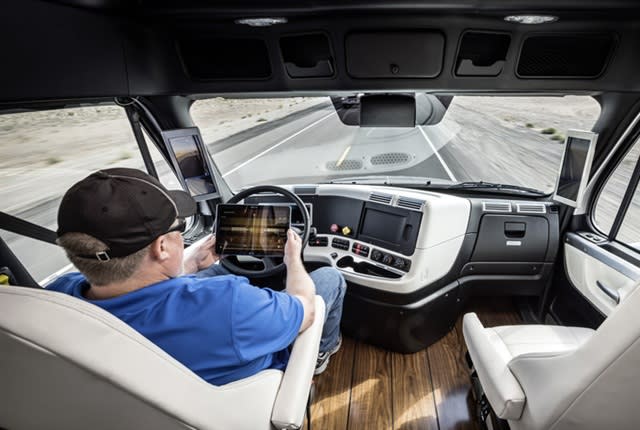
Hands off on the highway... Image: DTNA
It will take rewriting a sheaf of regulations and presenting a compelling business case on safety and fuel-economy gains to fleet operators before a Level 3 autonomous truck, like the Freightliner Inspiration demonstration truck, becomes a production tractor.
That’s why Daimler Truck North America is offering no timeline to when such a truck will be available to buy.
Rather, the OEM said it will continue to incrementally increase the available automation of routine tasks for truck drivers to help make driving trucks both safer and more efficient
In other words, explained DTNA executives at a Sept. 15 media briefing in Las Vegas, technology that will enable robustly engineered autonomous driving will be built into a highway tractor progressively over time— so it will be ready when the rules of the road and the buyers of trucks are ready for it.
Indeed, Diane Hames, DTNA General Manager of Marketing & Strategy, stressed that the Inspiration is not a prototype but “a technology showcase” for Daimler’s autonomous truck technologies and that it remains an ongoing engineering project.
Hames also said that Daimler’s vision for autonomous technology is “not about removing drivers” from trucks, but “extending their capabilities” to operate more safely and comfortably mile after mile.
She described the capabilities the systems provide as “bionics for drivers,” pointing out that they enable a driver to “see” farther than their eyes can and that “they don’t get tired.
“This technology is not about getting rid of drivers,” she added, “but taking away the tedium of driving on the highway for hours at a time so the job is less tiring.”
During a ride and drive for journalists (which also enabled several who hold CDLs to be certified to operate autonomous vehicles within Nevada), DTNA engineers showed how intuitive it is for the truck driver to engage the Innovation’s Highway Pilot system when prompted by an electronic dash display to put the vehicle into autonomous mode, once he or she has positioned it in a highway lane.
Highway Pilot is the system that enables autonomous operation by linking the Innovation’s “camera mirrors” and long- and short-range radar inputs with other onboard systems that provide lane stability, collision avoidance, speed control, braking and steering.
Most of the technology that allows the truck to be operated autonomously is already on the market, including within the Detroit Assurance suite of safety systems offered on Freightliner Cascadia and Cascadia Evolution tractors.
A key exception is a system that uses an electro server motor to executive steering commands dictated electronically by the Highway Pilot.
“It’s the final piece that makes it an autonomous system,” Derek Rotz, DTNA Director of Advanced Engineering, NAFTA, told HDT. “But this isn’t about one technology or another. Each of the enabling systems on the truck must interact.”
Rotz also pointed out that before an autonomous truck could be offered on the market, all the technology entailed and how it operates interactively “would still need to be engineered to take into account operating in all kinds of weather and traffic conditions as well as for robustness” in continuous commercial use.
More Drivers

Truck Drivers Need More Than Another Alert
Fleets have more visibility into truck health, safety events, and driver activity than ever. The next challenge is turning all that information into useful guidance for the person who has to decide what to do next.
Read More →
FMCSA Removes 110 Truck Driver Training Schools from Certified ELDT List
Federal regulators also are targeting more than 160 additional training providers and launching a nationwide audit of third-party CDL skills testers as part of a broader crackdown on trucking fraud.
Read More →
Hours of Service Pilot Programs: FMCSA Readies for 2027 Rollout
Two pilot programs could eventually reshape hours-of-service rules, giving truck drivers options to pause their 14-hour clock or use longer split sleeper rest periods.
Read More →
Medical Cards, English Proficiency Reshape Roadcheck Violations
Medical-card violations jumped to the top of the driver out-of-service list during CVSA’s 2026 International Roadcheck, while English-language proficiency violations appeared among the leading violations for the first time.
Read More →
Driver Trust Can Make or Break the Success of Fleet Safety Technology
New Teletrac Navman research suggests that onboarding, transparency about driver data, and positive feedback can play a significant role in how commercial drivers respond to safety and coaching technology.
Read More →
EEOC Sues KLLM Over Alleged Sex Discrimination in Driver Training
KLLM is facing a federal sex-discrimination lawsuit over policies the EEOC alleges put female truck driver trainees at a disadvantage.
Read More →
FMCSA Moves to Codify English Language Requirements for Commercial Drivers
By changing regulations on English-language proficiency requirements for commercial drivers, rather than relying on a guidance memo, the FMCSA said future administrations won't be able to walk back the Trump administration's stricter enforcement with just a memo.
Read More →
Drivers Put Western Star Trucks to the Test at Star Nation Experience
Watch to get an inside look at the Western Star trucks, technology, and community behind the Star Nation Experience 2026!
Read More →
Trump Administration Looks to Put More Veterans Behind the Wheel
The Freedom Haulers program pulls together existing and expanded programs at several federal agencies to recruit veterans to drive commercial heavy-duty trucks and cut the red tape for them to get a CDL, training, and employment.
Read More →
Putting Mack’s Command Steer to the Test
A test drive of Mack’s Command Steer active steering system evaluates how it can make truck driving easier and less tiring.
Read More →