




Related: Freightliner Maps Road Ahead for Autonomous Technology
Driving Freightliner’s Autonomous Truck
Sometimes, trucking journalists do very funny things — like being certified to drive a truck that is pretty much able to drive by itself.
by Steve Bouchard
September 16, 2015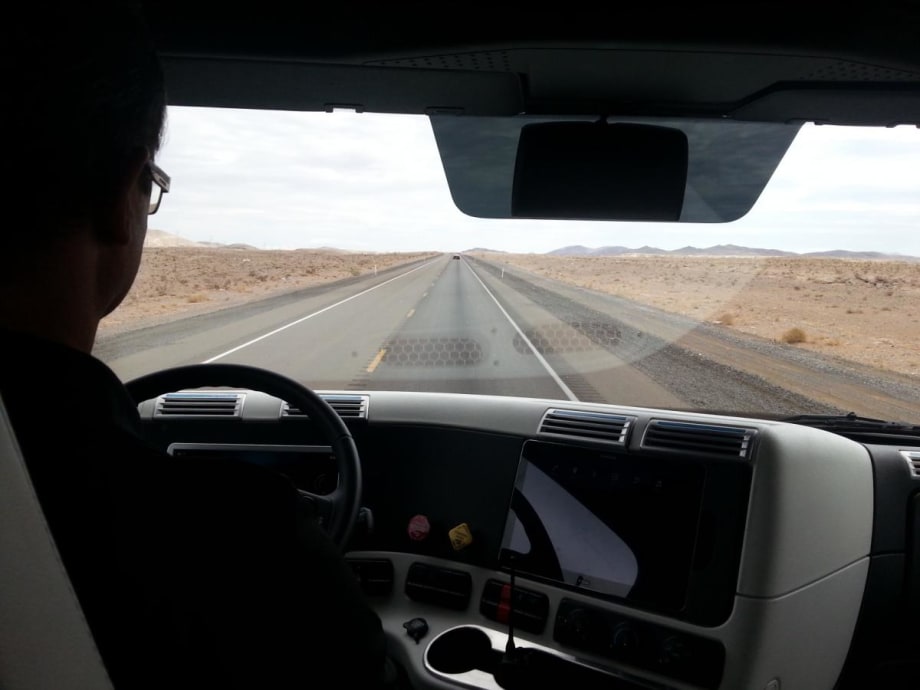
5 min to read
LAS VEGAS -- Sometimes, trucking journalists like me do very funny things. Like being certified to drive a truck that is pretty much able to drive by itself.
Daimler Trucks North America took a few trucking reporters to Las Vegas week so they could drive the Freightliner Inspiration autonomous truck, unveiled in Las Vegas in May.
The prerequisite to sit behind the self-steering wheel of the Inspiration was to hold a commercial driver’s license. Fortunately, I got one a dozen years ago, otherwise, I would have missed what was waiting for me at the Las Vegas Motor Speedway.
There were two trucks at the event. Jim Martin, one of the few Freightliner engineers certified to drive the autonomous truck, would certify six trucking journalists, reminding us that nobody ever passed the test before.
The State of Nevada granted the Inspiration permission to run on the road. The technology in the truck is what the National Highway Traffic Safety Administration calls a Level 3 autonomy level, with Level 4 being full autonomy. Because the truck can roll several miles without the driver touching the steering wheel or the pedals, Nevada requires DTNA to explain what systems are on the truck and how they work, in order to deliver the certification mandated by the state to drive the autonomous truck on their highways.
I wish I could say it was terribly difficult to get the certification, but it was not.
Martin took us for a first ride while he was driving the Inspiration on a loop of about 10 miles, including a good stretch on Hwy. 15 close to the Motor Speedway, and explained to us everything we needed to know before taking the wheel (or the seat, if you prefer). The goal is to train drivers on autonomous commercial vehicle operations in both normal and automated driving modes.
If you know how to operate a cruise control on a vehicle and pay attention to the road while driving, you’re pretty much ready to drive DTNA’s autonomous truck. It uses a combination of commercially available technologies to find its way between the marking lines of the road and to stay between them.
What allows the Inspiration to be autonomous is the system called Highway Pilot. It uses adaptive cruise control and lane departure warning systems, which are found in DTNA’s Detroit Assurance suite of safety systems. It also uses automated steering, full range radar (offering a 18 degrees view and a 820 feet range) a short range radar (130 degrees, 230 feet), a front stereo camera (which you won’t find commercially), and some great mirror cameras that offers a view behind and even pan when the trailer turns, virtually eliminating every blind spot.
In order to use the Highway Pilot system, you simply reach a certain speed and have the engine brake disabled. So when the display clearly showed me that the Highway Pilot was available, I pushed the “resume” button on the steering wheel, just like you do with a cruise control, and the truck kept the 55 mph pre-programmed speed. And when I read on the display that the Highway Pilot was active, I just removed my hands from the steering wheel and my feet from the pedal. Then the next five seconds were very strange, I guess it’s supposed to be when you let a Class 8 truck drive by itself.
Then your brain realizes that the system works and the vehicle stays right between the marking lines, staying 3.5 seconds behind any other vehicle, exactly at the speed you programmed.
It's that easy and so similar to using cruise control: You can enable the system by pushing the “set” or the “resume” button on the steering wheel, accelerate using the “set” button, and press the “off” button or the service brake pedal to disable the system.
Daimler’s engineers pre-programmed the system so I would have to intervene and take control of the truck at some point. For instance, what would happen if the lane marking could not be seen by the cameras for some reason. A notification and a 10 second countdown appeared on the display, letting me know it was time for me to take over.
That day in Vegas was fairly windy, and we could easily see the system fighting the wind to keep the vehicle right in the middle of both lanes. That’s the kind of benefit the autonomous trucks can bring – less fatigue for drivers.
Drivers who are afraid that autonomous trucks take their job can stay calm and keep driving. Drivers have to take control of the autonomous truck to enter and exit the highway, at intersections and to make turns.
DTNA made it clear that the autonomous truck needs a driver, one who is aware of what’s happening and who is responsible for the vehicle.
Diane Hames, general manager of marketing and strategy at DTNA, insists that technology doesn’t want to get rid of the driver. “Absolutely not,” she says. “Technology can reduce fatigue. Over time, focusing on the road is an activity that leads to fatigue.”
With the autonomous truck, the “driver has to be on the seat, and has to be able to take control of the truck, but the level of concentration required is not the same,” says Hames. “The truck never gets tired, and can react more quickly in certain situations.”
Autonomy actually pays off. Studies conducted in Germany by Daimler shown that autonomous trucks can reduce fatigue by 25%, according to Mary Aufdemberg, director of product marketing for Freightliner Trucks.
Subscribe to Our Newsletter
More Equipment

How Volvo Updated Its D13 for EPA 2027 [Watch]
Volvo’s updated D13 promises lower emissions without sacrificing performance or fuel economy. Take a closer look at what changed inside the engine in this HDT Spotlight video.
Read More →
Michelin Tire Improves Efficiency and Durability for Regional Fleets
The Michelin X Multi Energy D2 is a regional haul drive tire engineered to help fleets improve fuel efficiency, durability and traction in demanding stop-and-go operations.
Read More →
ZF Expands Commercial Vehicle Push in North America
ZF is expanding its North American commercial-vehicle presence with new transmission applications, electrification, trailer technology and autonomous-driving systems.
Read More →
Tesla Wants a Self-Driving Semi. Are Cameras Enough?
Could Tesla’s camera-only autonomous driving technology work on an 80,000-pound Semi? In this commentary, HDT's Deborah Lockridge takes a look at Tesla, Cybercab, and how autonomous trucks see the road.
Read More →
Kodiak: Driverless Long-Haul Truck Launch on Track for 2026
Kodiak AI says its driverless long-haul safety case is 93% complete and it remains on track to begin commercial operations by year-end 2026.
Read More →
What DOT’s Automated Vehicle Strategy Means for Trucking
The U.S. Department of Transportation issued a new automated-vehicle strategy that outlines plans for driverless-truck regulations, cross-state freight corridors, and federal safety standards.
Read More →
East Coast Port Launches $45M Electric Truck Push
The Port Authority of New York and New Jersey announced millions in incentives for zero-emission drayage trucks, yard tractors, and new charging hubs near the port.
Read More →
PlusAI Going Public to Fund Autonomous Truck Launch
A SPAC deal could provide PlusAI with up to $300 million as it works toward a 2027 commercial launch of factory-built autonomous trucks.
Read More →
NHTSA Moves to Rewrite Truck Fuel-Economy Rules
The National Highway Traffic Safety Administration says it lacks authority to regulate medium- and heavy-duty truck engines separately from complete vehicles, but the existing standards have not yet been eliminated.
Read More →
Detroit Opens Orders for EPA 2027 Engines
Detroit isn’t starting from scratch to meet EPA 2027 diesel emissions standards. Its Gen 6 DD13 and DD15 engines keep much of today’s platform while updating the fuel and aftertreatment systems.
Read More →