





This article is Part of a series, "How Freight Movement is Changing," exploring how logistics trends are affecting trucking. Read more:
How Technology is Making Logistics More Efficient
Rollzi Brings a High-Tech Twist to an Old Trucking Model
When Damien Hutchins was in the brokerage business, he was struck by how much time is wasted in trucking because trucks have to stop so drivers can sleep. So he co-founded a tech-enabled trucking company, Rollzi, to bring a new operating model to the industry: Single-lane relays.
March 31, 2023
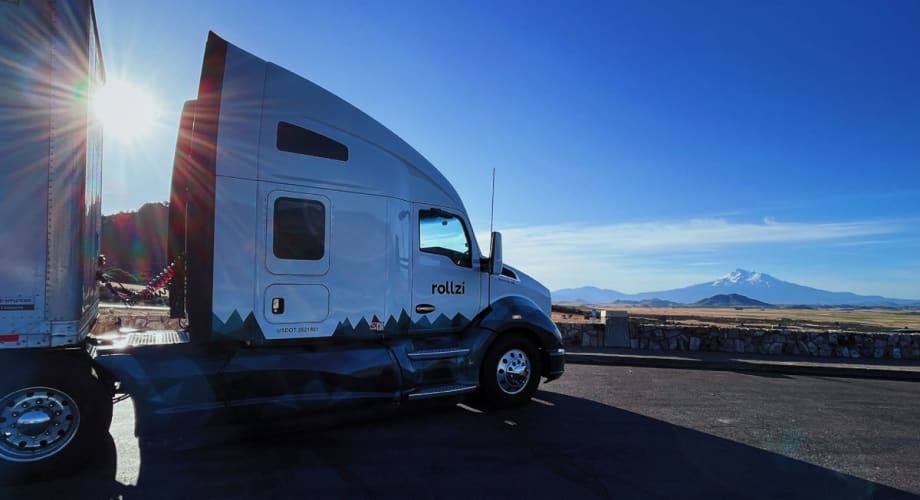
Rollzi’s proprietary technology powers a single-lane relay strategy in which multiple drivers combine to deliver loads, increasing truck utilization and efficiency.
Photo: Rollzi
7 min to read
When Damien Hutchins was in the brokerage business, he was struck by how much time is wasted in trucking because trucks have to stop so drivers can sleep. So he co-founded a tech-enabled trucking company, Rollzi, to bring a new operating model to the industry: Single-lane relays.
Based in Seattle, Rollzi is co-founded by Hutchins, who is CEO, and Jonathan Epstein, chief financial officer. Epstein has a background in finance and real estate, while Hutchins has experience in technology and logistics startups, most recently heading the brokerage team at the Convoy digital freight network.
“It still seems crazy to me that freight is sitting in parking lots all night,” he says. With his single-lane relay strategy, “a load could move 1,000 miles but be handed off to a new driver and a new truck every 250 miles, a relay of the load. It gets there in half the time, the drivers all get to return to their home terminals every night, the shipper gets faster delivery.”
On top of that, he says, in addition to the relay, he can slip-seat those trucks, where another driver comes in and does the same relay overnight.
“And so if we can get double the revenue miles for those same fixed costs, it starts to change the whole cost structure, and it’s no longer this rate-per-mile game,” Hutchins says. “It’s just a utilization game: How many moving miles on a loaded box I can get.”
New Twist on an Old Idea
In fact, relays are not a new idea. It’s been used by less-than-truckload and companies such as UPS for some time.
One driver leaves from one city, another driver leaves from a different city, and they meet with their loads at a halfway point set up by a dispatcher. As the drivers approach the designated city, they call each other to determine an exact meeting point. They swap trailers at the meeting point, then turn around and head back to their home terminals with the new load, and each takes its load closer to its final destination.
What Rollzi and a handful of other companies are doing is bringing new technology to the model.
“Until recently, fast decision-making tied to the dynamic nature of trucking and all of its variables has not been possible,” Hutchins says. “By using technology and our single-lane relay approach, we can drive more revenue per truck than a traditional carrier, we can provide better service levels for customers, and deliver better pay and quality of life for drivers.”
Rollzi’s proprietary technology considers dozens of data points to model the most efficient relay for each driver, truck, trailer and load. These data points can include live data from telematics, market inputs, service activity, driver location and hours of service, fuel prices, traffic data, weather data and more.
When Rollzi dispatches a load using its system, called Pace, it can dispatch the pickup, the breaks, the fuel stops, the relay points, truck changes.
“But the drivers don't have to stick to that exactly, because our system will learn from it. So if we find that they’re combining a 30-minute break with a fuel stop at a place that they prefer to go, the system will say, when this driver is making this route, he likes to stop at this Seven Feathers truckstop that has a certain amenity and we should consider that for when we when we create the route next time.”
“And now we know Shawn is going to take his 30 a little bit later, but he's also going to fuel up, saving us a stop. So now he has a new adjusted ETA.”
It started its relay operations on I-5.
“It was really important for us to focus on a dense lane. With all the freight coming out of LA we know we were going to always have reloads going north.”
The company recently added a lane from Detroit to New Jersey.
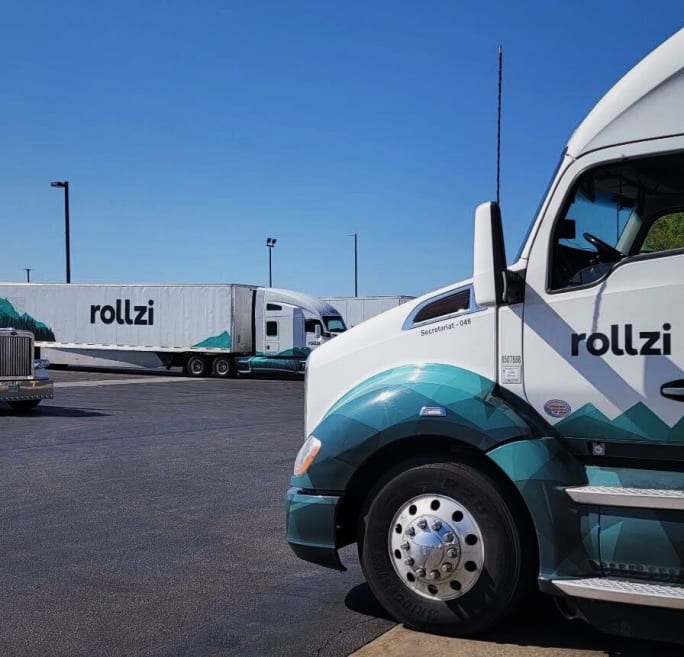
For shippers, Rollzi’s single-lane relay model cuts transit time down so freight arrives to its destination faster.
Photo: Rollzi
Using Technology to Solve Logistics Problems
Hutchins calls himself “the non-tech tech guy.”
“I've always been in the operation side. But I do understand tech. I've been the head of a software companies before. When developers build something, I can kind of review do a little bit of code review. But mostly, it was just a high-level understanding of how technology works, a looking at, what are the problems? How are we solving them today? Which of those tasks should we just avoid doing all together?”

"If we can get double the revenue miles for those same fixed costs, it starts to change the whole cost structure," says Rollzi co-founder Damien Hutchins.
Photo: Rollzi
For example, the check call — phone calls coming in all day long from customers and brokers asking, ‘Where’s my freight?’
“I thought, we have the technology to automatically deliver that information to you.”
The system knows where each truck is, who’s the driver, how many hours they have left in their hours of service, the next stop in the route, what the load is and who might be asking about the load.
When that call comes in, the system recognizes who it’ from. Voice-to-text software allows it to glean what load they’re asking about. Then the computer can tell the caller where the load currently is, what’s the next stop and the final stop, and what time it’s expected at the final location.
“That reduces the need for an internal person hired by me to answer that phone, look it up and let somebody know where their load is,” Hutchins says. “We're still providing the same level of service and the same amount of information, but we're providing it faster, and probably more accurately, because we're sort of anticipating what that need is.
“So, we look at every task that we're doing. And instead of saying, ‘How do we do it better,’ we say, ‘Should we be doing this at all? Or is there a different solution for how we should solve this problem?’”
Do Truck Drivers Like the Single-Relay System?
For drivers, an obvious benefit of the single-lane strategy is they get home more often. But what about the conventional wisdom that drivers don’t want to share trucks?
“Yeah, I worried about that a lot at first,” Hutchins says. “And what I found is, drivers don't mind slip-seating in certain scenarios. All of our drivers are home every week, so they spend way more time in their own beds than they might in a normal over the road operation. So that helps.”
Trucks are kept standard as much as possible, and all are outfitted with the same amenities, including microwaves, TVs, refrigerators, GPS, and “really nice foam mattresses with covers.”
“We found that as long as we keep all of them clean and hold everybody to a pretty high standard of cleanliness and taking care of the trucks, and they're pretty much the same as you move from one to the other, drivers don't seem to mind quite as much.
“Do they still have their favorites? Absolutely. But I get very little pushback now on drivers moving from one truck to another.”
In fact, he says, he has gotten more comments about drivers getting a bit bored driving up and down I-5 than complaining about wanting to stick to the same truck.
The trucks also have radio systems that are like a CB but communicate over the 5G network, allowing all Rollzi’s drivers to talk to each other no matter where they are.
“One of our values is accurate transparency, so they all can talk. I know some carriers cringe at the thought of drivers actually talking to each other, but we like it when they just communicate about what the issues are out there and they help each other out.”
Hutchins says its turnover rate was about 4% at the end of last year, so the company must be doing something right.
Rollzi also says it treats drivers like all employees should be treated. Its drivers are paid by the hour, including any and all on-duty time. The company pays its drivers for fueling, waiting at facilities or during breakdowns. Rollzi also pays overtime, equips its late-model trucks with technology and amenities that make life on the road enjoyable, and provides a career path for all drivers including management and a pathway to independent contractor.
Expanding its Single-Lane Relay Strategy
Rollzi’s customers include major food and beverage companies, as well as consumer packaged goods and home-furnishing retailers. The company also takes spot market shipments from a short list of top freight brokerages.
The company is small but growing. Today Rollzi has 22 trucks. Last year, Rollzi announced it had raised $8 million in seed equity and credit financing to fund and accelerate the company’s expansion.
“I get the question a lot about what makes a carrier a tech carrier. And for us, it really is our strategy. Our strategy is not possible without the technology. That single-lane relay just doesn't work if you don’t have full visibility and control over the trucks and the drivers and the loads.” Hutchins believes all carriers need to understand what tools are out there and how they can leverage those tools to reinforce their own strategies.
“I don't think that everybody needs to do a single-lane relay strategy. But I think that using the technology to enable parts of your strategy that maybe you didn't realize were possible is important, and it makes us all better.”
Explore the entire collection of 'How Freight Movement is Changing.'
Subscribe to Our Newsletter
More Fleet Management

Sponsored•September 16, 2026
Color Match Smarter: Tools That Restore & Perform
For fleet managers and collision repair professionals keeping heavy-duty trucks on the road, getting the color right the first time isn't just about appearance — it's about efficiency, turnaround time, and bottom-line results. Discover how today's digital color tools are transforming the repair process from guesswork to precision.
Read More →
FMCSA Pauses Biennial-Update Enforcement Amid Motus Transition
Carriers whose updates were due on or after June 1 have more time, while FMCSA works to stabilize its new registration system and warns of phishing sites impersonating its new carrier registration system, Motus.
Read More →
Sponsored•September 14, 2026
2026 Blueprint for Countering Smarter Supply Chain Theft
Cargo theft is no longer just the cost of doing business. It's a multi-billion-dollar criminal enterprise exploiting vulnerabilities across your fleet, drivers, and supply chain.
Read More →


Sponsored•September 1, 2026
How Telematics Improves Visibility, Control, and Performance in Refrigerated Fleets
Explore how telematics help refrigerated fleets improve visibility, uptime, efficiency, compliance, and cargo protection across connected cold chain operations.
Read More →
What the U.S.-Canada Trade War Means for Trucking
Escalating U.S.-Canada tariffs could disrupt cross-border freight, reduce truck volumes, raise costs, and create new uncertainty for carriers on both sides of the border.
Read More →
What Are Trucking’s Top Concerns for 2026?
The American Transportation Research Institute wants to know what's worrying trucking fleet managers, drivers, and other stakeholders in its annual Industry Issues survey.
Read More →
American Trucking Associations Looks for a New Leader
ATA President and CEO Chris Spear abruptly left his job at the association on August 21, at a pivotal time for the trucking industry.
Read More →
Public Wi-Fi Cybersecurity Risks: How Truck Drivers and Fleets Can Protect Their Data
Public Wi-Fi can expose truck drivers and fleets to credential theft, malware, and other cyber threats. Here’s how to reduce the risk on the road.
Read More →
For Nicky Cupp, Fleet Innovation Starts With Frustration
HDT Truck Fleet Innovator Nicky Cupp turns everyday pain points at Fraley & Schilling into opportunities for better technology and smarter processes.
Read More →
Adam Buttgenbach’s Approach to Electric Trucks: Start With Where They Fit
HDT Truck Fleet Innovator Adam Buttgenbach helped PepsiCo build one of North America’s largest EV fleets by focusing on where electric trucks make operational sense.
Read More →