





"The question we ask ourselves all the time is, 'Can elephants dance?' We’re a big elephant."
Q&A: Cummins' Samperio On Rapid Pace of Technological Change
How can Cummins and the industry keep up with the rapid pace of technological change in truck engine and propulstion? We asked José Samperio, Cummins’ new executive director and general manager for North American on-highway business, in a short interview during TMC's annual meeting.
March 7, 2023
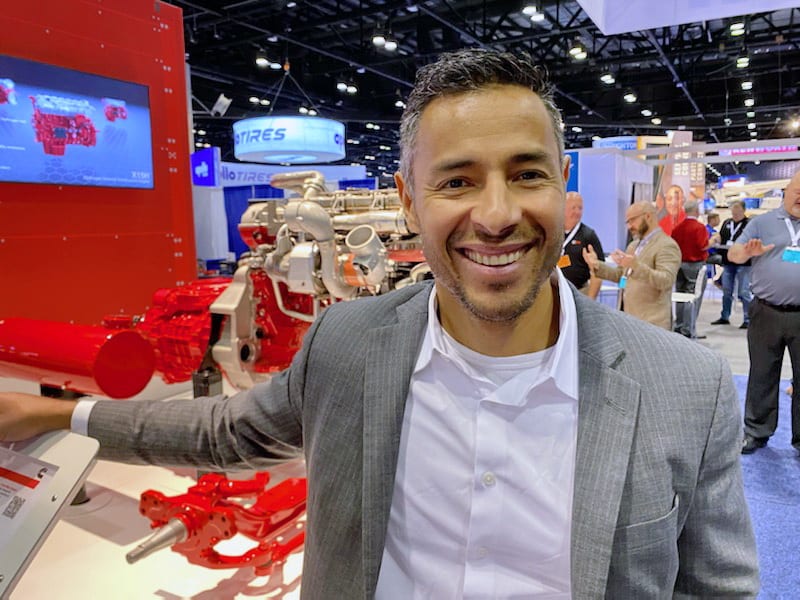
José Samperio, Cummins executive director and general manager, North America On-highway, at TMC.
Photo: Jim Park
5 min to read
How can Cummins and the industry keep up with the rapid pace of technological change in truck engine and propulsion? We asked José Samperio, Cummins’ new executive director and general manager for North American on-highway business, in a short interview during TMC's annual meeting.
Samperio succeeds Amy Boerger, who will retire at the end of March after 39 years with the company. He brings nearly 20 years of Cummins experience across engineering, service, strategy and sales.
He started with Cummins at the Jamestown Engine Plant, where he served as a product engineer. He spent time in China and Latin America, where he was general manager for Cummins’ Power Systems business. For the past two years he served as the executive director – sales for the On-Highway Business in North and South America.
HDT Equipment Editor Jim Park caught up with Samperio on the trade show floor at the ATA’s Technology & Maintenance Council annual meeting in Orlando, Florida, in early March.
The interview below has been edited for clarity and length.
HDT: With GHG 2027 and the push to maintain the pace of battery-electric truck development happening simultaneously, does this industry have the resources to manage all that?
Samperio: The industry has known for probably the past five to seven years that the next 10 years we will need more research investment than we have in the past 20 years. Literally.
I mean, look at all the new products Cummins is going to launch. For engineering companies and technology companies (we like to think ourselves a technology company), we see that as a good thing, because the more it gets challenging, the more we think we can compete well.
I think partnerships are the way of the future. You see this everywhere, now. Some can be like the one we have now with Meritor and some can be just a partnership, like the collaboration we announced publicly with DTNA on fuel cells. They have things they need to get done, we have things that we need to get done, we can do a lot together. I think you're going to see more of that — the industry trying to be more efficient in getting to the point where everybody wins. We're going to see more cooperation across all manufacturers, I think.
HDT: How do you think the startup companies will weather this two- or three-year transition where there’s no revenue but lots of engineering dollars being spent?
Samperio: I think it's going to be a challenge.
I think, for all of us incumbents that are seeing some of the disadvantages, the question we ask ourselves all the time is, “Can elephants dance?” We’re a big elephant. Moving something one way or another, by even one degree, feels monumental. But the startup companies can do things faster; they're nimble, they’re more agile.
But on our side, not only do we have the brand name, but we have the resources of an existing business, like continuous funding that can keep us going for the long term. I don't know how [startups are] going to do it.
From our side, and that of the other industry incumbents, we have our existing business to fund future development. We're going to be in this for the next 10-20 years. This candle is going to burn slowly. It’s going to be 20 years of continuous investment.
HDT: Now that you have Meritor on board, enabling a basically integrated powertrain and providing some battery-electric resources, how is that going to help Cummins move forward?
Samperio: The way we think about it is, how does this help our customer base? When you do the right things for your customers, your carriers, and your dealer channel, then good things happen.
Now that we have an integrated powertrain, the customers will benefit two ways. The first one is from an engineering integration perspective. You saw what we did with the Eaton-Cummins joint venture. That led to better and more efficient product development. With Meritor, we’ll be able to do the same thing. We can also extend adjacently with the investments they made in electric powertrains and inverters. All that allows Cummins to offer a better value proposition for the customer.
And also from a channel perspective of customer support and customer service, having a more integrated view how we do things rather than having to do a little bit here and a little bit there, now we're able to do it all together. It's going to take a while. It's going to be a process, a journey, but from a customer base perspective, I think it’s going to be a lot better.
HDT: How do you see the next five years unfolding? Do you have any predictions?
Samperio: There's going to be a lot of people retiring. A lot of people are going to say, ”That’s enough.” But I think a lot of us in the industry, and I count myself among them, are going to embrace these challenges. We're excited about launching new technology.
I think it will challenge us on how to balance the costs with the technology, but this industry will continue to innovate. We've proven over the past 20 years that we can innovate. We have a track record, but it’s not always obvious to people outside the industry. Once they stop and see what the trucks and the technology looked like 20 years ago and how they look today, it’s been an amazing 20-year run. I think the industry will continue to innovate. There'll be challenges, but the industry will figure it out.
Subscribe to Our Newsletter
More Equipment

How Volvo Updated Its D13 for EPA 2027 [Watch]
Volvo’s updated D13 promises lower emissions without sacrificing performance or fuel economy. Take a closer look at what changed inside the engine in this HDT Spotlight video.
Read More →
Michelin Tire Improves Efficiency and Durability for Regional Fleets
The Michelin X Multi Energy D2 is a regional haul drive tire engineered to help fleets improve fuel efficiency, durability and traction in demanding stop-and-go operations.
Read More →
ZF Expands Commercial Vehicle Push in North America
ZF is expanding its North American commercial-vehicle presence with new transmission applications, electrification, trailer technology and autonomous-driving systems.
Read More →
Tesla Wants a Self-Driving Semi. Are Cameras Enough?
Could Tesla’s camera-only autonomous driving technology work on an 80,000-pound Semi? In this commentary, HDT's Deborah Lockridge takes a look at Tesla, Cybercab, and how autonomous trucks see the road.
Read More →
Kodiak: Driverless Long-Haul Truck Launch on Track for 2026
Kodiak AI says its driverless long-haul safety case is 93% complete and it remains on track to begin commercial operations by year-end 2026.
Read More →
What DOT’s Automated Vehicle Strategy Means for Trucking
The U.S. Department of Transportation issued a new automated-vehicle strategy that outlines plans for driverless-truck regulations, cross-state freight corridors, and federal safety standards.
Read More →
East Coast Port Launches $45M Electric Truck Push
The Port Authority of New York and New Jersey announced millions in incentives for zero-emission drayage trucks, yard tractors, and new charging hubs near the port.
Read More →
PlusAI Going Public to Fund Autonomous Truck Launch
A SPAC deal could provide PlusAI with up to $300 million as it works toward a 2027 commercial launch of factory-built autonomous trucks.
Read More →
NHTSA Moves to Rewrite Truck Fuel-Economy Rules
The National Highway Traffic Safety Administration says it lacks authority to regulate medium- and heavy-duty truck engines separately from complete vehicles, but the existing standards have not yet been eliminated.
Read More →
Detroit Opens Orders for EPA 2027 Engines
Detroit isn’t starting from scratch to meet EPA 2027 diesel emissions standards. Its Gen 6 DD13 and DD15 engines keep much of today’s platform while updating the fuel and aftertreatment systems.
Read More →