




Q&A: Akasol North America President Roy Schulde
Akasol is one of Europe’s largest supplier of battery systems for commercial vehicles with hybrid-electric or all-electric drives and is now moving into the North American commercial vehicle market.

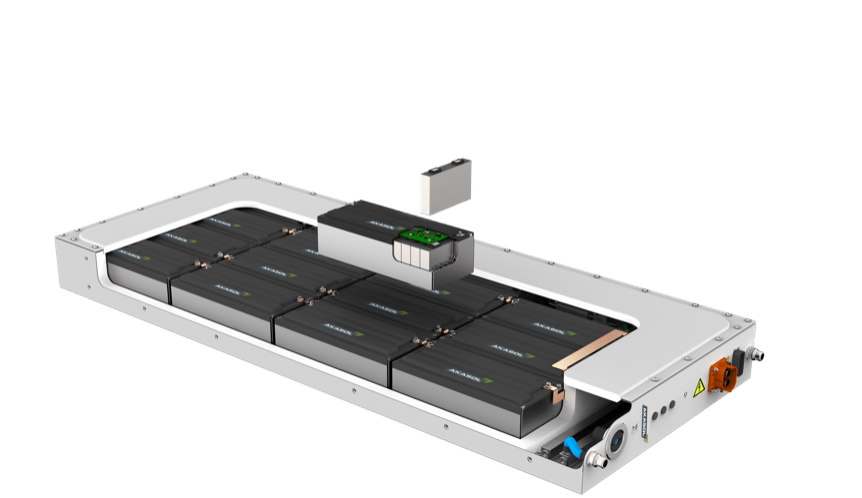
The AKASystem OEM PRC lithium-ion battery system for commercial vehicles will be produced in the U.S. at a plant in Novi, Michigan.
Image: Akasol
Akasol AG, based in Darmstadt, Germany, was founded in 1990 and has since emerged as a leading European manufacturer of high-performance, lithium-ion battery systems for commercial vehicles, rail vehicles, industrial vehicles, and ships and boats.
Akasol is one of Europe’s largest suppliers of battery systems for commercial vehicles with hybrid-electric or all-electric drives and is now moving into the North American commercial vehicle market.
Roy Schulde, president of Akasol's North American operations, spoke with HDT about his company’s past, its products, and its future goals in this marketplace.
HDT: Tell our readers a little bit about how Akasol was founded.
Schulde: The company began as a student club at the Technical University in Darmstadt.. A group of engineering students founded it as a nonprofit group to compete in academic contests for world championships in emerging battery technology. Those competitions naturally led to involvement with solar vehicles and eventually expanded into battery systems for light vehicles and electric trucks. The common denominator was the battery technology used in each case. And the systems and technologies these students developed led to the founding of Akasol GmbH in 2008. The company went public in 2018 with a successful IPO and became Akasol AG. And today, that translates into over 30 years of experience in developing and deploying these battery systems.
HDT: Over time, then, the company decided to concentrate on commercial vehicles and vocational applications?
Schulde: Yes. Over time, it became clear that passenger car OEMs were going to concentrate on proprietary battery technology for their electric vehicles. So, Akasol made the decision to concentrate on vocational and industrial machines, including construction and mining equipment, and marine vessels as well as medium- and heavy-duty trucks and buses. We have attracted many well-known European customers over the years, including large, blue chip European truck and bus OEMs, such as Daimler and Volvo.
HDT: I wasn’t aware that battery-powered vehicles were moving into mining applications.
Schulde: Yes. There are big benefits for mine operators running full-electric vehicles because that allows them to get away from the massive costs associated with ventilating mines and removing noxious diesel emissions in them. We are working with Medatech in Canada on such applications.
HDT: What is behind Akasol’s decision to move into the North American electric commercial-vehicle market?
Schulde: A lot of it has to do with the global nature of trade today and the fact that our European customers require that we develop products that can be sold in the United States per the Buy America Act guidelines issued by the Federal Transit Administration. Transit buses acquired with federal public transportation funding must have final assembly in the United States and have a certain percentage of the bus cost be of domestic origin. Batteries can make up about 25% of the cost of an electric bus, so it’s necessary for us to manufacture our systems in the U.S. We also want to be able to serve the other commercial vehicle markets in North America with local product.
HDT: What aspects of your products and technology do you feel set you apart from your competitors?
Schulde: We are 'cell agnostic' when it comes to battery technology. We have decades of experience in developing the best available solutions for any given application, whether it demands more power, higher energy levels, a larger number of cycles, or other requirements. We currently offer battery systems that utilize pouch and prismatic cells. We are also in development of a new type of battery system with cylindrical battery cells, which offers higher energy density per pack. We believe they will be applicable for long-haul, heavy-duty electric truck applications where cost and battery weight are limiting design factors. This is similar to battery cell technology employed by Tesla. We showcased a prototype cylindrical cell-based system at the Battery Show in Stuttgart, Germany, earlier this year. And we will have our latest version on display at the Battery Show in Novi, Michigan, later this year.
HDT: Obviously, you are bullish on the developing market for electric trucks in North America.
Schulde: We see buses adopting full electric technology first. And so that market will be our initial focus in the United States. We also have ongoing battery applications for medium-duty trucks with known duty cycles – established, unvarying routes with recharge times over night. So, we are looking carefully at refuse trucks and delivery trucks. We understand that battery technology may not get to a point where we can do all-electric long-haul applications. There you may see fuel-cell technology as the prime power source, which will still need a certain level of battery technology as an intermediate storage medium that we can supply. Generally speaking, our philosophy is there is not one battery solution that fits all applications. And, again, that is why we try to be technology agnostic when assessing a new application.
HDT: Are you in talks with any North American truck OEMs?
Schulde: We are talking with American OEMs. And we expect a major announcement in this area in the near future. But that is all I can say at this time.
More Fuel Smarts

How Volvo Updated Its D13 for EPA 2027 [Watch]
Volvo’s updated D13 promises lower emissions without sacrificing performance or fuel economy. Take a closer look at what changed inside the engine in this HDT Spotlight video.
Read More →
Diesel Price Spike Shortens Payback for Natural Gas Trucks, Report Says
Energy Vision estimates fleets could recover the higher purchase price of an RNG-fueled Class 8 tractor in 1.3 to 2.8 years under current fuel-price scenarios.
Read More →
Calstart Becomes Catalyst Mobility, Reflecting Broader Focus
Calstart is now Catalyst Mobility, reflecting the nonprofit’s growing national role in clean transportation, including zero-emission trucks, infrastructure and incentive programs.
Read More →

Record Diesel Prices Squeeze Trucking Fleets
Average U.S. diesel prices have climbed to nearly $6 a gallon, surpassing the 2022 record as tight refinery capacity and Middle East disruptions keep fuel costs elevated.
Read More →
How Fuel Delivery Shapes Engine Performance
Fuel delivery depends on more than what happens at the injector. For fleet, maintenance and technical professionals, looking at the full path from pump to injector can provide useful context for understanding engine performance.
Read More →
East Coast Port Launches $45M Electric Truck Push
The Port Authority of New York and New Jersey announced millions in incentives for zero-emission drayage trucks, yard tractors, and new charging hubs near the port.
Read More →
California Bill Could Shed Light on Electric Truck Prices
Why do battery-electric Class 8 trucks remain so expensive? A California bill headed to Gov. Gavin Newsom would give fleets and state agencies more visibility into what manufacturers charge.
Read More →
Detroit Opens Orders for EPA 2027 Engines
Detroit isn’t starting from scratch to meet EPA 2027 diesel emissions standards. Its Gen 6 DD13 and DD15 engines keep much of today’s platform while updating the fuel and aftertreatment systems.
Read More →
Zero-Emission Truck Corridor Planned for West Coast
California, Oregon, Washington, British Columbia and Baja California are coordinating plans for truck charging and hydrogen fueling from Canada to Mexico.
Read More →
A Closer Look at Kenworth’s Electric T880E Vocational Truck [Video]
Learn more about Kenworth's T880E battery-electric vocational truck at the Paccar Technical Center, including its range, applications, upfitting considerations, and PTO options, in this HDT Spotlight video.
Read More →