




Pursuing a Tank Rust Mystery
Is ultra-low-sulfur diesel fuel causing rust in steel fuel tanks? A shop foreman in Georgia believes that the relatively new fuel, or perhaps biodiesel blends, are to blame for the damaged saddle tanks he's seen in the last yea

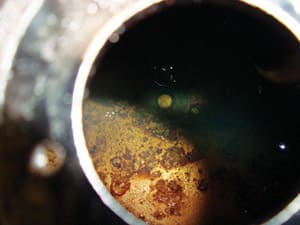
Rust forming inside steel saddle tanks might be caused by ultra-low-sulfur diesel fuel, some maintenance people believe. This rusty tank was on a Ford truck operating in northern Georgia. (Photo by Chris Sands)
Is ultra-low-sulfur diesel fuel causing rust in steel fuel tanks? A shop foreman in Georgia believes that the relatively new fuel, or perhaps biodiesel blends, are to blame for the damaged saddle tanks he's seen in the last year
or two. Rust gets into fuel lines, clogs filters and lowers fuel pressure; that, in turn, causes low power and damage to injectors.
An industry trade group says it's gotten similar reports about underground storage tanks, and that the federal government is looking into it. A maintenance consultant says aluminum tanks are corroding, too. Steel tanks are widely used on vocational trucks, and Ford Motor Co. uses them exclusively on its medium-duty models used for all hauling tasks.
Ford tanks is where Chris Sands, who runs the repair shop at a multi-brand dealership in suburban Atlanta, sees the problem. Rust usually forms when water gets inside tanks and owners don't take steps to remove it. Rust shouldn't happen in otherwise clean tanks but is, on F-250 to F-750 trucks his mechanics work on.
"We discovered the rusting issue after seeing trucks with low power issues returning in less than 3,000 miles from the first repair," Sands says. "Rust did not occur to us until we started cutting open the filters to see what was plugging them up. How many times have trucks come in with low power, and we checked the fuel pressure, found it low and slapped on filters and sent them on? It seems like more than 50 percent had the same problem in a short period of time and it was traced back to the tanks. We have gotten very proactive when we get low power issues now and I make my techs check the tanks on any low power complaint."
He's sent damaged tanks to a nearby radiator shop to have them boiled and their interiors coated to try to prevent rust formation. Injectors are affected because Ford's Navistar-built PowerStroke and Cummins ISB diesels need a certain amount of fuel pressure to operate. His dealership sells and services Ford commercial trucks, which is why he sees the problem mostly in Ford tanks, but he's heard of it in other truck makes with steel tanks. Ford uses only steel tanks in its midrange trucks, and a spokesman said its safety and service specialists have not heard of many corrosion problems. Other truck makers said they haven't either.
Sands at first thought the tank-rust problem coincided with introduction of ultra-low-sulfur diesel fuel in late 2006, because he didn't see tank rust until afterwards. He had heard that refiners add sodium chloride - common salt - to fuel to combat formation of algae, and that salt "acts as a moisture magnet" that in turn reacts with steel to cause the rusting.
The American Petroleum Institute says stories of salt being added to ULSD may come from refiners' practice of using salt beds to dry the fuel before it's shipped. But refiners do not add salt, an API spokesman says. The trade group has gotten reports of rust formation in underground tanks, but there's no pattern to them, geographically or otherwise.
Sands also wonders if unregulated biodiesel fuels are to blame, but the National Biodiesel Board says that's not true. It points to research done by the Steel Tank Institute that shows biofuel-diesel blends do not cause rust in underground storage tanks. It believes those findings should also extend to steel saddle tanks on trucks, though they weren't specifically tested.
"A handful of filling stations have reported this problem, rust in underground storage tanks," says Prentiss Searles, the API spokesman. "It's relatively new. It does not appear to be widespread, but there's no pattern to where it does appear." The federal Environmental Protection Agency knows about the rust problem and scheduled a meeting on it with industry representatives for late January. API and NBB reps are among those who intended to attend the meeting.
"It also happens in aluminum tanks," says Darry Stuart, a fleet maintenance consultant and past general chairman of the Technology & Maintenance Council of the American Trucking Associations. "It just takes longer."
ULSD fuel was introduced in October 2006 for use in engines meeting EPA-2007 and now 2010 emissions regulations. Their diesel particulate filters will clog if residue from higher-sulfur fuels move into exhaust streams. Sulfur acts as a lubricant and its removal was a problem at first, so refiners added compounds to compensate, but salt is not one of them. "Anytime you get a new fuel, you have to see what it does," Searles says, and the tank rusting might be an unforeseen side effect.
From the February 2010 issue of Heavy Duty Trucking.
More Maintenance

Color Match Smarter: Tools That Restore & Perform
For fleet managers and collision repair professionals keeping heavy-duty trucks on the road, getting the color right the first time isn't just about appearance — it's about efficiency, turnaround time, and bottom-line results. Discover how today's digital color tools are transforming the repair process from guesswork to precision.
Read More →
Wrong Repair Prompts Recall of Freightliner, Western Star 4x2 Trucks
DTNA is recalling more than 2,400 trucks that received an incompatible software fix instead of the hardware repair required to address brake valve corrosion.
Read More →
Truck Drivers Need More Than Another Alert
Fleets have more visibility into truck health, safety events, and driver activity than ever. The next challenge is turning all that information into useful guidance for the person who has to decide what to do next.
Read More →
The Maintenance Checks Trucking Fleets Should Prioritize Before Fall Freight Picks Up
Making it through August isn’t the same as being ready for the next several months of operation. Find out what systems may have suffered from summer heat and need to be checked out before fall.
Read More →
What Three Fleets Are Doing Differently When Buying Truck Parts in 2026
With freight improving but costs still climbing, fleet maintenance executives explain how they're balancing price, quality, and supplier relationships.
Read More →
Paccar Recalls 2027 Trucks Built This Summer for Possible Electrical Problem
The nearly 6,000 Kenworth and Peterbilt trucks in the recall could potentially lose engine power, among other things.
Read More →
Will API PC-12 Oil Change Trucking Fleet Maintenance?
The new API PC-12 heavy-duty engine oil category reflects the changing demands of modern diesel engines. But fleets like Foodliner are looking to getting their own data before making decisions on adopting the new oils and questions such as extending oil drain intervals.
Read More →
Brake Safety Week to Focus on Drums and Rotors
Commercial vehicle inspectors are focusing on truck brakes during CVSA's Brake Safety Week, August 23-29.
Read More →
Possible Battery-Cable Fires Prompt Recall of 15,000+ International MV and HV Trucks
On the recalled vehicles, manufacturing variations can cause the battery interconnect cable to contact the auxiliary stud and hold down the bracket.
Read More →
Rush, MCT Team Up to Grow Refrigeration Service Network
The joint venture will operate MCT's network of Carrier Transicold dealerships and mobile service locations, with the companies promising greater service capacity and uptime for refrigerated fleets.
Read More →