




Propane's Cheap and Ready
Propane is no longer just for your backyard barbeque or the furnace and water heater in your rural home. It's an efficient and economical fuel that powers millions of vehicles overseas, and proponents in the United States say it deserves to catch on in a big way here

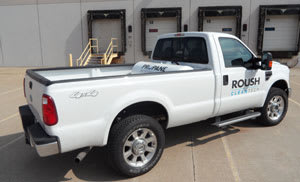
This 2009 F-250 looks like any other SuperDuty work truck except for its stout propane tank, mounted in the bed behind the cab.
Propane is no longer just for your backyard barbeque or the furnace and water heater in your rural home. It's an efficient and economical fuel that powers millions of vehicles overseas, and proponents in the United States say it deserves to catch on in a big way here.
Among the backers are executives at Roush CleanTech in Livonia, Mich., near Detroit, which offers propane conversion packages for Ford-powered trucks and buses. One of them is the F-250 pickup that Todd Mouw, vice president of sales and marketing, and Brian Carney, director of marketing, let me drive during a recent visit - but not before they delivered a pep talk on propane's low price and wide availability.
Propane typically costs $1.50 to $2 per gallon less than gasoline or diesel, they say, and is sold at 3,000 locations in the U.S. That's many more than the number of locations currently available for fueling with natural gas, which many Americans believe is the fuel of the future.
Experts say we have more than 100 years' supply of natural gas, and we're seeing a widely reported drilling boom in several states. But more than half of all propane here is made from natural gas. Historically, propane was produced as a byproduct of oil refining, so it is also called liquefied petroleum gas, or LPG.
Users of propane-fueled vehicles fill up at outlets that sell "autogas," which is what propane's called elsewhere in the world. About 17 million cars and trucks overseas burn it, according to the Propane Education & Research Council. Only 270,000 vehicles use it here. Mouw and Carney want to boost that number, which is why the Roush F-250 and other demonstration vehicles exist.
Autogas is sold with road taxes attached, and it is best obtained in bulk from a special station. Roush has a 5,000-gallon tank outside its shop a mile or so west of its headquarters. It paid $1.99 a gallon for a recent replenishing. The tank and its pump might cost $10,000 for a fleet to obtain, Mouw said. That's a small fraction of a fleet-size natural gas facility; prices depend on storage and pumping capacity, but prices can range from $500,000 to $1.5 million or more.
The cost of converting a light truck such as the F-250 to compressed natural gas has been about $25,000, Mouw said. However, Detroit's Big Three recently announced bi-fuel gasoline-natural gas pickups that carry premiums of $10,000 to $ 12,000, about what a Roush propane conversion costs.
The Roush system is simpler because it's propane-only. Its steel tank is pressurized to a modest 250 to 300 pounds per square inch when full, compared to 3,600 psi for compressed natural gas (CNG), which means CNG tanks must be much stronger. A cryogenic tank for liquefied natural gas is rather complex.
Government incentives are available in some places to offset conversion costs, but, partly because of much lower costs for filling stations, propane can make a decent business case on its own, Mouw and Carney said.
Propane only
In a Roush conversion, the stock Ford gasoline system is discarded and the propane fuel system installed. It consists of a special 55-gallon steel tank in the bed behind the cab, plus fuel lines, fuel rack, pump and controls, as well as injectors on the engine's heads. The tank is obvious. Everything else is beneath the truck's skin. Unlike old dual-fuel systems, the Roush system uses only propane and handles it as a liquid, not as a vapor.
An engine's electronic controls are modified to consume propane, which has an octane rating of 105 instead of regular gasoline's 87, Carney explained. Propane contains 10% to 15% less energy as measured in British thermal units, so if a truck's getting 15 mpg on gasoline, it'll get about 12.5 mpg on propane. However, propane's cheaper, so the total fuel cost is still considerably less.
At the Roush filling station, Carney showed me how the Ford's tank is topped off. It's a lot like filling a propane bottle for your grill. The stout nozzle has a sleeve that you screw onto the truck's special filler neck. Then you trigger it, and the tank fills in a few minutes, about the same time as with gasoline. There's a faint pop as you pull off the nozzle; you might get a whiff of the gas. Propane is safer than gasoline if there's a leak because it quickly evaporates and dissipates, he said.
Now we were set to go. The Roush truck's starting sequence is a bit different. Insert the key into the column-mounted ignition switch and twist it like you're cranking over the engine. Then release it, and after two or three seconds, the engine starts. During that pause, propane vapors are purged from the fuel lines and replaced with liquid fuel. Pop the transmission lever into D and drive away.
The truck's behavior is "remarkably unremarkable," Mouwsaid, and he was right. The Ford 300-horsepower 5.4-liter V-8 was smooth and gutsy, and it ran like it was using gasoline. Its 5-speed TorqShift automatic transmission shifted just like it's supposed to. After all, it had no idea what the engine was burning. My drive over Livonia's sometimes rough concrete streets had me aware of the empty F-250's stiff ride, which I expected from a 3/4 ton 4x4's suspension.
Clean burning
I couldn't smell any fumes from the engine. Propane burns cleaner than gasoline, so it emits fewer pollutants. Propane-powered vehicles emit 12% less carbon dioxide, about 20% less nitrogen oxide and up to 60% less carbon monoxide than gasoline-powered vehicles, says the Propane Education and Research Council.
There are stories of engines running twice as long as usual because the cylinders stay clean. Roush makes no claims about engine life, but it does note that some users extend oil drain intervals because the crankcase oil stays cleaner.
Propane work is an offshoot of Roush's work on Ford Mustangs, which it upgrades for high-performance street and race use, Carney explained. Years before, the company's founder, Jack Roush, worked as a Ford engineer, which led him into specialty engine work when he went out on his own.
Installation of the systems is done by Roush technicians at its own facilities and by authorized upfitters such as Knapheide and Adrian Steel.
Roush currently does custom engineering for other automakers, so it might have propane products for them some day.
Some ups and downs of propane
What are propane's downsides? Aside from the conversion cost, it's different than what most users are accustomed to, and a user has to have a fuel source. These can be found through online locators, but propane is currently a better choice for vehicles that stay local. Price varies with locale and might be more volatile than natural gas.
As for safety, a few days after visiting Roush, I attended a Cummins event where an engineer disagreed with my casual description of a propane vehicle's tank as "a big barbeque bottle."
"No!" he barked. "They're more than that." They have to be - and Roush ensures that they are - because in everyday use, propane expands when exposed to high heat. In extreme cases, tanks can and have exploded.
Until recent years, Cummins made and sold a propane-fueled ISB for yard tractors, but the market dwindled, and the builder has instead embraced natural gas with the ISL-G medium/heavy-duty engine and ISX12-G for heavy trucks and tractors. The propane ISB experience taught Cummins people that, with safeguards, it's a decent fuel for cars and light trucks but not for heavier trucks, the engineer said.
The dollar figures indicate that propane autogas seems a good idea where the fuel and engines that efficiently burn it are available.
Information is available online from:
www.roushcleantech.com
www.autogasusa.org/fueling-with-propane/
More Fuel Smarts

How Volvo Updated Its D13 for EPA 2027 [Watch]
Volvo’s updated D13 promises lower emissions without sacrificing performance or fuel economy. Take a closer look at what changed inside the engine in this HDT Spotlight video.
Read More →
Diesel Price Spike Shortens Payback for Natural Gas Trucks, Report Says
Energy Vision estimates fleets could recover the higher purchase price of an RNG-fueled Class 8 tractor in 1.3 to 2.8 years under current fuel-price scenarios.
Read More →
Calstart Becomes Catalyst Mobility, Reflecting Broader Focus
Calstart is now Catalyst Mobility, reflecting the nonprofit’s growing national role in clean transportation, including zero-emission trucks, infrastructure and incentive programs.
Read More →

Record Diesel Prices Squeeze Trucking Fleets
Average U.S. diesel prices have climbed to nearly $6 a gallon, surpassing the 2022 record as tight refinery capacity and Middle East disruptions keep fuel costs elevated.
Read More →
How Fuel Delivery Shapes Engine Performance
Fuel delivery depends on more than what happens at the injector. For fleet, maintenance and technical professionals, looking at the full path from pump to injector can provide useful context for understanding engine performance.
Read More →
East Coast Port Launches $45M Electric Truck Push
The Port Authority of New York and New Jersey announced millions in incentives for zero-emission drayage trucks, yard tractors, and new charging hubs near the port.
Read More →
California Bill Could Shed Light on Electric Truck Prices
Why do battery-electric Class 8 trucks remain so expensive? A California bill headed to Gov. Gavin Newsom would give fleets and state agencies more visibility into what manufacturers charge.
Read More →
Detroit Opens Orders for EPA 2027 Engines
Detroit isn’t starting from scratch to meet EPA 2027 diesel emissions standards. Its Gen 6 DD13 and DD15 engines keep much of today’s platform while updating the fuel and aftertreatment systems.
Read More →
Zero-Emission Truck Corridor Planned for West Coast
California, Oregon, Washington, British Columbia and Baja California are coordinating plans for truck charging and hydrogen fueling from Canada to Mexico.
Read More →
A Closer Look at Kenworth’s Electric T880E Vocational Truck [Video]
Learn more about Kenworth's T880E battery-electric vocational truck at the Paccar Technical Center, including its range, applications, upfitting considerations, and PTO options, in this HDT Spotlight video.
Read More →