




Related: Nikola One - Disruptive Technology?
Nikola Motor CEO Compares Truck Manufacturers to Kodak
Nikola Motor CEO Trevor Milton said that the Nikola One's hydrogen-powered electric motor could change the industry in the same way digital cameras changed photography.
by Today's Trucking
May 8, 2017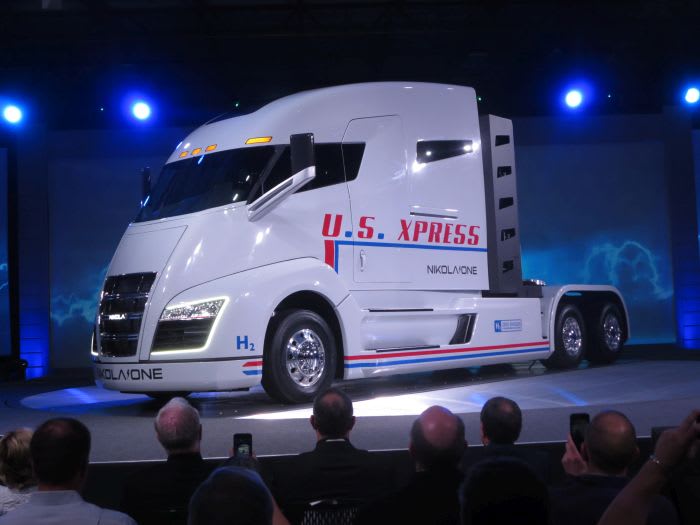
Photo: Tom Berg
2 min to read
Photo: Tom Berg
The founder and Chief Executive Officer of Nikola Motor Company suggested today’s truck manufacturers face a fate similar to Kodak, which watched its film business collapse during the advent of digital cameras.
“They [Kodak] were so powerful that they never expected to change anything,” Trevor Milton said in an address to the 66th annual meeting of the Quebec Trucking Association. “Why change something that already works?”
His Utah-based company is certainly looking to reinvent the idea of a Class 8 truck, as it looks to produce a hydrogen-powered electric model known as the Nikola One.
One of Kodak’s main mistakes was that it focused solely on an existing product without considering a changing environment, he told the crowd. "In the event of a war, for example, the liter of diesel could reach five or seven dollars ... You'll never have to pay that kind of money to run the Nikola One."
Milton also compared the truck’s concept to the arrival of the first smartphones, which also took the marketplace by surprise.
Apple combined the iPhone and iTunes to change the way people purchased music. Nikola One’s monthly payments will include the price of the truck as well as fuel, maintenance, insurance, and even the windshield wipers. The company plans to develop a related network of hydrogen fueling stations, too.
"In the automotive world, emotions sometimes motivate acquisitions," he said. "But not in trucking. It is only money that dictates decisions.”
"The other companies took a long time to figure out what was happening, and that's what's going to happen with the trucking industry," he said.
Once produced, the Nikola One is expected to travel up to 1,900 kilometers on a single filling of the hydrogen fuel cell system, while delivering 1,000 horsepower and 2,000 lb-ft of torque.
"Other manufacturers are trying to meet the new emissions standards by sacrificing torque and power, but drivers do not want to drive a truck that does not have power," he said, stressing that his truck will also offer a quicker braking response than its diesel-powered counterparts.
"I love the history of diesel," Milton added. "It used to be the most efficient and efficient alternative. But there is now a more efficient, efficient and emissions-free alternative."
The truck’s batteries will offer a further environmental benefit when they are removed after 1.6 million kilometers of service and sold for a fifth of their traditional price to store solar energy, he said.
"By 2021 the truck will be on the road, it's not a dream," Milton concluded. "The future is here and we're all going to be part of it.”
Subscribe to Our Newsletter
More Fuel Smarts

Wex Adds Cardless Fuel Payments for Over-the-Road Customers
A new fuel card feature for Wex customers offers convenience and security.
Read More →
New California Law Could Shed Light on Electric Truck Prices
Why do battery-electric Class 8 trucks remain so expensive? A California bill signed by Gov. Gavin Newsom would give fleets and state agencies more visibility into what manufacturers charge.
Read More →
How Volvo Updated Its D13 for EPA 2027 [Watch]
Volvo’s updated D13 promises lower emissions without sacrificing performance or fuel economy. Take a closer look at what changed inside the engine in this HDT Spotlight video.
Read More →

Diesel Price Spike Shortens Payback for Natural Gas Trucks, Report Says
Energy Vision estimates fleets could recover the higher purchase price of an RNG-fueled Class 8 tractor in 1.3 to 2.8 years under current fuel-price scenarios.
Read More →
Calstart Becomes Catalyst Mobility, Reflecting Broader Focus
Calstart is now Catalyst Mobility, reflecting the nonprofit’s growing national role in clean transportation, including zero-emission trucks, infrastructure and incentive programs.
Read More →
Record Diesel Prices Squeeze Trucking Fleets
Average U.S. diesel prices have climbed to nearly $6 a gallon, surpassing the 2022 record as tight refinery capacity and Middle East disruptions keep fuel costs elevated.
Read More →
Sponsored•September 9, 2026
How Fuel Delivery Shapes Engine Performance
Fuel delivery depends on more than what happens at the injector. For fleet, maintenance and technical professionals, looking at the full path from pump to injector can provide useful context for understanding engine performance.
Read More →
East Coast Port Launches $45M Electric Truck Push
The Port Authority of New York and New Jersey announced millions in incentives for zero-emission drayage trucks, yard tractors, and new charging hubs near the port.
Read More →
Detroit Opens Orders for EPA 2027 Engines
Detroit isn’t starting from scratch to meet EPA 2027 diesel emissions standards. Its Gen 6 DD13 and DD15 engines keep much of today’s platform while updating the fuel and aftertreatment systems.
Read More →
Zero-Emission Truck Corridor Planned for West Coast
California, Oregon, Washington, British Columbia and Baja California are coordinating plans for truck charging and hydrogen fueling from Canada to Mexico.
Read More →