




Monitoring Driver Behavior can Improve Safety and Reduce Costs
Driver monitoring has evolved tremendously in recent years. Some carriers still rely on reports from a 1-800 "how's my driving" number to find out when a driver is driving poorly, but many more are putting technology to wor
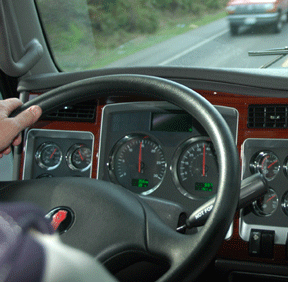
Driver monitoring has evolved tremendously in recent years. Some carriers still rely on reports from a 1-800 "how's my driving" number to find out when a driver is driving poorly, but many more are putting technology to work
to take advantage of near-real-time reporting on driver performance. Today's technologies allow fleets to keep track of not only where their trucks are at any moment, but also how the trucks are being operated.
Fleets have become more interested in tracking driver behaviors, particularly in response to the new CSA enforcement program put in place last year by the Federal Motor Carrier Safety Administration.
"The biggest things we are seeing a push for (from customers) is driver performance and driving habits," said Robin Hamlin, product manager for McLeod Software. "Anything to do with driver performance such as lane changes, braking and quick starts."
Ray West, vice president and general manager of the Innovative and TL200 divisions at TMW Systems, said his company's customers want information from collision avoidance and stability systems transmitted back to the home office. Fleet managers can then use this information in predictive modeling based on driver behavior to help prevent accidents and to identify drivers who may need additional coaching and training.
"Safety, cost and regulations are driving carriers to automate the driver management process with mobile communications tied to equipment on the truck and the trailer," West explained.
Jim Sassen, senior manager of product marketing for Qualcomm Enterprise Services, agreed that in recent years there has been a rise in the emergence of safety systems that can monitor following distance and lane departures.
"There is no doubt that driver safety remains an increasingly important issue with fleets," Sassen said. "In addition to the need to manage the high costs associated with accidents, many of our customers are also finding that their increased focus on safety is also leading to greater driver satisfaction and retention."
Brian McLaughlin, chief operating officer for PeopleNet, says safety, security and compliance have become important issues for fleet managers. Mobile communications companies such as his are working with other providers to integrate information from devices such as lane departure monitoring systems, rollover prevention products, speed monitoring and black box data that captures what happens in the moments before a truck crash. He says customers also are interested in the ability to remotely shut the truck down. "That is our largest growing segment of applications that we deliver," he said.
The amount of information that can be accessed from the truck's electronic control module and other systems is astounding. For instance, Rand McNally's new in-cab mobile communication product, the TND 760 Fleet Edition, monitors more than 200 metrics collected from the vehicle, such as vehicle speed, idle time, hard brake count, cruise control usage, coasting out of gear, rpm and more. Captured in a Web-based fleet management application called FleetWatcher, some metrics can be viewed in near real-time by the fleet, and some via exception-based reports. Fleets can receive e-mail alerts for exceptions. It also integrates with back-office management from providers such as TMW and McLeod. (This is in addition to navigation, e-logs and wireless communications.)
There also are companies that focus specifically on the driver monitoring aspect. Take GreenRoad Technologies. Its GreenRoad Safety Center is a system installed in the truck that monitors up to 120 driving maneuvers and alerts drivers to unsafe handling, such as hard braking or improper cornering. An LED display in the cab flashes a green light when a maneuver is safe, a yellow light when it is unsafe, and a red light when it is hazardous. The system also provides detailed reports through GreenRoad Central, a Web portal where drivers and managers can pull a history of each driver's behavior and look at overall patterns.
Some systems are using video cameras to offer insight on what's going on both in and out of the cab. For instance, C.R. England and Dart Transit recently entered into partnerships with Mobileye, a technology company that offers collision-avoidance and lane departure warning systems.
The Mobileye system uses a camera mounted on the vehicle's windshield that records at 15 frames per second. The system identifies lane markings and vehicles beside and in front. Algorithms within the system determine if there is a risk based on closing speeds between the truck and the vehicle in front. Audio and visual alarm is given if a collision is imminent. The lane departure warning system sounds an audible alert when the truck moves too close to the lane markings on either side.
It's not just in-cab alerts, however. The system can also send notifications of following time violations or lane departures back to the fleet via the truck's onboard mobile communications systems such as those from Qualcomm, PeopleNet and DriverTech.
Skip Kinford, chief executive officer of Mobileye, said fleet managers can select the types of notifications they want. For instance, some may only want to be alerted to following-time violations and not lane departure events. "The fleet manager can then use the information for training and coaching their drivers," he said.
With a driver shortage plaguing the industry, Kinford noted that "fleets want to retain their drivers, but want to improve their drivers at the same time."
Monitoring driver behavior can extend beyond what is happening on the roadway to behavior inside the cab. SmartDrive's system uses video and vehicle data to identify critical safety issues. The device is triggered by sudden vehicle movements, such as swerving or hard braking, or by speed-sensor information from the vehicle's computer. This system records video of driving incidents from inside and in front of the vehicle before and after an event.
These events are transmitted to a SmartDrive review team, where teams score the events based on 50 driving observations, including what the driver was doing just before the event. Once the event has been analyzed by the review team, that information is made available to the fleet via a Web-based response center.
Fleet managers can then use the information for driver coaching or training. This enables them to focus their efforts on the riskiest drivers or the riskiest driving behaviors. And unlike systems that simply track data such as hard braking or speeding, the video of the events themselves can be used in training/coaching drivers.
Another camera-based system is DriveCam. Its video event recorder continuously monitors and captures driving behavior, and provides real-time driver feedback. Exception-based video and data are uploaded via cellular connection to DriveCam's Data Center, where they are immediately available to the fleet. Proprietary data analytics, combined with expert video review, highlight the causes of poor driving and prioritize actions needed to reduce fleet risk and operating costs. Configurable alerts direct fleets to online tools, including hotspot mapping for analysis of poor driving.
Of course, different fleets have differing driver monitoring needs.
"I don't see mass adoption of lane departure or driver cams or crash avoidance systems," said Christian Schenk, vice president of product marketing for Xata Corp. "Where we have more aggressive adoption is inside private fleets. In a for-hire environment, the truck is a revenue generating machine and it becomes a question of how you can pull cost out of it."
And size does matter. "I don't think you will see companies between five and 100 trucks start buying these systems, because there is no
More Safety & Compliance
FMCSA: Stop Using These 15 Electronic Logging Devices
Fleets and drivers must replace the revoked ELDs with ones on the FMCSA's registered device list of electronic logging devices.
Read More →
How HDT’s 2026 Truck Fleet Innovators Are Rethinking Fleet Operations
Meet five trucking leaders who are challenging assumptions, solving operational problems, and putting innovative ideas to work.
Read More →
Geotab Launches Tool to Speed Fleet Incident Investigations
Geotab Investigations brings telematics data, video, photos, reports and other evidence into one case file to help fleets determine what happened and resolve incidents faster.
Read More →
FMCSA Moves to Codify English Language Requirements for Commercial Drivers
By changing regulations on English-language proficiency requirements for commercial drivers, rather than relying on a guidance memo, the FMCSA said future administrations won't be able to walk back the Trump administration's stricter enforcement with just a memo.
Read More →
Trump Administration Expands Homeland Security's Role in Trucking Enforcement
The administration's latest trucking crackdown goes beyond roadside inspections, expanding Homeland Security's role in commercial vehicle enforcement and investigations involving CDL training schools.
Read More →
Paccar Recalls 2027 Trucks Built This Summer for Possible Electrical Problem
The nearly 6,000 Kenworth and Peterbilt trucks in the recall could potentially lose engine power, among other things.
Read More →
Brake Safety Week to Focus on Drums and Rotors
Commercial vehicle inspectors will be focusing on brakes during CVSA's Brake Safety Week, August 23-29.
Read More →
Trump Administration Looks to Put More Veterans Behind the Wheel
The Freedom Haulers program pulls together existing and expanded programs at several federal agencies to recruit veterans to drive commercial heavy-duty trucks and cut the red tape for them to get a CDL, training, and employment.
Read More →
$604 Million Verdict Tests Broker Liability After Supreme Court Ruling
C.H. Robinson plans to appeal after a Texas jury found it bore the largest share of responsibility for a fatal 2021 crash, in a case that follows the Supreme Court's Montgomery decision allowing negligent hiring claims against freight brokers.
Read More →
How Fraley & Schilling Improved Logbook Compliance by Over 50%
Fraley & Schilling needed a way to close a compliance workflow gap in its ELD system without adding more work from driver training, reminders, and back-office follow-ups. It found the answer in a custom driver app.
Read More →