





Related: Drivers Key to Cutting Idle Costs
Mesilla Valley Adopts Auxiliary Solar System
Mesilla Valley Transportation recently purchased close to 1,000 eNow solar auxiliary energy systems for its Navistar trucks. The pioneering fleet discovered benefits beyond reduced idling.
August 8, 2017

Note the eNow solar panel on the roof fairing of this MVT rig. Photo courtesy MVT.
2 min to read
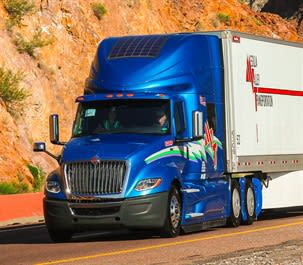
Note the eNow solar panel on the roof fairing of this MVT rig.Photo courtesy MVT.
Mesilla Valley Transportation recently purchased close to 1,000 eNow solar auxiliary energy systems for its fleet of Navistar trucks. It’ll be one of the technologies showcased on MVT’s entry in the "Run on Less" fuel economy program next month put on by the North American Council for Freight Efficiency.
"We're always looking for innovative, more effective and efficient ways to operate," says Royal Jones, CEO and president of MVT. "Our daily idle time is less than 6% on the whole company fleet and we utilize electric APUs 100%."
The problem is, the electric APUs typically don't last the full rest cycle for drivers, especially in the American Southwest where much of MVT's fleet operates. The solar panels help the electric APUs keep drivers comfortable the entire rest period, Jones explains. In addition, "Over time we had noticed shortened battery life and shortened alternator life due to the demand on batteries and the fact that we run eight batteries."
In testing the solar system from eNow, MVT noted increased daily run time for auxiliary equipment, such as in-cab HVAC; increased battery life from six months to two years; saving approximately 3 gallons of fuel per day from reduced engine idling; and decreased maintenance cost due to reduction in engine idling.
That testing, combined with Navistar's testing of the eNow system on its CatalIST SuperTruck at Navistar Proving Grounds, led to the purchase of the eNow energy systems for the MVT fleet.
This wasn't MVT's first foray into using solar power. MVT had tried making its own system about five years ago, before flexible solar panels were available to the industry, but abandoned the effort when it discovered the loss in aerodynamics created too much of a fuel economy penalty. But it didn’t take the panels off the test trucks, and later it found those trucks didn’t need the yearly battery replacement its other trucks do. Now it is running several hundred trucks outfitted with the eNow panels.
With the eNow eCharge system, solar photovoltaic (PV) panels are mounted on the roof of the tractor, trailer, or both. The PV panels capture sunlight and convert it to direct current (DC) electricity. The DC electricity goes to eNow’s proprietary solar charge controller, which maximizes the power output of the PV panels and then sends the power the vehicle’s battery system. eNow’s eCharge provides full-system charging, supplying more than enough power to charge the batteries and run auxiliary equipment.
Subscribe to Our Newsletter
More Fuel Smarts

How Volvo Updated Its D13 for EPA 2027 [Watch]
Volvo’s updated D13 promises lower emissions without sacrificing performance or fuel economy. Take a closer look at what changed inside the engine in this HDT Spotlight video.
Read More →
Diesel Price Spike Shortens Payback for Natural Gas Trucks, Report Says
Energy Vision estimates fleets could recover the higher purchase price of an RNG-fueled Class 8 tractor in 1.3 to 2.8 years under current fuel-price scenarios.
Read More →
Calstart Becomes Catalyst Mobility, Reflecting Broader Focus
Calstart is now Catalyst Mobility, reflecting the nonprofit’s growing national role in clean transportation, including zero-emission trucks, infrastructure and incentive programs.
Read More →

Record Diesel Prices Squeeze Trucking Fleets
Average U.S. diesel prices have climbed to nearly $6 a gallon, surpassing the 2022 record as tight refinery capacity and Middle East disruptions keep fuel costs elevated.
Read More →
Sponsored•September 9, 2026
How Fuel Delivery Shapes Engine Performance
Fuel delivery depends on more than what happens at the injector. For fleet, maintenance and technical professionals, looking at the full path from pump to injector can provide useful context for understanding engine performance.
Read More →
East Coast Port Launches $45M Electric Truck Push
The Port Authority of New York and New Jersey announced millions in incentives for zero-emission drayage trucks, yard tractors, and new charging hubs near the port.
Read More →
California Bill Could Shed Light on Electric Truck Prices
Why do battery-electric Class 8 trucks remain so expensive? A California bill headed to Gov. Gavin Newsom would give fleets and state agencies more visibility into what manufacturers charge.
Read More →
Detroit Opens Orders for EPA 2027 Engines
Detroit isn’t starting from scratch to meet EPA 2027 diesel emissions standards. Its Gen 6 DD13 and DD15 engines keep much of today’s platform while updating the fuel and aftertreatment systems.
Read More →
Zero-Emission Truck Corridor Planned for West Coast
California, Oregon, Washington, British Columbia and Baja California are coordinating plans for truck charging and hydrogen fueling from Canada to Mexico.
Read More →
A Closer Look at Kenworth’s Electric T880E Vocational Truck [Video]
Learn more about Kenworth's T880E battery-electric vocational truck at the Paccar Technical Center, including its range, applications, upfitting considerations, and PTO options, in this HDT Spotlight video.
Read More →