




Management Software: No Longer Islands of Automation
Whether you call it a trucking management system, fleet management software, trucking enterprise software or a freight management system, in a nutshell, these systems manage vehicles (and the things on them), people and money.

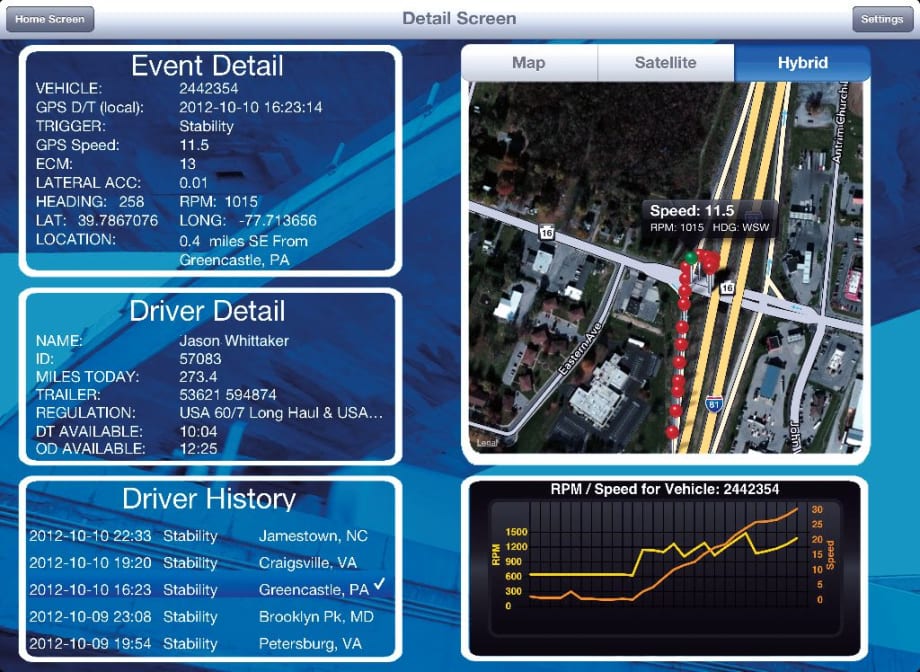
PeopleNet recently unveiled a mobile app that sends alert notices to fleet managers when a critical event occurs. The app displays a map of the location, vehicle and driver information.
PeopleNet recently unveiled a mobile app that sends alert notices to fleet managers when a critical event occurs. The app displays a map of the location, vehicle and driver information.
Whether you call it a trucking management system, fleet management software, trucking enterprise software or a freight management system, in a nutshell, these systems manage vehicles (and the things on them), people and money.
Just as trucking companies come in all shapes and sizes, there are a number of TMS options, from full-featured enterprise management software to more limited dispatch and routing offerings. There are systems that are installed on site on the fleet's computers and ones that are Web-based, or “in the cloud.”
No matter the size or delivery method, however, to be a viable contender in the marketplace today, TMS must integrate with other technologies a fleet may have, such as mobile communications, routing, navigation or on-board computers.
Whatever kind of TMS, they are “not little islands of automation,” says Ken Weinberg, vice president and co-founder, Carrier Logistics Inc. Instead they are systems that can take information from a variety of automated sources and totally integrate that data within the system to get a single output: a dispatched truck that's safe and productive.
“Over the last few years there has been a convergence of data fleets use to manage their operations,” says Adam Kahn, director of marketing product and indirect channels for Qualcomm Enterprise Solutions. “It's evolved from ‘where's my truck and how can I talk to my driver’ into a much more complex network of data communication.”
Pulling all the pieces together
Companies are looking for a solution that manages all their major business processes, including financial and operations management, says Mark Cubine, vice president marketing, McLeod Software. “Robust integration of planning/dispatch with mobile communications has become very fundamental,” he says.
In addition to providing services for locating and tracking vehicles, mobile communication providers have added capabilities such as workflow management, performance monitoring in terms of speed, fuel economy or hard braking, and other information, such as electronic driver logbook data that can be brought back into a fleet's enterprise system, Cubine says.
Brad Young, director of industry marketing for TMW Systems, says fleets traditionally deployed a TMS to better control fuel costs.
Today that's only part of the savings. A TMS helps fleets reduce paperwork by digitizing files, imaging and indexing, which yields efficiency gains.
Fleets can derive real value from tight integration between their dispatch, navigation and mobile communications systems by better managing things such as out-of-route miles, documenting/collecting detention charges, on-time performance and other factors.
In addition, by integrating with mobile communications, fleets can give drivers the same functionality as someone in the back office. They can update trips or capture reference numbers and other information at the point of delivery.
“You are extending that (back office functionality) out to your driver base,” Young says. The end result is fewer driver managers in the back office. “Instead of having 10 people with 10 drivers each, I can have two people with 50 drivers each.”
Shift to safety
In recent years, there have been changes in fleet management in terms of not only what we're measuring, but how we are measuring it and how we are delivering it, says Christian Schenk, senior vice president, XRS.
“Outside of being able to manage driver time and mileage and paying them, more and more fleets are getting on board with compliance,” Schenk says.
“Safety and compliance are more important than ever,” Cubine agrees. Five to 10 years ago, he says, “tracking not only the company's, but individual drivers’ CSA compliance wasn't in the picture then, but is very important now.”
Smooth integration between technologies makes that job much easier. For instance, Cubine notes that there has been a greater emphasis on being able to plan around a driver's actual available hours of service, thanks to the integration of electronic onboard recorder information from mobile communications with a TMS.
On-board safety systems also play a role in managing safety. While collision avoidance and lane departure warning systems activate when an event is actually taking place, managers can still use that data later on to coach better driver behavior in the future. ATMS can help crunch those numbers.
T.J. Thomas, director of marketing and customer solutions — Controls group at Bendix, says that when its Bendix Wingman collision prevention system activates, it can capture a video clip of that event so the fleet can get an accurate context of what just happened.
Hans Molin, Vision Systems and SafetyDirect product manager at Bendix, adds that the video and other data collected can be used to coach that driver.
“The thing is to summarize what different behaviors drivers show regardless of which vehicle they are in,” Molin says. For instance, the summary may list a driver's average following distance, how often the collision avoidance system activates, how many lane departures have they had, hard braking events, etc.
That information can all be collected on a scorecard with driver rankings based on real data. “You can target the training based on that ranking and use the data you have to reinforce it.”
Mobile applications
Trucking management systems are also riding the mobility wave, although some companies have embraced it more than others.
For instance, XRS recently implemented a completely mobile platform for compliance and fleet optimization applications that runs on more than 50 types of mobile devices.
While not all fleets are moving to a complete mobile solution, increasingly, they are expecting to have mobile access to their TMS.
Cubine says the functions deployed for drivers via mobile still fit in a narrow window of functions that were for the most part already available on proprietary hardware-based systems for mobile in-cab systems.
He notes that the mobile applications for the enterprise operations can bring information, notifications, alerts, and the ability to deal with situations that need immediate attention to the back office and management team when they are away from their desk or their computer.
“Our customers want the appropriate office personnel to have easy access to the common functions they would need to do off-hours,” TMW's Young says. “It's not that I can do my same job, say dispatch 50 trucks, from my iPad that I do from my desk,” he explains. Instead, fleets want managers to have the ability to respond to an after-hours call for a com check, for instance, without having to go back into the office.
The fleet view
John Erik Albrechtsen, manager of operations for Paul's Hauling in Winnipeg, Manitoba, says integration between systems is key to his company's operations. Paul's uses TMW enterprise software with PeopleNet mobile communications and ALK navigation and route compliance products.
Albrechtsen notes that the goal of any trucking company remains the same: moving your customer's products from point A to point B.
However, that job has gotten much more demanding, he says. An important element has been improved communications between their external customers and their internal customers (drivers, field staff).
“The truck cab is a driver’s office, and we put those devices into the cab to help us and to help them,” he says. “We couldn't do the amount of work we do today without technology.”
The company used to spend a lot of time on navigation, getting directions to the drivers and monitoring route adherence.
The integrated software makes that job much easier. If a truck does go off route, or encounters some kind of delay, they can warn customers of a late delivery.
Any TMS costs money. Smaller operations may believe they can't afford such a system.
“People still track things on Excel spread sheets,” says TMW's Young. “We don't recommend it, but it works for some. But if you have customers that are asking for sophisticated electronic data exchange, that's when you have to step up to the plate and get an application that gives you that connection to your customers so you can offer them tracing and tracking through a Web portal.
“Having that technology as part of your sales offering is becoming a necessity. It's a cost to do business.”
Beyond that, he says, the efficiencies fleets can gain with a TMS makes expansion easier.
“There are probably some 20 truck operators who want to stay 20 trucks, but others are looking to get to 50 or 120.”
But these fleets don't want to have to add internal staff as they add trucks. An automated system is the only way to do that.
More Fleet Management

Color Match Smarter: Tools That Restore & Perform
For fleet managers and collision repair professionals keeping heavy-duty trucks on the road, getting the color right the first time isn't just about appearance — it's about efficiency, turnaround time, and bottom-line results. Discover how today's digital color tools are transforming the repair process from guesswork to precision.
Read More →
FMCSA Pauses Biennial-Update Enforcement Amid Motus Transition
Carriers whose updates were due on or after June 1 have more time, while FMCSA works to stabilize its new registration system and warns of phishing sites impersonating its new carrier registration system, Motus.
Read More →
2026 Blueprint for Countering Smarter Supply Chain Theft
Cargo theft is no longer just the cost of doing business. It's a multi-billion-dollar criminal enterprise exploiting vulnerabilities across your fleet, drivers, and supply chain.
Read More →


How Telematics Improves Visibility, Control, and Performance in Refrigerated Fleets
Explore how telematics help refrigerated fleets improve visibility, uptime, efficiency, compliance, and cargo protection across connected cold chain operations.
Read More →
What the U.S.-Canada Trade War Means for Trucking
Escalating U.S.-Canada tariffs could disrupt cross-border freight, reduce truck volumes, raise costs, and create new uncertainty for carriers on both sides of the border.
Read More →
What Are Trucking’s Top Concerns for 2026?
The American Transportation Research Institute wants to know what's worrying trucking fleet managers, drivers, and other stakeholders in its annual Industry Issues survey.
Read More →
American Trucking Associations Looks for a New Leader
ATA President and CEO Chris Spear abruptly left his job at the association on August 21, at a pivotal time for the trucking industry.
Read More →
Public Wi-Fi Cybersecurity Risks: How Truck Drivers and Fleets Can Protect Their Data
Public Wi-Fi can expose truck drivers and fleets to credential theft, malware, and other cyber threats. Here’s how to reduce the risk on the road.
Read More →
For Nicky Cupp, Fleet Innovation Starts With Frustration
HDT Truck Fleet Innovator Nicky Cupp turns everyday pain points at Fraley & Schilling into opportunities for better technology and smarter processes.
Read More →
Adam Buttgenbach’s Approach to Electric Trucks: Start With Where They Fit
HDT Truck Fleet Innovator Adam Buttgenbach helped PepsiCo build one of North America’s largest EV fleets by focusing on where electric trucks make operational sense.
Read More →