




Making Driver Scorecards Work
A trucking company decided to give out an award for the best driver, so they asked employees to nominate and vote on the honor. The winner, however, turned out to have one of the worst safety records in the fleet.

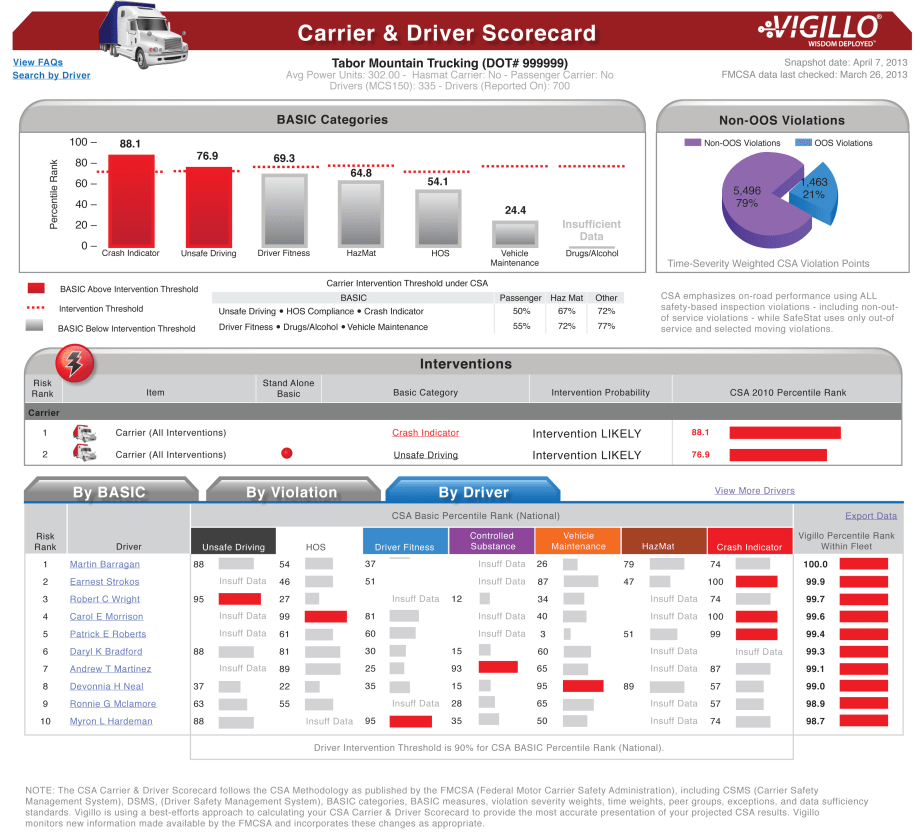
Easy-to-understand graphs and charts like this one from Vigillo helps both drivers and their managers see at a glance where they stand.
A trucking company decided to give out an award for the best driver, so they asked employees to nominate and vote on the honor. The winner, however, turned out to have one of the worst safety records in the fleet.
After developing a driver scorecard system, this fleet learned the best driver was actually someone very few people knew, because he was a quiet man who just came in, did his job and did it safely.
Don Jerrell, associate vice president with HNI, told this anecdote while moderating a panel discussion on driver scorecards at the Fleet Safety Conference this summer in Schaumburg, Ill.
Driver scorecards help fleets use the vast amounts of data available. They make it easy to see at a glance which drivers are performing well and which ones need coaching or even disciplinary action.
Scorecards have generated a lot of interest since the advent of the Federal Motor Carrier Safety Administration’s Compliance, Safety, Accountability enforcement program, but some carriers have been using them for years.
Fleets often discover the same approach works for a variety of operational issues, ranging from idle reduction to paperwork procedures.
“There is tons of data out there,” explained Jeremy Stickling, director of human resources and safety with Nussbaum Transportation in Normal, Ill. “It means nothing if you can’t use it. A good scorecard puts this into a meaningful format so you can make your data work for you.”
There are five key factors the panelists identified to help make driver scorecard programs work.
1. Use objective data
Stickling stressed that you have to focus on objective, measurable data. “We look at millions of data points, I think it’s 8,000 per driver. And there’s bad data that needs to be thrown out.”
Then you have to convert all that data into some sort of points system. The values you assign to various factors will be different from the fleet down the street, depending on your operations and your priorities.
2. Make them visually effective
While scorecards can be done with an Excel spreadsheet, more sophisticated versions use a graphic interface with easy-to-understand graphs and charts.
“One of our guiding principles is, I ought to be able to hold up the scorecard and have the guy in the back of the room get something out of it,” said Steve Bryan, founder and CEO of Vigillo, which offers CSA scorecards. Red means something needs attention.
At Nussbaum, drivers are assigned points for factors ranging from accidents to idle time, all wrapped into one bottom-line score. Gold, silver or bronze award levels are indicated by the appropriate colored medal pictured on the cover sheet of their quarterly scorecard.
3. Use them as a coaching tool
One of the key goals of scorecards is elevating problems, Bryan said. Just looking at CSA, he said, there are seven different BASICs, or feeds of data. How do you decide what’s important?
“If your fleet has 500 drivers and you’re just looking at a big dump of the data, it’s going to be hard to figure out where the problems are,” he said.
Once you identify problem drivers, make sure their driver managers have the information they need to coach those drivers to do better.
At Nussbaum, in monthly driver manager meetings, they review the scorecard results and share ideas on how to get drivers to improve. Poor performers get advice on improving their scores in face-to-face meetings.
4. Reward drivers
Scorecards should be used to reward the best drivers as well as correcting problems.
“It’s not always that you’re identifying the zeros; sometimes you’re identifying the heroes,” Bryan said.
J.A. Frate is a union shop in Chicago, where you can’t motivate drivers by singling out the best ones for increased pay, explained President Jill Dinsmore. So about 10 years ago, the company started developing a scorecard for its 55 drivers.
The scorecards cover not only safety, but also operational items. Top drivers get cash and other prizes each month. The driver of the year gets more, including getting to drive a new truck spec’d with extras and his or her name on the side.
At Nussbaum, drivers get quarterly bonuses based on their scorecard levels. One driver recently earned a $1,500 bonus. “If you’re asking people to go the extra mile, it means a little more if they are rewarded for that,” Stickling said.
5. Get driver buy-in
While posting scorecard information can motivate competitive drivers, it also can create negative feelings when the scores aren’t so good, Dinsmore warned.
“For the drivers on the bottom, you have to make sure this doesn’t become a morale buster instead of a booster.” She recommended talking one-on-one to those who are unhappy with the system to make sure they understand it can benefit them.
J.A. Frate developed its scorecard with input from a core group of drivers. One key to driver acceptance has been giving drivers the opportunity to appeal points to a rotating panel made up of drivers, she said.
It’s important to get driver input not only while developing the scorecards, but also as an ongoing improvement effort.
“We’re always tweaking the scorecard,” Stickling said. “You’re going to get feedback when you go live with this. Listen to that feedback. It’ll help get driver buy-in if they know you’re listening to them.”
More Drivers

Why Hiring Truck Drivers Is Getting Harder
Higher recruiting costs, a shrinking driver pool, and renewed pay competition are raising the stakes for fleets heading into 2027.
Read More →
Roehl Offers Truck Drivers $10,000 Retention Incentive
Payments begin after the first load and continue in mileage-based installments for eligible experienced drivers joining the fleet.
Read More →
Platform Science Adds Dispatch and Safety Tools
Four additions to PS Fleet help fleets monitor loads, manage driver coaching, share truck locations and adjust video system settings.
Read More →
When Language Stops the Truck: The Return of ELP Out-of-Service Orders
English language proficiency rules for commercial drivers aren’t new, but renewed out-of-service enforcement has raised the stakes. Here’s what carriers need to know before a driver reaches a roadside inspection.
Read More →
Samsara Launches Custom AI Agent Builder
Agent Studio lets fleets create AI tools for hours-of-service monitoring, reporting and driver support, including agents that communicate by phone.
Read More →
Trucker Path Expands Reserved Parking Network
Trucker Path has added close to 6,000 more truck parking spaces to its Trucker Path Reserved Parking Network with the addition of Safe Truck Parking.
Read More →
EEOC Sues Texas Trucking Company Over Driver Age Limits
The agency says Trancasa USA rejected applicants over 65 and applied tougher driving-record standards to those over 60.
Read More →
Nussbaum, Roehl Announce Second Driver Pay Increase This Year
This year has seen a swath of major truck driver pay increases as freight capacity has tightened.
Read More →
From One Generation to the Next: How Mentorship Builds Safer Truck Drivers
After three decades in trucking, Harold Perry shares what he's learned about driver safety, mentorship, and helping the next generation build confidence behind the wheel.
Read More →
Truck Drivers Need More Than Another Alert
Fleets have more visibility into truck health, safety events, and driver activity than ever. The next challenge is turning all that information into useful guidance for the person who has to decide what to do next.
Read More →